Follow Us on Google
•Navy nabs 8 in 4 months
Stories by Steve Agbota
Nigeria’s seaports are witnessing a worrisome rise in stowaway incidents.
Experts are linking the trend to deepening poverty and weak enforcement of maritime laws. The situation, they warn, reflects growing desperation among youths and gaps in port security systems.
They added that the endemic challenge of illegal boarding of ships by stowaways at the ports in Lagos, Delta, and Port Harcourt, is giving Nigeria a bad image in the comity of maritime nations.
On several occasions, stakeholders and shipping agents have raised concerns over the rising cases of stowaways at Nigeria’s ports, warning that the trend poses serious safety risks and breaches international maritime regulations.
Daily Sun learnt that a stowaway is a person who secretes himself or herself aboard a ship without the consent of the shipowner or the person in charge, and who is on board once the ship has left port.
In 2022, Daily Sun reported that the crew of a Chinese vessel allegedly dumped 12 Nigerian stowaways into the open sea off the coast of Liberia. During the incident, two of the stowaways reportedly died, while 12 others were later rescued by fishermen after being abandoned at sea by the Chinese cargo ship OPHELIA PANAMA.
After they were rescued by the Liberian fishermen in the waters of Grandcess, Grand Kru County, the 12 Nigerians confessed to being stowaways who unlawfully boarded the Chinese vessel at Delta Port, Warri, in an attempt to escape to Japan and seek greener pastures.
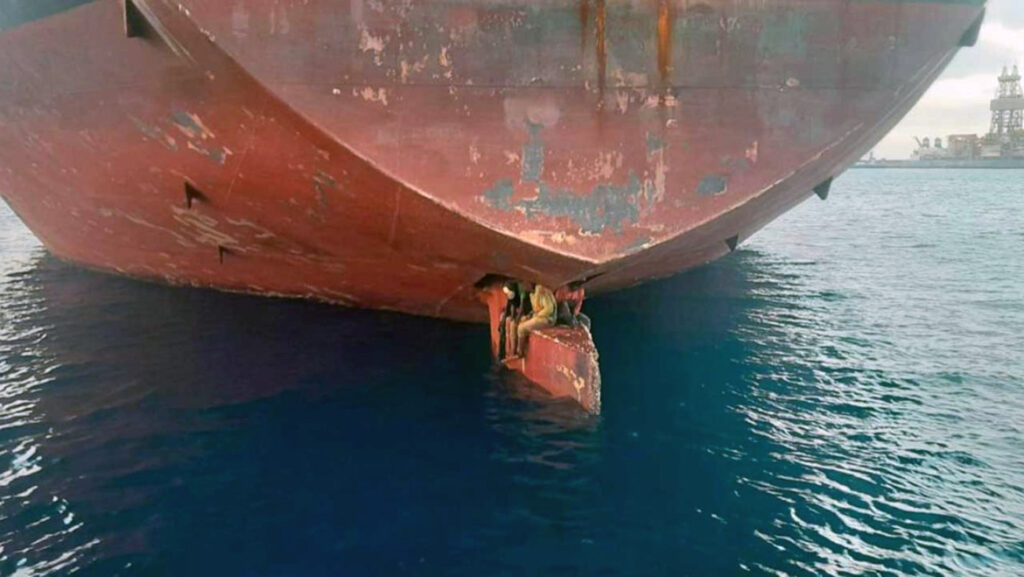
In 2023, two of the four rescued Nigerian stowaways narrated how they survived 14 days on a ship’s rudder by drinking their urine before being rescued off the coast of Brazil. A development that the stakeholders described as a national and international embarrassment.
The stowaway situation is largely blamed on the nation’s ailing economy, weak laws and the failure of relevant agencies to prosecute offenders.
As the situation persists, the Shipping Association of Nigeria (SAN) recently revealed that shipping lines operating into the nation’s seaports record more than 2,300 stowaways annually. The association also said that for each repatriated stowaway, shipping lines are mandated to pay $2000 to the government’s coffers through the Nigerian Immigration Service (NIS).
However, stakeholders who spoke with Daily Sun said that the situation is unique to Nigeria, stressing that vessels calling at ports in Tema (Ghana), Lome (Togo) or Cotonou (Benin Republic) do not face such challenges.
Just last week, the Nigerian Navy disclosed that eight stowaways were arrested in separate operations since the beginning of 2026.
Incidents recorded between March and April involved stowaways intercepted on vessels and near the Lagos Fairway Buoy. Conversely, experts said that the growing trend of stowaways gaining access to ships through unconventional routes, particularly the rudder compartment, points to the need for stricter external vessel checks.
According to reports, in March 2026, naval operatives intercepted two stowaways off the Lagos coast during a routine patrol. The suspects were found concealed aboard a vessel and were subsequently handed over to the appropriate authorities for further investigation.
In early April, the Navy arrested three Ghanaian nationals who had illegally boarded a Europe-bound vessel in Lagos. The interception, also confirmed by the Navy in a briefing, highlighted the continued use of Nigerian ports as transit points for irregular migration.
Similarly, in mid-April, three additional stowaways were apprehended aboard the merchant vessel MSC Stella near the Lagos Fairway Buoy. Naval authorities disclosed that the individuals were attempting to travel unlawfully to Europe when they were discovered during security checks.
Speaking with Daily Sun on the issue, Gbenga Leke Oyewole, a seasoned maritime security expert and former Senior Special Assistant on Maritime Services to ex-President Goodluck, said that if the national economy is very strong, robust, and provides employment for people, nobody would think of stowing away to other countries where they can do menial jobs, saying that is the primary thing to be addressed.
“That our economy should be robust and provide employment to people, and there should be good wages for any work that people do. That is the number one thing that will stop it. But going beyond that, the likes of NIMASA that is their primary responsibility.
Other News
“Under the ISPS code or whatever, Ports areas are international. Most of our ports, especially in Lagos and some other ports, are international ports. Whatever it is, to protect the perimeter of such Ports must be done by NIMASA. Who does not have business in the port should not gain access to the port.
“You will find out that even though we’ve had one or two cases of stowaways at the airport, it is not as rampant as catching eight people within a month or four, because that place is still well protected,” he said.
He added that there is a need to improve the perimeter security of the ports, and whoever gains access or denies access must be well looked at by the maritime administration.
He urged the port security officers, which include the Navy, the DSS, and other security agencies in the port, including immigration, to rise to the occasion as well to ensure that people who are not supposed to be found within the port premises are not found there.
But way beyond all those efforts, he pointed out that the economy of the country should deter people from going out.
“If I can earn very good money in Nigeria, why must I go to a country I don’t even know? Because I don’t even know where this ship is headed. The ship is going to a worse country than Nigeria. Nigeria is not the worst country on earth. So why would somebody just want to go away at all costs? Because the person is not happy. So the citizens must be happier than we are. So, I think that is the bottom line,” he added.
The chairman of SAN, Boma Alabi, once said that stowaway incidents have become a growing concern for shipping companies in Nigeria, especially when compared to other countries in West and Central Africa.
Alabi noted that the persistence of stowaway cases at Nigerian ports is largely due to weak laws and the failure of relevant agencies to prosecute offenders.
“Stowaways arrested or repatriated are not prosecuted; rather, they are released, thereby creating no deterrence to others, which means they continue doing it because there is no deterrence or sanction,” she said.
She explained that each shipping line records between two and three stowaway incidents weekly, adding that about 15 container shipping lines operating in Nigeria are affected.
At a recent stakeholders’ meeting in Lagos, she also raised concern over the operational and financial burden posed by stowaway incidents on shipping companies.
Alabi noted that shipping agents continue to grapple with cases of stowaways boarding vessels undetected, leading to delays in vessel departure as investigations and disembarkation processes are carried out.
She further highlighted the heavy financial implications associated with such incidents, including fines, diversion costs, and additional crew management responsibilities, as well as the reputational risk to Nigeria as a port of origin.
According to her, “Shipping companies are often held responsible for situations that are largely security-related and beyond their operational control.”
The SAN Chairman called for stronger and more coordinated port security measures, improved collaboration among relevant agencies, and the establishment of a clear responsibility framework to prevent undue liability on shipping companies.
Meanwhile, the Commander, Nigerian Navy Ship (NNS) Beecroft, Commodore Aiwuyor Adams-Aliu, reiterated the Navy’s commitment to maintaining maritime security and preventing criminal activities within Nigeria’s territorial waters.
He warned that stowaway attempts pose serious safety risks and violate international maritime regulations.
Although official Navy sources indicate that the total number of intercepted stowaways in 2026 may be higher, at least eight arrests have been independently verified through media reports.
Meanwhile, a former President of the Nigerian Merchant Navy Officers and Water Transport Senior Staff Association (NMNOWTSSA), Engr. Matthew Alalade explained that while onboard security has improved significantly, most stowaways now exploit areas outside the vessel structure.
“You hardly find stowaways inside the vessel anymore because onboard security is tight. What we are seeing now is people coming through small boats and hanging on the rudder,” he said.
He advised that shipping companies and agents must adopt proactive measures, including deploying speedboats to inspect vessel undersides before departure, especially when ships are lightly loaded.
Alalade also clarified that international maritime practice does not permit captains to harm stowaways, stressing that any individual found onboard must be handed over at the next port of call for proper repatriation. “There is no right to throw anyone overboard. The standard procedure is to report to the next port and hand the person over to authorities,” he said.