Follow Us on Google
By Chinenye Anuforo
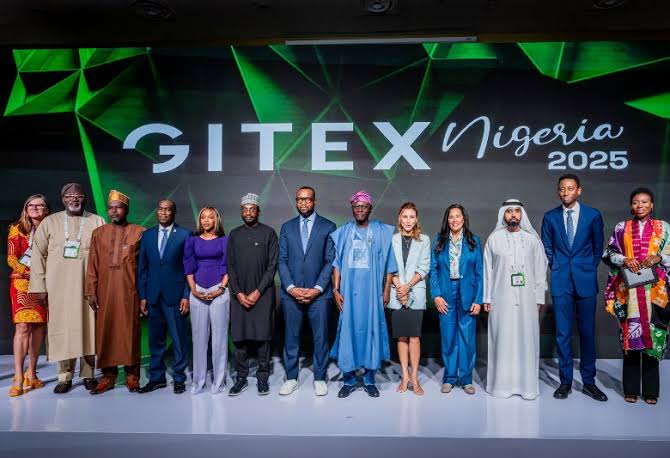
Nigeria hosted its first homegrown edition of GITEX this September, a four-day gathering split between Abuja and Lagos that drew global investors, multinational technology firms, policy makers, and hundreds of startups.
It was pitched as a defining moment for Nigeria, a stage to showcase innovation and position the country as the continent’s technology hub.
The event opened with a Government Leadership and Artificial Intelligence Summit in Abuja before shifting to Lagos, where the Eko Convention Centre and the Landmark Centre hosted the Tech Expo and the Startup Festival.
Organisers said more than 600 startups from over 20 countries took part, alongside investors, regulators, and industry leaders. Exhibitions ran across sectors including fintech, agritech, healthtech, cybersecurity, and cloud infrastructure, while investor matchmaking sessions sought to link young founders with venture capitalists and corporate partners.
The Federal Government (FG) used the platform to highlight policy initiatives designed to accelerate digital transformation. Minister of Communications, Innovation and Digital Economy, Dr. Bosun Tijani, told participants that the country’s ICT sector had already grown into a key driver of the economy. He said technology contributes between 16 and 18 per cent of the country’s Gross Domestic Product, and projected that by 2027 the figure will rise to 21 per cent. “AI will widen the productivity gap between nations,” Tijani said, stressing that countries without strong digital infrastructure would fall further behind. “Countries that are already ahead will move even faster while those still catching up will find it even more difficult.”
He announced measures to push digital adoption and close Nigeria’s gaps. Project BRIDGE, a planned 90,000-kilometre fibre backbone, is expected to improve connectivity nationwide. The government’s Three Million Technical Talent (3MTT) programme is being expanded to train more young Nigerians with digital skills. Tijani also unveiled a research fund to support 75 new innovation projects from October 1, and said talks were ongoing with global tech giants to build hyperscale data centres in the country. He described Lagos as the natural anchor for these ambitions, calling the state a launchpad for Africa’s tomorrow.
Lagos State Governor, Babajide Sanwo-Olu, reiterated framing the city as the epicentre of Africa’s digital economy. “Lagos is where the energy of Africa collides with the ambition of the future”, he said.
Other News
The event gave startups a global stage. The Supernova Challenge, a competition for early-stage companies, handed prize money and publicity to winners in categories including fintech and agritech. Founders said the exposure was invaluable. “We need a federal government innovation fund,” said Olu Olufemi-White, CEO of Alami Capital, during a Lagos panel.
“A fund that is intentional, that is of the standard you would find at the top institutions across the world. We are resilient, but support us by backing us with capital. Because what you do is you signal to the world that you have confidence in our innovation.”
Several entrepreneurs said the meetings with investors and corporates were the most valuable part of the conference, offering access that is often difficult to secure within Nigeria. But, many stakeholders also warned that initial interest must be backed by follow-through. Raising capital, securing pilot projects with large firms, and breaking into conservative local markets remain difficult.
Analysts noted that adoption cycles are long, and infrastructure gaps, from power to reliable internet, remain a major barrier to scaling solutions.
Tijani acknowledged these concerns, insisting that government policy would prioritise inclusivity and broad access. “Technology must reduce inequality, create shared prosperity, and fuel productivity across entire sectors, not just serve elites,” he told delegates. The minister cited agriculture as an area where Nigeria lags because of limited digital penetration. He noted that maize yields in Nigeria average 2.5 tonnes per hectare compared with 10 to 12 tonnes in Brazil, a gap he said is largely due to the absence of technology-driven solutions.
GITEX Nigeria also highlighted the growing importance of the digital economy to Nigeria’s future revenue mix. Several officials predicted that ICT earnings could overtake oil revenues by 2027, citing growth in fintech, cloud services, data centres, and software. The upcoming National Digital Economy and New Governance Bill was referenced as a step toward consolidating regulation and providing a framework for digital innovation.
The numbers from the event highlighted its scale. Thousands of participants moved through Lagos venues over two days, engaging with hundreds of exhibitors from multiple continents. Delegations from venture capital firms, technology multinationals and African startups mingled in exhibition halls and breakout rooms, with many describing it as the largest tech showcase Nigeria had ever hosted.
Yet, amid the optimism, there were scepticism. Stakeholders noted that Nigerian policymakers have often made ambitious announcements at global conferences, with limited implementation afterward. The test for GITEX, they argued, will be whether promised fibre networks are actually built, whether the 3MTT programme reaches millions of young people, whether data centres are constructed, and whether startup funding trickles down beyond Lagos and Abuja.
“For now, GITEX Nigeria has succeeded in putting the country at the centre of a global conversation about Africa’s digital future. It gave startups visibility, drew investors into dialogue with government, and positioned Nigeria as serious about digital transformation. But the months ahead will determine whether the event marks a turning point or just another high-profile showcase”, Jide Awe, stated in a telephone conversation with Daily Sun.