Follow Us on Google
By Steve Agbota
The ICC International Maritime Bureau (IMB) recently raised the alarm over the resurgence of piracy in the Gulf of Guinea (GoG) waters in its mid-year report for 2023.
During this period, about 20 crew members were said to have been abducted in separate incidents in the GoG between January and June of 2023.
The resurgence of pirate attacks in this crucial route for international shipping lines has been a source of major concern. This is even as maritime experts who spoke with Daily Sun said the recent fuel subsidy removal and crude oil theft were the major reasons piracy returned to the GoG.
The recent spike in piracy may push international shipping lines to jerk up the price of transporting goods via the GoG or even avoid the route due to fears of being kidnapped and robbed, according to experts and shippers.
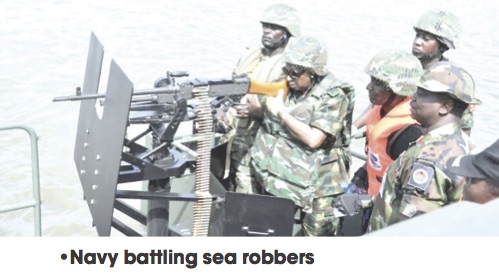
Piracy incidence declined in the GoG waters between 2021 and 2022, following persistent patrolling of West African waters by international navies and the launch of the Integrated National Security and Waterways Protection Infrastructure, also called the Deep Blue Project, in 2021 by the Federal Government.
Nigeria was also able to arrest 27 pirates and secured conviction of about 10 of them with the help of Nigeria’s Suppression of Piracy and Other Maritime Offences Act, 2019 (SPOMO Act), which aims to prevent and suppress piracy, armed robbery and any other unlawful act against a ship, aircraft and any other maritime craft, including fixed and floating platforms.
Following these efforts and achievements, Nigeria received various commendations from United Nations (UN), IMB and other international organisations, which led to the removal of Nigeria from the list of maritime crime-prone nations.
However, a January to June IMB Piracy and Armed Robbery Report Summary Sheet released late last week stated that 65 incidents of piracy and armed robbery against ships were recorded in the first half of 2023, an increase from 58 incidents for the same period in 2022.
Of the 65 incidents reported, 57 vessels were boarded, four had attempted attacks, two were hijacked and two were fired upon. Perpetrators successfully boarded 90 per cent of targeted vessels. Violence towards crew continues with 36 taken hostage, 14 kidnapped, three threatened, two injured and one assaulted.
IMB Director, Michael Howlett, said: “The resurgence in reported incidents, including hostage situations and crew kidnapping in the Gulf of Guinea waters is concerning. The IMB calls for continued, robust regional and international naval presence as a deterrent to address these crimes.”
The mid-year report further stated that the Gulf of Guinea witnessed a concerning surge in maritime incidents between Q1 and Q2 of 2023, with five incidents in the first quarter and nine in the second quarter. Out of these, 12 were classified as armed robberies and two as piracy, predominantly targeting anchored vessels in the region.
Fourteen crew were kidnapped, of which eight crew members were taken from vessels anchored within territorial waters. Additionally, in two separate hijackings, 31 crew members were held hostage, communication and navigation equipment were destroyed and partial cargoes were stolen. One of these incidents also involved the abduction of six crew members.
“We once again call on Gulf of Guinea regional authorities and the international community to refocus their attention on the region, to establish long-term, sustainable solutions that effectively address these crimes and protect the seafaring and fishing communities,” Howlett said.
Speaking with Daily Sun, a maritime security expert, who doesn’t want his name in print, said the problem is going to definitely create insurance issue because war risk insurance has not been removed from Nigerian bound cargoes before the piracy return to GoG.
“You want to know why this piracy attacks coming up. They want to ask those people who are in charge of deep blue project because they gave initial success on the deep blue project. The truth is that those pirates left the sea to go and steal crude oil, they are now at fight. The crude oil is very tough. They know they can’t win and they have moved back to sea.
“But the same people who fought these pirates out of the sea are the same people who are fighting them out of stealing crude oil, not ending blue project. So, those are the issues,” he said.
He said definitely cost of shipping will be going up because people will take additional insurance on the imported items coming to the country.
Also speaking with Daily Sun, maritime security expert and former Director with the Global West Vessel Specialist Nigeria Limited (GWVSL), a firm once saddled with providing maritime security at the nation’s waterways, Mr. Leke Gbenga Oyewole, said: “I think we are still not doing the very right thing. I know that recently, the Navy boasted that they repressed piracy significantly, the coast is fairly cleared and they have taken Nigeria out of the piracy prone countries and all that.
“But then, we did not really tactically repress piracy. We did not address those issues that started it and sustain it. So, it is bound to come back.”
He said the recent development in Nigeria will likely naturally instigate piracy because the President has removed subsidy finally, which means nobody will import with a view to collect subsidy from government because everyone will tidy up its end.
“What has been happening till date is that some people will take money from the Central Bank of Nigeria (CBN) to import cargo, when the cargo comes in, it does not come to Nigeria. Rather, it goes to our neigbouring countries ike Benin Republic where they will sell to Togo, Ghana, Cameroon and they will send a little to Nigeria. All they have sold to other countries, they are still coming back to collect subsidy in Nigeria.
“Otherwise, how is it that they removed subsidy in Nigeria and there were riots in Cameroon? What is the relationship? This is where we are as a nation. Now that they have removed subsidy, I think and hope it would address that problem to an extent because anybody that buys product now, he either bought it for Nigeria or for our neigbours.”
As it is now, he said people that import, there will not be any sharp practices attach to it, saying that if anyone bought for Ghana, take it to Ghana and If anyone bought for Nigeria, bring it to Nigeria, which may naturally also address it.
Conversely, he hinted that the other part that will still continue to cause the problem of piracy attacks on GoG is the crude oil theft.
According to him, concerning crude oil theft, people that use barges or whatever smaller vessels to steal either from ware-head, terminals or other locations can fill a bigger ship stationed either offshore Nigeria or so called Togo triangle.
“In the course of doing that business, fellow thieves will also attack them and take the product away from the earlier thief. Again, when they sell successfully and make money, in many cases, there is what they called remain onboard.
“There are some transactions that may even come in cash. When those ones are sold, they know there is money onboard of that particular ship. So they may attack that ship to collect the money if it is not the product. So they go for either product or the money. These things are natural,” he said.
He said what should be done as a nation, is to harmonise all the silos of the surveillance apparatus in Nigerian Maritime Administration and Safety Agency (NIMASA), Nigerian Ports Authority (NPA), Nigeria Customs Service and whenever they exist over the maritime space.
“We need to harmonise them and create a very robust one, more robust than any of them they have presently because what they have now is not robust enough. If you go to the Coast of Gulf of Mexico that is America, it is not possible that somebody approaches the maritime boundary of America with any form of craft without being checked within minutes of arrival into their territory. We should have something like that in place far more robust than they are having now.
“And this is not rocket science technology. These are all the shelve things that we can buy with lower money than all the ones we have in silos now and let it be so automated that it will spin to each of the agency according to their mandate. There is no way a ship will report an attack that the operation or the attack will be so quick that they will disappear and nobody will be able to trace them not to talk of hijacking the whole ship or offloading the cargo and nobody has approached them,” he said.
He said if the pirates keep doing it successfully like that they will continue because it is good money for them by hijacking a ship, especially those petroleum products or crude oil, offload it into their own and take it to one corner where they also do some STS.
He added that these people also have extreme audacity to do that and it is because they know nobody is pursuing or approach them.
Said he: “So we need to harmonise what we have that everybody will see each other’s gap. If an incident is reported, Navy is not approaching it, NPA, NIMASA, Customs including MSA and everybody will know that somebody has slept on duty.
‘The products these pirates are interested in must be known because most of these pirates don’t attack containership in many cases. At least, 95 per cent of time, they don’t attack containership. So they attack only tankership. So what is the interest in that? Why is it that it is only in Nigeria that they still steal crude oil till today? I want to the believe that President Bola Ahmed Tinubu has come out to address this challenges. And so far I have no reason to doubt him.
“So let us see as president has addressed this. I have heard so many things from the principals around him now that suggest that this problem will go down because they are working day and night to ensure that the agencies are on the same page as to surveillance of the coast, which will be very good. These are the things I think would solve this menace,” he said.