Follow Us on Google
By Emmanuel Adeyemi
(Lokoja), Ighomuaye
Lucky (Benin), George
Onyejiuwa (Owerri),
Scholastica Hir (Makurdi),
Noah Ebije (Kaduna) and
Tony John (Port Harcourt)
AT about 1:00p.m on penultimate Wednesday, Jesse Keayn, an avid investor in startup technology companies, arrived at the ornately furnished home of his close friend residing in the Akwakuma area of Owerri, the Imo State capital.
The doors of the sitting room which were usually closed, to keep the interior cool and allow the air-conditioning system function optimally was on this particular Wednesday thrown wide open, to let in air. Reason was that the mediumsized diesel generator in compound was not in use – a decision taken by his friend to conserve fuel and reduce the money spent purchasing diesel to run the generator – a clear fallout of the abrupt removal of fuel subsidy by the Federal Government on May 29, 2023 worsted by the rapidly falling value of the naira, which in turn has made the price of practically everything in the country to skyrocket.
Like his host, Mr Keayn is bothered by the descent of the naira into what is fast seeming to be an abyss, which many people like the Executive Director, Centre for Policy Impact Research, Joseph Akintobi Adewale, blamed on the President Bola Tinubu administration following the economic and fiscal policies it has pursued since it succeeded the
Muhammadu Buhari administration.

It is on record that since the removal of subsidy, the statutory allocation to the federal, state and local governments had significantly risen from about N650 billion, disbursed
to them monthly during the erstwhile Buhari administration to over N1 trillion which they have been receiving under President Tinubu, but across the length and breathe of
the country, the citizenry lament and groan that noticeable benefits have not come to them from the subsidy removal exercise.
The feelings of the people strikes the right chord in Adewale, who said: “Rather, what we have seen and experienced is the unbridled punishment of the 200 million Nigerians striving daily to support their families through various, genuine economic activities and even do very hard labour to survive while the less than one per cent of the privileged
class, comprising the ministers, national legislators, federal political appointees, their hangers-on and the other individuals that generally cluster around them and members of
their families and friends are having life more abundant.”
Much as he recognised that the Tinubu government bears a measure of the blame for the present situation, he, however, strongly contended that in the states most of the governors have not been forthright in utilising the resources released to them from
the Federation Account. For this reason, Keayn believes that the civil society groups who too often point accusing fingers and highlight the policy failings of the Tinubu administration should more stridently mobilise the people against the state governors, to demand accountability for statutory funds released to them. “Why, for instance, should a state governor waste money on three to four hours live broadcast of its ‘empty governance activities’ on a television station on a daily basis,” Keayn queried, adding that the insane and wanton profligacy of some state governors has contributed immensely to the morass hardship that has beset the nation.
“After wasting state resources on frivolities, over-inflated poorly executed contracts, what usually follows is that there are no funds to equip hospitals, school laboratories,
chairs and desks for school pupils and, of course, no salaries for civil
servants. “Wholesale looting and conversion of the looted funds into the United States dollar as a store of value is contributory to the falling value of the naira because much
more of it is chasing the dwindling supply of the American currency,”
Keayn said.
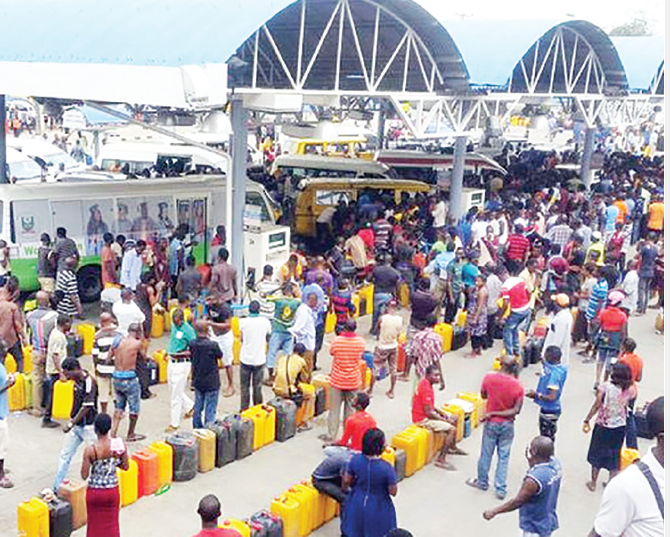
Under the present situation, the Federal Government cannot claim that subsidy has not returned as claimed by many. Indeed, our investigation across the states showed that the pump price of fuel is below N1,000, which is the current range of the landing cost of fuel at the Lagos depots. Therefore, most Nigerians going through hardship are of the opinion that the Federal Government should openly return fuel subsidy the
same way it removed it. We hereby present the situation in some states.
KADUNA
Against the backdrop of the increasing frustration which Nigerians are going through on account of the rising pump price of petrol, the cry for the return of fuel subsidy, properly cleansed of the huge corruption hat attended the administration of the policy all through the eight-year tenure of the Buhari administration, is rising in decibel.
Today, small businesses like barber shops, hairdressing salons, business centres, viewing centres, restaurants, tailors and schools, among others, which depend on
petrol generators for power supply are not finding it easy surviving the socio-economic hardship.
According to Solomon Nuhu, who operates a business centre in the Kakuri area of Kaduna: “It is not easy surviving this fuel price removal of subsidy on electricity to
save Nigerians from the hands of unscrupulous elements that exploit every single opportunity for their selfish ends. The legislators should be reminded that Nigerians are passing through hellfire on earth since the May 29 careless order to remove fuel subsidy. Tinubu should not be ashamed to revert it because this is what the citizens want, following the untold torture since this government came into power.”
KOGI
In the New Layout quarters, Lokoja, the capital of Kogi State, Bala Danjuma, who runs a barbing salon said that the high cost of petrol has greatly affected his business. He said that customers no longer patronize him, preferring to scrap their hair by themselves or patronise the local Hausa barbers which is far cheaper.
The situation got worse due to the epileptic power supply from the Abuja Electricity Distribution Company, AEDC, which supplies electricity for only two to three hours a day. Sometimes for a whole week, there will be no light and in some cases power supply would be available in the night by which he would have closed for the day.
With the high cost of petrol, he had to increase the price he charges for haircuts from N400 to N700 to stay afloat. The higher price drove the customers away, who began to patronise the local, itinerant Hausa barbers, who will scrap the whole of
the hair for just N200.
Danjuma told Sunday Sun that he was making up to N6,000 daily before the removal of the subsidy. Back then he was spending between N800 and N1,200 to fuel his generator.
But currently, he spends up to N3,500 while making less than N7,000 a day from haircuts.
Also, Mrs Taiwo Sharon, who has a big business centre along Lugard Road, Lokoja, said that the oil subsidy removal which caused petrol prices to skyrocket has adversely affected the business as she no longer make money as she used to do.
Sharon said that she had to start charging more for services rendered to her customers, to cover the cost of running the generator due to frequent power outages.
Her words: “Honestly, most times, we doze off here because there’s no light to work and if I say I will use the generator my clients will not be able to afford the amount I will charge them.
“AEDC is killing our business, most days in the week we stay without power supply and when there is supply, it rarely lasts longer than two to three hours and sometimes with low current. Yet, every month, AEDC brings a bill of ₦18,000 and state internal revenue people bring several bills.