Follow Us on Google
• Schools, markets, banks shut in South East
By Christopher Oji, Juliana Taiwo-Obalonye, Ndubuisi Orji, Godwin Tsa, Adesuwa Tsan, Abuja, Okey Sampson, Umuahia, Jude Chinedu, Enugu
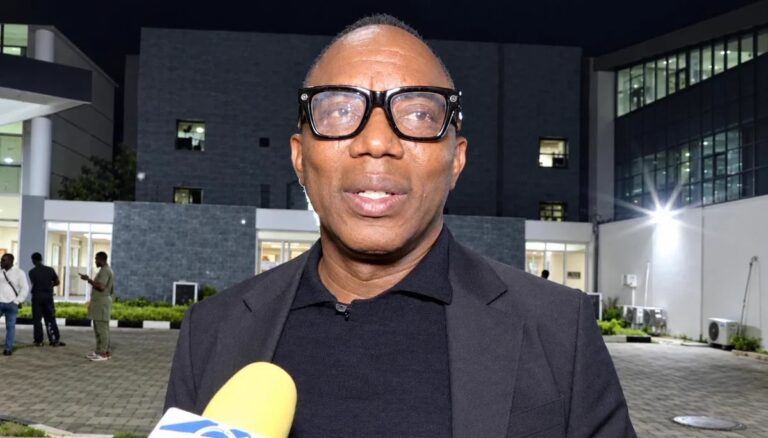
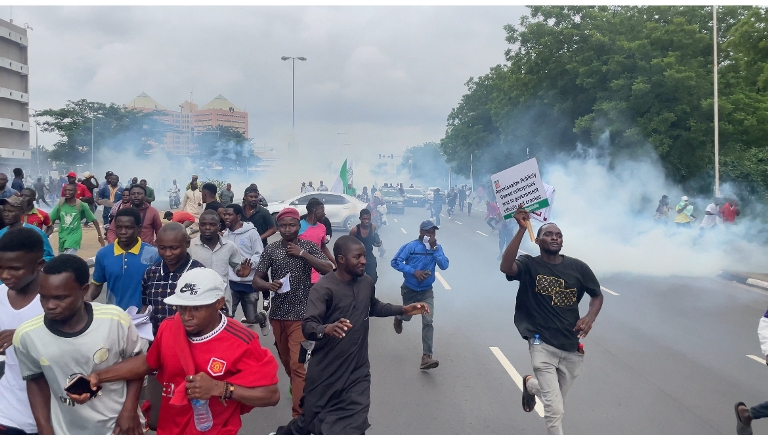
The #FreeNnamdiKanuNow protest in Abuja turned violent yesterday as Police fired teargas at protesters led by Omoyele Sowore. A heavy security lockdown constricted Abuja’s Three Arms Zone and key government precincts as demonstrators took to the streets to demand the release of IPOB leader, Nnamdi Kanu.
Similarly, economic activities were stalled in the South East states of Anambra, Enugu, Abia, Anambra and Ebonyi. The Lagos Police Command showed force in the state as its personnel patrolled round the metropolis.
In the Federal Capital Territory, Abuja, military, police and DSS personnel turned back workers and restricted access to the Federal Secretariat, the National Assembly, the Supreme Court and the Presidential Villa. By mid-morning, the city centre was a ghost town as access points were sealed and movement limited along routes into the capital’s political heart.
Several arrests were made, including that of Aloy Ejimakor, one of Kanu’s lawyers and brother of the detained IPOB leader while many others were injured
The police also restricted movement in parts of the city centre and they mounted checkpoints and blockades to contain unrest.
Kanu has been held since June 2021 over allegations linked to terrorism and incitement of violence across the South-East region. Government maintains that his trial must run its full course before any consideration of release.
In the FCT, barricades spanned from the National Mosque area through the Supreme Court Junction, with commuters from the Mararaba and Nyanya axes halted at multiple checkpoints.
Security sources confirmed that the deployment was a coordinated operation designed to thwart any attempt by violent actors to hijack the protest, following intelligence reports warning of potential disruptions.
Meanwhile, hearing in the police suit against Sowore and other conveners of #FreeNnamdiKanuNow protest suffered a setback as court activities at the Federal High Court in Abuja came to a halt.
As of 9:30am when the reporter got access into the premises of the high-rise building that houses about 13 courts, all the courtrooms were under lock and key. Although very few court workers, lawyers, litigants and private guards of the court were seen in the premises, no judge was sighted.
Justice Mohammed Umar had, on Friday, fixed yesterday for the respondents in the ex-parte motion filed by the police, on behalf of the Federal Republic of Nigeria (FRN), to show cause why the interim order made by the court should be vacated.
•Security operatives fired live bullets at us – Sowore
Meanwhile, Sowore has accused security operatives of launching an unprovoked attack on peaceful protesters during yesterday’s rally in Abuja.
The activist alleged that security forces opened fire shortly after the protest began at the front of the Transcorp Hilton, Abuja.
He also confirmed that some individuals were arrested.
“Eventually, they arrested some people. I heard Nnamdi Kanu’s younger brother was arrested and beaten, and his lawyer was also arrested and beaten. They’ve all been taken to the FCT Command.
“There were about 10 trucks that arrived as soon as we started the protest. There was no provocation on our part, like we had promised. It was an orderly and peaceful protest.
“Suddenly, from nowhere, they started shooting at us; tear gas and some live bullets were fired at us. Luckily, I don’t think anybody was hit by live bullets, but they were just shooting all around us.”
•Counter protest
Counter protests also swept through Abuja as a group of demonstrators rallied against calls for the release of the detained IPOB leader.
The counter-protest came just hours after security forces dispersed the #FreeNnamdiKanuNow demonstration organised by activist Omoyele Sowore near the Transcorp Hilton.
The opposing group converged near the Labour House Bridge in the city’s central area around mid-morning, holding up placards that read, “No Pressure to the Rule of Law.”
Clad in matching shirts and waving the Nigerian flag, the protesters moved in a coordinated manner as patriotic songs played in the background. Their message was clear: Nigeria must respect the ongoing judicial process and resist any attempt to interfere with the courts.
•Security presence
The Federal Secretariat complex, normally teeming with civil servants, vendors and visitors was unusually quiet; only a handful of early arrivals managed to gain entry before access was shut down entirely.
By mid-morning, the usual bustle along Federal Secretariat Road and approaches to the National Assembly had vanished, with armed personnel manning multiple barriers. The FCT Police Command urged residents to avoid the Central Business District and adhere to traffic diversions to prevent any breach of peace.
The protest, organised by groups sympathetic to IPOB, followed renewed calls from the South East Governors’ Forum and several lawmakers for a political resolution to Kanu’s detention.
Although organisers pledged a peaceful demonstration, the visible security presence underscored the government’s concern about the potential for unrest, given past experiences with pro-Biafra protests.
Across the city, security checks around the Presidential Villa intensified with heightened stop-and-search measures and a pronounced show of force as officials monitored the area. Access remained restricted even for villa-tag holders, signalling heightened caution in the wake of the protests.
•Pursue justice in courts
Special Adviser on Media and Public Communication, Sunday Dare, has Sowore to desist from using street protests to influence judicial processes. According to him, justice is achieved through the legal system, not public demonstrations.
Dare wrote on his verified X account, @SundayDareSD: “Protests, threats, attempts at mob actions, and inflammatory rhetoric do not aid the judicial process. Instead, they hinder it, creating unnecessary tension and undermining the rule of law,” he stressed.
The presidential aide criticised Sowore’s continued use of public agitation and appeals for sympathy to affect court matters as an outdated approach incompatible with modern democracy. He warned that such conduct would not be tolerated in any society that respects the law.
“You cannot employ protest and civil unrest to demand the release of someone accused of terrorism and whose case is still in court. Not even in America,” Dare noted.
Clarifying the context, Dare explained that the legal case against Kanu, predates President Bola Tinubu’s tenure and remains under judicial review. “This administration respects the independence of the courts and will not interfere in ongoing legal proceedings,” he affirmed.
Reiterating President Tinubu’s dedication to justice and constitutional governance, Dare warned that while freedom and democracy are fundamental, “they have their limits,” and violating these will provoke the full force of the law.
“The judiciary should be let alone to do its work without interference. President Tinubu remains committed to upholding the rule of law and ensuring justice is served fairly and transparently,” he concluded.
•Anambra, Enugu, Ebonyi, Abia
In Umuahia, Abia State, all public institutions, including schools, banks and markets were shut down. There were restrictions on vehicular movement as most commuters stayed indoors.
Some of the protesters marched from Isi Gate in the state capital, heading to Government House, but on getting to Okpara Square, they were accosted by the state Commissioner of Police, Danladi Isa.
The protesters insisted on taking their message to Governor Alex Otti. But the CP appealed to them to give him the message, promising to deliver it to the Governor.
Isa appealed to the protesters to disperse and go home so that criminal elements will not infiltrate and hijack the protest. At Afaraukwu, Umuahia, Kanu’s home town, protesters carried placards some of which read: “Free Kanu now,” “The IPOB leader has committed no crime,” “Kanu must be set free now.”
Some of the protesters said it was the height of injustice for Kanu to remain in detention all these while.
One of them queried the rationale behind keeping Kanu behind bars, while Sunday Igboho is roaming the streets and some arrested bandits, released.
“If Sunday Igboho should be allowed to room the streets and the Federal Government negotiates and releases arrested bandits, why should they not release Nnamdi Kanu?”
Although everywhere in the commercial city of Aba was calm, soldiers patrolled the streets in a show of force. Enugu streets were unusually empty. Across the state capital, businesses, schools and markets were shut down. Banks, shopping malls, and petrol stations were also closed, while major roads were completely deserted.
Although some government offices opened for skeletal operations, attendance was poor and very little activity took place.
A visit to areas such as Ogbete Main Market, Agbani Road, New Haven and Independence Layout showed empty streets and closed shops, as transport operators and traders stayed off the roads.
Residents told our correspondent that their decision to remain indoors was both for safety reasons and to show solidarity with protesters in Abuja, where the main demonstrations were taking place.
Other News
“We support the call for Nnamdi Kanu’s release, but people here are afraid of being caught up in violence or police confrontation,” said a trader at Achara Layout who refused to give his name.
In Enugu, there was no human and vehicular movements on many major roads, including the ever-busy Abakaliki/Onueke highway, Ezzama/Oshiri/Onicha/Uburu/Okposi road, Abakaliki/Afikpo highway, Abakaliki/Enugu highway and other major roads in the state.
At Okposi Junction known as the court area, which used to be a beehive of activities, the area was completely empty.
Only armoured military tanks were seen patrolling the area. Shops, markets and offices were completely shut down.
In Ebonyi, it was a similar situation as residents did not engage in any physical protest rather they stayed at home in their areas. Many government offices, including courts, banks and markets, were also under lock and key.
SP Joshua Ukandu, Police Public Relations Officer (PPRO) in the state, told reporters in Abakaliki that the closure of shops and markets by some individuals were due to fear of the unknown. Anambra also witnessed a similar situation as Onitsha markets and streets were deserted.
•Police show force in Lagos
The Lagos Police Command showed force in the state as its personnel patrolled round the metropolis.
Commissioner of Police, Olohundare Jimoh, who led the operation said the movement was to ensure no protest was done in the city.
Jimoh, who addressed the press at Ikeja Under Bridge, described Lagos as protest free.
“As you can see, normal businesses are going on. School children are moving freely. Hospitals are open. In fact, commercial activities are going on smoothly. There is no blockage or harassment or motorists.
“I have deployed heads and commanders of operational squads, including tactical units to strategic areas. I have made adequate deployment to Ojota, Lekki Toll Gate, Ikeja and other volatile areas. All Area Commanders and their DPOs are on ground. I am getting situation reports from all over the state and there is no report of violence or protest.
“We are here doing everything possible to contain violence. Even though we know there is no protest, we are here to protect lives and property and to make sure that hoodlums do not raise their ugly faces.”
He explained that the command had made strategic deployments to all flashpoints where protests had previously occurred, including the Lekki Toll Gate, Ojota, Maryland, Gani Fawehinmi Park and other key areas across the metropolis.
• Presidency seeks sanction for Kanu’s lawyer
President Tinubu’s adviser, Mr. Bayo Onanuga, has urged legal authorities to impose sanctions on Mr. Aloy Ejimakor, a lawyer representing Nnamdi Kanu, leader of the Indigenous People of Biafra (IPOB), for participating in yesterday’s #FreeNnamdiKanu protest in Abuja.
Speaking through his official X account, @aonanuga1956, Onanuga expressed surprise at seeing Ejimakor among the protesters, who were reportedly mobilised by Sahara Reporters publisher and 2023 African Action Congress (AAC) presidential candidate, Omoyele Sowore. “I was quite taken aback to spot Aloy Ejimakor in the middle of that small protest group led by Sowore.
It makes me question his judgment.”
Onanuga criticised Ejimakor’s involvement as contrary to the principles governing legal conduct, referencing the ongoing treason trial against Kanu. “With the prosecution’s case concluded, it is imperative that Mr. Ejimakor focuses on presenting a strong defence in court,” Onanuga emphasised. “Instead, he has chosen to join a career anarchist in a protest that only undermines the judicial process.”
Onanuga described the demonstration as “shambolic” and raised concerns about Ejimakor’s professional ethics. He called on relevant legal bodies to “review and consider sanctions to uphold the integrity of the legal profession in light of this unethical behaviour.”
The heightened security environment around the Unity Fountain and other protest hotspots contributed to a tense atmosphere, even as demonstrators remained orderly according to organisers.
•NUJ kicks
Meanwhile, the Nigeria Union of Journalists (NUJ), FCT Council, has condemned the unlawful arrest and assault of AFP journalist, John Okunyomih. Secretary of the union, Jide Oyekunle, described the incident as “a gross violation of press freedom and an affront to democratic principles.” Okunyomih was reportedly manhandled by armed soldiers and policemen and had his camera and equipment damaged near the Unity Fountain.
The NUJ demanded an immediate investigation and called on the Inspector-General of Police, Kayode Egbetokun and the FCT Commissioner of Police, Dantwaye Miller, to identify and sanction those responsible and to replace the damaged gear.
“The harassment of journalists performing their legitimate duty is unacceptable. Security agents must be reminded that journalists are not enemies of the state but partners in nation-building,” Oyekunle stated. The Council urged authorities to uphold constitutional guarantees and international press freedom standards and to replace the damaged equipment to deter future attacks on media professionals.
Witness accounts highlighted the challenges faced by journalists on the frontline.
BusinessDay reporters, Tony Ailemen, Tunde Adeniyi, Ladi Patrick-Okwoli and Michael Godwin narrowly escaped harm when Police fired teargas directly at the back window of their vehicle while they covered the protest.
Ailemen explained that the crew was conducting a vox pop near the Ministry of Finance bus stop around 1pm when the police action occurred.
Before targeting the journalists, Police had fired teargas at an elderly woman selling Okpa, a traditional Igbo cake, forcing bystanders to flee and leaving her exposed. “We identified ourselves as press, but the police still fired in our direction,” he recounted. “They launched teargas at our car, and we had to flee.” The cameraman, Mr. Adeniyi, sustained injuries from the teargas attack. It was only due to the prompt intervention of commuters at the bus stop that the BusinessDay team was able to recover.
The heightened security environment around the Unity Fountain and other protest hotspots contributed to a tense atmosphere, even as demonstrators remained orderly according to organisers.
As protesters pressed their case for Nnamdi Kanu’s release, the day’s events centred on a tension between civil liberty and public order. The government’s readiness to deploy extensive security apparatus in advance of a potentially volatile protest underscores a broader priority: preventing violence while maintaining stability in a city that has historically borne the weight of contentious demonstrations.
•HURIWA slams FG, IGP, Army chief
The Human Rights Writers’ Association of Nigeria (HURIWA) has slammed the Federal Government and its security agencies over what it described as a shameful, lawless and dictatorial clampdown on peaceful Nigerians, who gathered in Abuja to demand justice and the release of Kanu.
The association said the disgraceful show of force orchestrated and unleashed on peaceful residents of the Federal Capital Territory (FCT), by the Inspector General of Police and the Chief of Army Staff was proof that the Nigerian government under President Bola Tinubu is descending deeper into militarised tyranny, where peaceful dissent is treated as treason and citizens are ruled through fear instead of justice.
HURIWA said it was both laughable and tragic that an entire capital city could be locked down simply because a handful of young Nigerians said they would march peacefully to ask for justice.
“Why is the government so afraid of its own people?” the group asked. “What is it hiding? Only leaders with unclean consciences fear the sight of citizens expressing themselves. Only dictators, tyrants and looters of public funds are terrified seeing hungry, frustrated Nigerians pour into the streets to speak truth to power.”
National coordinator of the group, Emmanuel Onwubiko, in a statement described as “insanity in uniform” the deployment of hundreds of soldiers, armoured vehicles and police patrol teams across major routes in Abuja, turning what should have been a peaceful civic action into a tense military siege.
It said the reckless action of the security agencies crippled economic and commercial activities across the city; banks were shut, filling stations stopped dispensing fuel, commuters were stranded and private businesses lost billions of Naira in a single day.
HURIWA blamed the chaos on the paranoid conduct of the Police and the Army, accusing both institutions of creating unnecessary panic and tension.
“The protesters were not armed, not even with a stone,” it said. “Yet live ammunition and tear gas were fired at harmless citizens. The government must explain why such unconstitutional brutality was unleashed on people whose only crime was demanding justice.”
The Association also faulted the security advisory issued by the United States Embassy, warning its citizens to stay away from the protest venues, describing it as a foreign conspiracy against Nigeria’s democracy.
It wondered why a sovereign government would allow itself to be guided by what it called “a baseless, imported panic message,” to justify domestic repression.
“Did Nigerians invite Americans to the protest? Did they plan to storm the US Embassy? That advisory was totally irrelevant, yet the government used it as an excuse to flood Abuja with troops. It smacks of complicity,” HURIWA declared.
The group warned that the government’s growing intolerance for peaceful protests is a dangerous provocation that could one day spiral out of control. “If you keep pushing citizens to the wall, they will fight back,” HURIWA cautioned. “No government can suppress the people forever. Hunger and injustice will always find a voice. Nigeria is not a military barracks; it is a democracy; at least, it is supposed to be.”
It accused the Tinubu administration of ruling with fear and intimidation, saying the clampdown exposed an embarrassing level of insecurity within the government circles. “Even if protesters marched toward Aso Rock, they could never breach its walls. That place is impenetrable and heavily guarded. So, what exactly is the government afraid of? The truth?” HURIWA asked.
The group demanded that the Federal Government immediately halts the use of soldiers for crowd control, release all arrested protesters without delay and pay compensation to business owners, whose operations were crippled by the security lockdown.
It also urged the National Human Rights Commission and the international human rights bodies to launch independent probes into the violent disruption of the protest.
HURIWA further warned that Nigeria’s democracy was being choked by a leadership that mistakes citizens’ cries for justice as threats to its survival.
“This is not the democracy Nigerians fought for,” the statement said. “When a government uses live bullets on its own people for daring to ask questions, it has lost moral legitimacy. Those who are clean do not fear accountability. It is those with blood and corruption on their hands who tremble at the voice of the people.”
The Association reiterated that peaceful protest is a constitutional right, not a privilege. It said the continued militarisation of civic spaces will only deepen public resentment and erode trust in government institutions.
“No government that silences its people can ever claim to be democratic. Nigeria’s rulers must stop this war on citizens and start governing with conscience,” the group said.