Follow Us on Google
By Chinwendu Obienyi
Nigeria’s foreign-exchange reserves have climbed to their highest level in seven years, buoyed by renewed investor confidence, stronger oil receipts and sustained balance-of-payments inflows, the Central Bank of Nigeria (CBN) said on Tuesday.
FX reserves rose to $46.7 billion as of Nov. 14, 2025, the strongest position since 2018 and enough to cover 10.3 months of imports, according to CBN Governor Olayemi Cardoso, whose remarks were delivered in Abuja by Deputy Governor for Economic Policy, Muhammad Abdullahi.
Cardoso described the development as a significant milestone in the central bank’s ongoing reform programme, saying it reflects improving macroeconomic fundamentals and renewed global appetite for Nigerian assets.
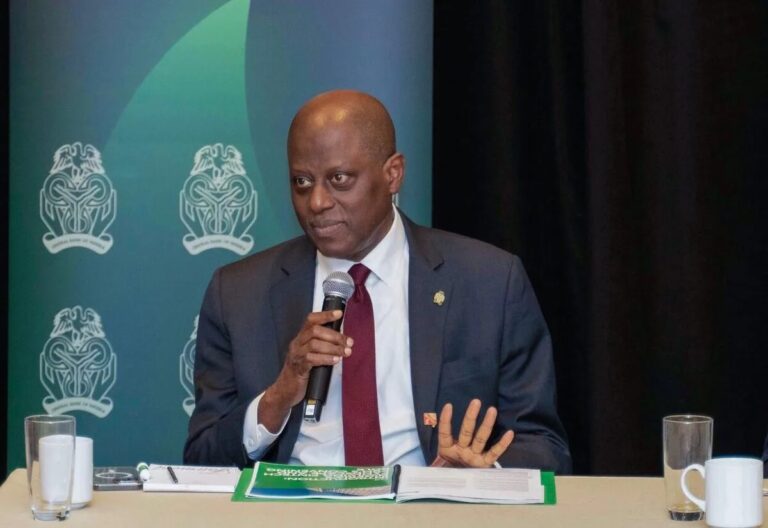
Foreign reserves have risen to $46.7 billion, supported by sustained inflows and renewed investor participation across various asset classes,” Cardoso said at an event marking the 20th anniversary of the central bank’s Monetary Policy Department.
He attributed the gains to stronger portfolio inflows, increased crude-oil earnings and policies designed to stabilise Nigeria’s volatile currency market.
The advance in reserves coincides with a continued strengthening of the naira, which has appreciated against the dollar this year as reforms improved market liquidity and narrowed arbitrage opportunities. The spread between the official market and the Bureau-de-Change segment has tightened to below 2 per cent, a level policymakers say indicates returning confidence in Nigeria’s exchange-rate framework.
Other News
Cardoso also pointed to easing price pressures as evidence that policymakers are gaining traction against inflation. Annual headline inflation decelerated to 16.05 per cent in October, down sharply from 34.6 per cent in November 2024, marking seven straight months of dis-inflation and the slowest rate in three years. Core inflation has also begun to moderate, supported by tighter monetary conditions and improved FX supply.
Nigeria’s macroeconomic rebound has not gone unnoticed by global investors or ratings agencies. Cardoso said all three major international ratings firms have recently upgraded Nigeria’s outlook, citing S&P Global Ratings’ move to shift the country to “positive” from “stable.”
He added that Nigeria’s removal from the FATF grey list earlier this year has helped restore the nation’s credibility in the international financial system, improving access to trade finance and foreign investment.
The combined effect of rising reserves, a stronger naira, slowing inflation and better ratings has created a more competitive currency, improved trade balances and a stronger foundation for inclusive development,” Cardoso said.
The governor used the anniversary to highlight the central bank’s monetary-policy evolution over two decades, crediting the Monetary Policy Department with reforms including the introduction of the Monetary Policy Rate in 2006, the interest-rate corridor system and more robust policy communication.
He said these reforms have laid the groundwork for Nigeria’s transition toward a full inflation-targeting regime, one of the central bank’s key strategic objectives.
Still, Cardoso cautioned that risks remain elevated amid global economic uncertainty, commodity-price volatility and domestic structural imbalances. He urged the department to strengthen analytical capacity, expand the use of technology and big data, and remain agile as Nigeria continues its shift toward a rules-based monetary policy framework.