Follow Us on Google
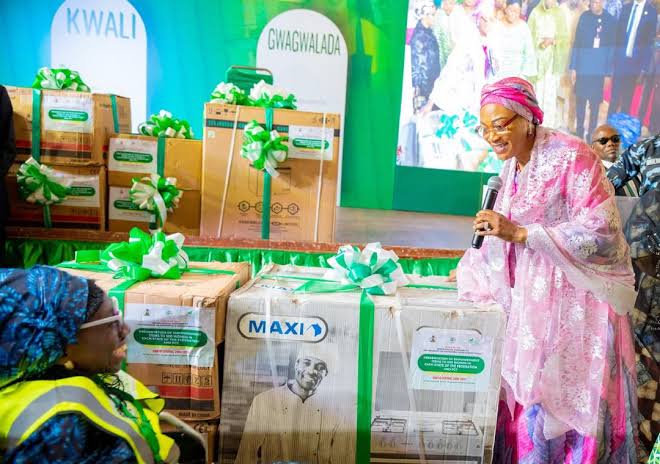
The First Lady of Nigeria, Oluremi Tinubu, has said children must not be allowed to go hungry, as she unveiled fresh steps by the Renewed Hope Initiative (RHI) to expand food banks, nutrition support and community interventions for vulnerable families across the country.
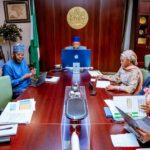
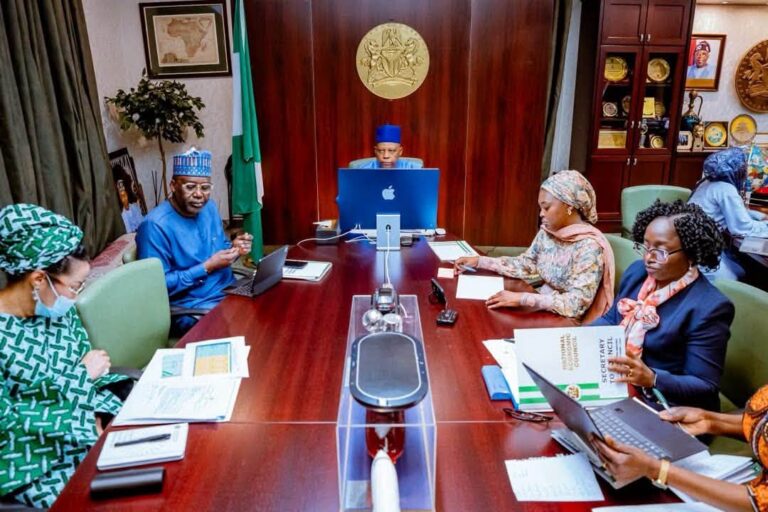
Addressing journalists after opening a meeting with the wives of state governors on Wednesday at the boardroom of the Office of the First Lady, Mrs Tinubu said the initiative was designed to tackle child malnutrition from the grassroots and ensure that pregnant women and nursing mothers also received support.
“Our children are not supposed to be going hungry,” she said. “No matter what, when you see a child that is malnourished in your state, you have to take them and make sure that they are properly cared for,” she charged the wives of governors.
She explained that the food banks being rolled out under the RHI would be located near primary healthcare centres to make it easier for families to access nutrition support alongside medical care.
“These food banks are built next to the primary healthcare centres so that the ones that need supplements can get their supplements; lactating mothers and pregnant women too will be given food items from the food bank, and also,” she said.
Mrs Tinubu said the project was being strengthened through support from donors and partner agencies, including the Bank of Agriculture, the Ministry of Health and Social Welfare, Dangote and the National Population Commission. She said the support would help build and sustain food banks across the states.
“What we have done so far is to come up with the strategy, which for me is a very good example,” she said. “It is now left for the first ladies to take it upon themselves and make sure that the states have more food banks because our children are not supposed to be going hungry.”
She said the effort was part of a broader social investment agenda under the RHI, which also covers education, scholarships, economic empowerment and environmental campaigns. According to her, the programme was meant to create a lasting impact beyond the current administration.
“What we are doing in this administration is to make sure that even generations unborn would benefit,” she said.
Mrs Tinubu also urged state governments and their spouses to do more to identify and support malnourished children early.
The First Lady further called for more donations, disclosing that she had personally contributed N500 million to the food bank drive, while the wives of governors had contributed N40 million. She further listed her previous interventions to include N2 billion for tuberculosis, N1 billion for breast cancer and N500 million for food malnutrition.
Mrs Tinubu said the RHI Green Nigeria Challenge, scholarships, storybook distribution and other initiatives remained on course but insisted that the fight against hunger among children must remain central.
Mrs Tinubu also reiterated that the reforms being pursued by President Bola Tinubu’s administration were aimed at building “lasting legacies” that would benefit generations yet unborn, even as she urged Nigerians to adjust to the changing realities of the economy.
Other News
Speaking while fielding questions from State House correspondents, she described her role, as well as that of the governors’ wives, as “only performing a supportive role”.
“I’m the housewife here, and I’m only playing complementary roles and supportive roles. And that’s what we, all these women here (governors’ wives), have been doing.”
She said the Renewed Hope Initiative (RHI) was created to help states multiply whatever support they received and translate it into practical benefits for citizens.
“As mothers in the nation, all I do is just coordinate them (wives of governors). That’s why we brought RHI on board, so that every state whatever trickles down, they are supposed to multiply it,” she said.
Mrs Tinubu said the administration’s policies, including subsidy removal, had been difficult but necessary. “What we are doing in this administration is to make sure that even generations unborn would benefit,” she said. “There are a lot of things that have really, like when we take subsidy removal, for example, if Nigerians didn’t believe in what he could do, I don’t think we would have had it so easy. It was tough. Very, very tough, which we all know.”
She added that the government was focused on changing the way Nigerians think about work, jobs and enterprise. “Now, everyone has to know the way of doing business is different,” she said. “The way we do business now is just quite different.”
The First Lady said many young people still expected government jobs, even though opportunities were now more likely to come through ministries, agencies and digital application platforms. “We have to inform the youth. You say there are no jobs? Have you visited any ministry to even say, oh, what do you have for the people?” she said. “They can go there. They can’t go to Mr. President’s office, but they can go to all the ministries’ agencies.”
She urged them to explore small and medium-scale enterprise opportunities. “I’m interested in some smaller and medium-scale enterprises. What do you have that I can key into? Those are the things that you can gain in this administration,” she said.
Mrs Tinubu said the government had made notable gains in agriculture, empowerment and social investment. She cited support for small businesses, grants for market women and a growing push for food security.
“We’ve really covered a lot of areas in Agric,” she said. “Because of food security, even I happen to have a garden… I have a garden that can produce okra that I can also give away. So every time I go there to harvest, I always have to give to my staff.”
She used the opportunity to encourage Nigerians to value local culture and food products. “We have a very, very proud culture. And I think this is high time we started promoting ourselves and this nation. We have what it takes to do that,” she said.
On economic empowerment, Mrs Tinubu said the RHI had reached tens of thousands of beneficiaries across different states through grants and support programmes.