Follow Us on Google
From Fred Ezeh, Abuja
In August 2020, the world Health Organization (WHO) certified Nigeria free of Wild Polio Virus (WPV). This followed years of sustained effort led by the Nigerian government and Rotary International, with the support of other non-profit organizations.
Before the certification, the country has recorded three consecutive years with no detected case of the virus across the country, which was a prerequisite for the WHO to consider the certification. However, the development signaled the end of decades of the fight against wild poliovirus in Nigeria.
But a few years afterwards, the country began to record new strains of polio known as circulating Vaccine-derived Poliovirus type 2 (cVPV2). Though not as deadly as the Wild Polio Virus, but the cVDPV has also proven to have devastating effect on the health of the children especially those below the age of five.
In Nigeria, new cases are being recorded in some states in Nigeria particularly in northern Nigeria. While no case of cVDPV2 was reported in 2025, there were 94 confirmed cases across 15 states in 2024. Majority of outbreaks have also been concentrated in northern states, including Kebbi, Sokoto, and Zamfara. A few weeks ago, two new cases of the vaccine-derived polio were reportedly detected in some of the States. This was in addition to the ones previously detected.
Things to know about WPV, cVDPV
Poliovirus is a pathogen targeted for global eradication. According to the WHO, Polio is a highly infectious disease that largely affects children under five years of age, causing permanent paralysis (approximately 1 in 200 infections) or death (2-10 per cent of those paralyzed).
The virus is transmitted from person-to-person, mainly through the fecal-oral route or, less frequently, by contaminated water or food. The virus multiplies in the intestine, from where it can invade the nervous system and cause paralysis. The incubation period is usually 7-10 days but can range from 4-35 days. About 90 per cent of those infected are often asymptomatic or experience mild symptoms, and the disease usually goes unrecognised.
Meanwhile, vaccine-derived poliovirus is a strain of poliovirus mutated from the strain originally contained in Oral Polio Vaccine (OPV). OPV contains a live, weakened form of poliovirus that replicates in the intestine for a limited period, thereby developing immunity by building up antibodies.
On rare occasions, when replicating in the gastrointestinal tract, OPV strains can genetically change, and may spread in communities that are not fully vaccinated against polio especially in areas where there is poor hygiene, poor sanitation, or overcrowding. The lower the population’s immunity, the longer vaccine-derived poliovirus survives and the more genetic changes it undergoes.
In very rare instances, the vaccine-derived virus can genetically change into a form that can cause paralysis, as does the wild poliovirus. This is what is known as a vaccine-derived poliovirus (VDPV). The detection of VDPV in, at least, two different sources, and at least, two months apart that are genetically linked, showing evidence of transmission in the community is classified as ‘circulating’ vaccine-derived poliovirus (cVDPV). Similar to wild poliovirus, cVDPVs can be of three types (1,2 or 3).
Global support for Nigeria
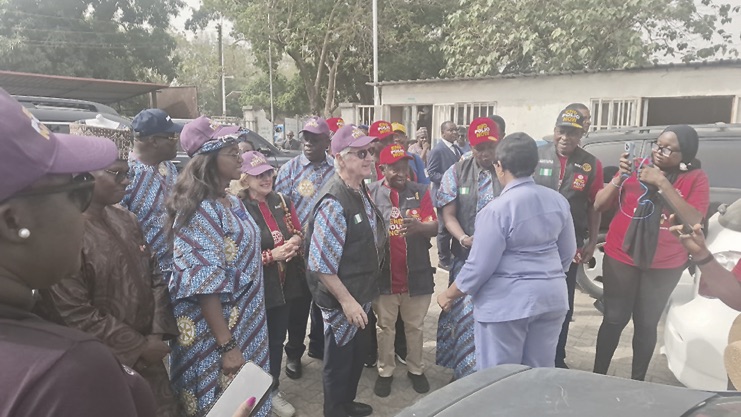
Nigeria’s efforts for the final push against the vaccine-derived virus attracted global attention and support. A few days ago, the President of Rotary International, Francesco Arezzo, paid a solidarity visit to Nigeria in company of his wife.
Arezzo said the visit was an opportunity to Asses the efforts and commitments of the country office of the Rotary International to the final lap of the fight against. “It also was an opportunity to celebrate the field workers that have committed time and resources to the cause of winning the war against polio.”
He noted that even though Nigeria has been declared wild poliovirus free, the country and the entire global community are just a flight away from a new case of wild poliovirus considering its porous borders. No country is 100 per cent free of polio until the entire world is eradicated of polio.
“We need to keep our guard firm because we promised the world that we would end polio, and they trusted us with responsibility, even though we have made some significant progress and recorded some great achievements over the years. Nevertheless, a polio case anywhere in the world is still a threat to the global community. Hence, we need to sustain the immunization and sensitization campaigns across our communities.”
Other News
He acknowledged that in Nigeria, a great achievement has been made. “But there’s still the case of vaccine-derived polio in some locations in the country especially in northern states. This is a wake-up call to all that the ‘fight’ is far from being over.”
He specifically acknowledged the commitment of Rotarians and non-Rotarians in Nigeria who had dedicated themselves to community services in Nigeria and beyond despite numerous challenges that could have demotivated them; and encourage them to sustain the momentum till there’s no case of polio in the world.
Arezzo also performed and monitored immunization exercise at a Primary Healthcare Centre (PHC) at Garki Area 2, Abuja, as part of support and moral booster for healthcare workers, and encouragement for mothers to ensure they complete the immunization circle for health and wellbeing of their babies.
District Governor, Rotary International D9127, Dr. Joy Okoro, said: “We are happy with the visit because we have longed for it. The visit has afforded us the opportunity to freely interact with the President of the Rotary International. Additionally, he is here to assess what we have achieved over the years with the resources provided for us. He’s been impressed with the success we have recorded.
“Nevertheless, we have mapped out strategies to tackle the increasing cases of vaccine-derived polio cases in some states in Nigeria. For instance, we don’t have Rotary Clubs in Kebbi, Sokoto and a few other states in northern Nigeria. Unfortunately, these are states where we are recording these vaccine-derived polio cases.
Vaccine-derived strains pose fresh challenges
Chairman, Nigerian National PolioPlus Committee (NNPPC), Hassan Josua, acknowledged that while Nigeria was declared free of wild poliovirus in August 2020, vaccine-derived strains have continued to pose fresh challenges to the country.
“Soon after the certification in 2020, we started seeing vaccine-derived viruses in some parts of the country, but we are responding aggressively. Once we detect a case, we organise an immediate corporate response within a 10-kilometre radius and sometimes expand beyond that.”
He disclosed that cases have declined significantly over time. “We have come down from 67 to 50, and now to much lower numbers. It is not easy, but we are working together to bring it down.”
Joshua highlighted the concentration of cases in some northern states, notably, Sokoto, Zamfara, Kebbi and Jigawa, stressing the challenge of cultural, religious and political dynamics, which must be carefully navigated in tackling the cases of vaccine-derived polio cases in the states.
“In addition to that, you have to understand the politics, the way of life, the culture and religion of the area. If you miss that, you can run into problems that you can not manage.”
Misconception remained a barrier
He pointed to non-compliance in some communities, and that misconception about vaccines has remained a barrier. “Some believe there is a spiritual cause. Others hide children during immunisation. That is why we choose our staff from the local communities and they must speak the language. However, we must change the culture through engagement.”
Joshua added that advocacy; traditional institutions and data-driven surveillance remain central to the response strategy. “We are not lacking in what to do. But we must continue advocacy, strengthen community ownership and ensure no child is missed.”
He noted the growing fatigue among the volunteers, and insisted that fatigue must not translate into surrender. “Volunteer fatigue is normal. But being tired is not giving up. We are 99.9 per cent done, and we must finish the fight.”
He urged Nigerians and the global community to see polio eradication as a shared responsibility. “Polio is only a flight away. If we do not eradicate it, our unborn children will be affected. Nigerians, non-Nigerians, Rotarians, non-Rotarians, we must join hands in our words and in our actions.”