Follow Us on Google

From Adetutu Folasade-Koyi and Molly Kilete, Abuja
The Federal Government has called for stronger collaboration between security agencies and the media to promote national security, tackle misinformation and build public confidence in security institutions.
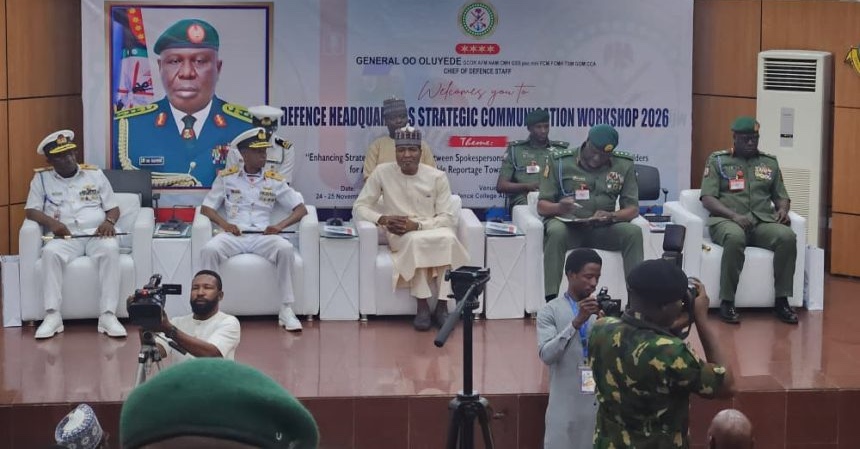
The Minister of Information and National Orientation, Mallam Idris Mohammed, made the appeal on Tuesday while declaring open the Defence Headquarters Strategic Communication Workshop 2026 in Abuja, themed “Enhancing strategic collaboration between spokespersons of security agencies and media stakeholders for accurate and responsible reportage towards improved national security”.
The minister, represented by the Director-General of Voice of Nigeria (VON), Mallam Jibrin Baba-Ndace, said that effective communication was as important as operational capacity in addressing the country’s security challenges.
He noted that the military and the media had distinct but complementary responsibilities, stressing the need for mutual respect, professionalism and regular communication between both institutions.
According to him, security agencies must provide timely and credible information, while journalists must ensure accuracy, provide context and avoid publishing information capable of endangering lives or compromising ongoing operations.
“Professional journalists must report without bias and avoid relying solely on unverified social media content. We must develop the capacity to interrogate information, establish facts and provide the necessary context, particularly when reporting defence and security matters,” he said.
Mohammed, however, cautioned that responsible reporting should not be interpreted as an attempt to shield security institutions from legitimate scrutiny or undermine the independence of the media.
He said the growing complexity of security threats, including terrorism, banditry, kidnapping, organised crime, cyber threats and the spread of false narratives, made strategic communication an essential component of the country’s national security architecture.
The minister warned that inaccurate reporting could generate fear, deepen public distrust and weaken confidence in security institutions, while silence or delayed communication during major security incidents could create information gaps exploited by misinformation and speculation.
He therefore called for strategic communication anchored on facts, consistency, transparency and respect for the public’s right to information.
The minister also highlighted the importance of improved coordination among security agencies, citing the Federal Government’s initiative in October 2026 towards developing a comprehensive National Threat Assessment and a rolling five-year strategy for defence and security operations.
He said the initiative was designed to strengthen coordination across the country’s defence, intelligence and security institutions.
Mohammed disclosed that operational reports for the first half of 2026 showed that the Armed Forces had conducted 14,231 operations across different theatres and rescued 1,016 kidnapped victims.
Other News
He said the achievements deserved recognition, urging the media to give balanced attention to both the challenges confronting the country and the efforts and sacrifices of security personnel.
“Media professionals should not focus exclusively on negative developments while overlooking operational successes and the sacrifices made by those working to protect our country. This does not mean abandoning critical journalism, but ensuring balanced reporting that acknowledges both the challenges and the progress being made,” he said.
He further stressed that trust between government institutions and the media must be strengthened through accurate communication, proper verification and responsible handling of sensitive operational information.
The minister maintained that the workshop’s emphasis on ethical responsibilities was not a call for censorship or restrictions on journalistic independence, but an opportunity to promote responsible communication.
“The public has a right to information, and that right must be respected. At the same time, the safety of citizens and the protection of sensitive security operations must be taken into consideration,” he said.
On efforts to address misinformation, Mohammed recalled that Nigeria and UNESCO had launched the International Media and Information Literacy Institute in April 2026 as a UNESCO Category 2 institution.
He said the institute was established to promote research, capacity building and international cooperation in media and information literacy, particularly in tackling misinformation and the challenges of an evolving information environment.
According to him, media literacy should extend beyond digital platforms to include strategic leaders, operational personnel and citizens across different levels of society.
He said citizens must be equipped with the skills to critically assess information, identify false narratives and make informed decisions.
Mohammed urged participants at the workshop to develop practical recommendations for improving relations between security agencies and the media, including effective communication channels, mechanisms for correcting inaccurate reports and a shared understanding of the operational realities confronting both sides.
He said that although the military and the media often had competing professional interests, both institutions ultimately served the same country and its citizens.
“The military may seek to protect sensitive information, while journalists naturally seek access to information. However, both institutions work for the same country and ultimately serve the same people. They must therefore find common ground and develop a sustainable framework for cooperation,” he said.
He urged the military to recognise the legitimate information needs of journalists, while encouraging media professionals to appreciate the operational considerations and security concerns of the Armed Forces.
He said maintaining a balance between national security requirements and the public’s right to information was essential to building a sustainable partnership between the two institutions.