Follow Us on Google
The Federal Government has unveiled a new Nigeria Early Years Agenda aimed at improving the survival, development, learning, and school readiness of children under five, amid concerns over poor early childhood outcomes across the country.
The agenda, developed under the Human Capital Development 2.0 framework, seeks to bring health, nutrition, education, water and sanitation, social protection, and other interventions together around the same child.
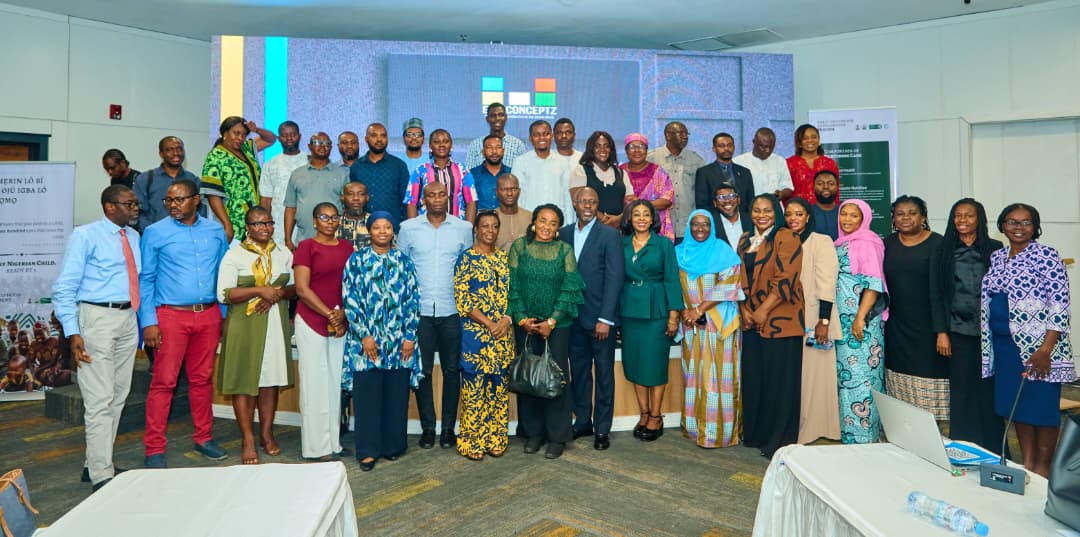
The Federal Coordinator, Human Capital Development 2.0, Dr Ado Muhammad, disclosed this in a technical briefing on Nigeria’s Early Years Agenda for government and development partners in Abuja.
He said the initiative was based on evidence showing that the first five years of life represent a critical window for human capital development, with about 90 per cent of adult brain architecture formed by age five.
In a presentation, Dr Muhammad noted that only 47.7 per cent of Nigerian children are developmentally on track on the Early Childhood Development Index (ECDI).
The presentation also showed that under-five mortality stands at 110 deaths per 1,000 live births, while 40 per cent of children under five are stunted.
On learning and school readiness, only 24 per cent of children aged four to six can write a simple word, 64 per cent can count from one to ten, while only 20 per cent demonstrate the ability to plan ahead.
Muhammad said early childhood development could not be treated as the responsibility of one ministry because children’s outcomes are influenced by multiple sectors, hence the agenda brings together the mandates of ministries covering budget and economic planning, finance, health, education, Women Affairs, agriculture, water resources and sanitation, humanitarian affairs, justice and other sectors.
He noted that the approach is based on the nurturing care framework, which emphasises good health, adequate nutrition, responsive caregiving, opportunities for early learning, and safety and security.
“The government’s analysis found that Nigeria already has numerous policies, institutions and programmes addressing aspects of childhood development, but lacks a mechanism that brings them together around the individual child,” he said.
The presentation further noted that eight existing data systems, including the National Identification Number system, National Social Register, health, education, child protection, agriculture and WASH information systems, collect information relating to children but do not currently follow the same child across services.
He also identified financing and budget execution as major challenges, stressing that about N2.6 trillion had been allocated to early-childhood-development-related activities at the subnational level, but only N724 billion was expended, leaving an allocation-to-expenditure gap of about N1.9 trillion.
Other News
“Actual expenditure was estimated at about N3,011 per child under five in the second quarter of 2025, compared with N26,617 if relevant budget lines were fully steered towards the target,” he added.
The analysis said the gap was largely in the release and drawdown of funds rather than appropriation, and also identified significant gaps in spending on responsive caregiving and early learning.
According to the presentation, responsive caregiving received only N13 million, while opportunities for early learning recorded zero funding across the three years reviewed. Together, the two components represented less than 0.01 per cent of the N582.7 billion tracked.
However, he noted that some education and skills expenditure may be classified under other budget lines.
Meanwhile, the proposed agenda seeks to use existing structures rather than create new institutions. “Five delivery platforms identified are primary healthcare centres, pre-schools and ECCDE centres, women’s affinity groups, farms and markets, and homes.”
The presentation said Nigeria has about 35,200 primary healthcare facilities, 92,000 pre-schools and ECCDE centres, 58,000 women’s affinity groups with about 1.1 million members, thousands of markets and close to 50 million households across 8,809 wards.
“The proposed approach is to layer early-years services onto the existing platforms, with delivery extending from federal and state authorities to LGAs, wards and households,” he said.
Meanwhile, the Federal Government said it is seeking support from development partners for state ECD investment plans, results-based financing, federal coordination, research, innovation and knowledge-sharing.
The proposed financing model would use Programme-for-Results and Disbursement-Linked Indicators, building on similar approaches used in education, primary healthcare and nutrition.
The government also said the ultimate objectives are to reduce stunting, increase the proportion of children developmentally on track, strengthen Nigeria’s human capital and ensure that more children are ready for school by age five.