Follow Us on Google
The Federal Government is set to establish a national electricity call centre to enable consumers across the country to lodge power-related complaints and report vandalism of critical electricity infrastructure for prompt action.
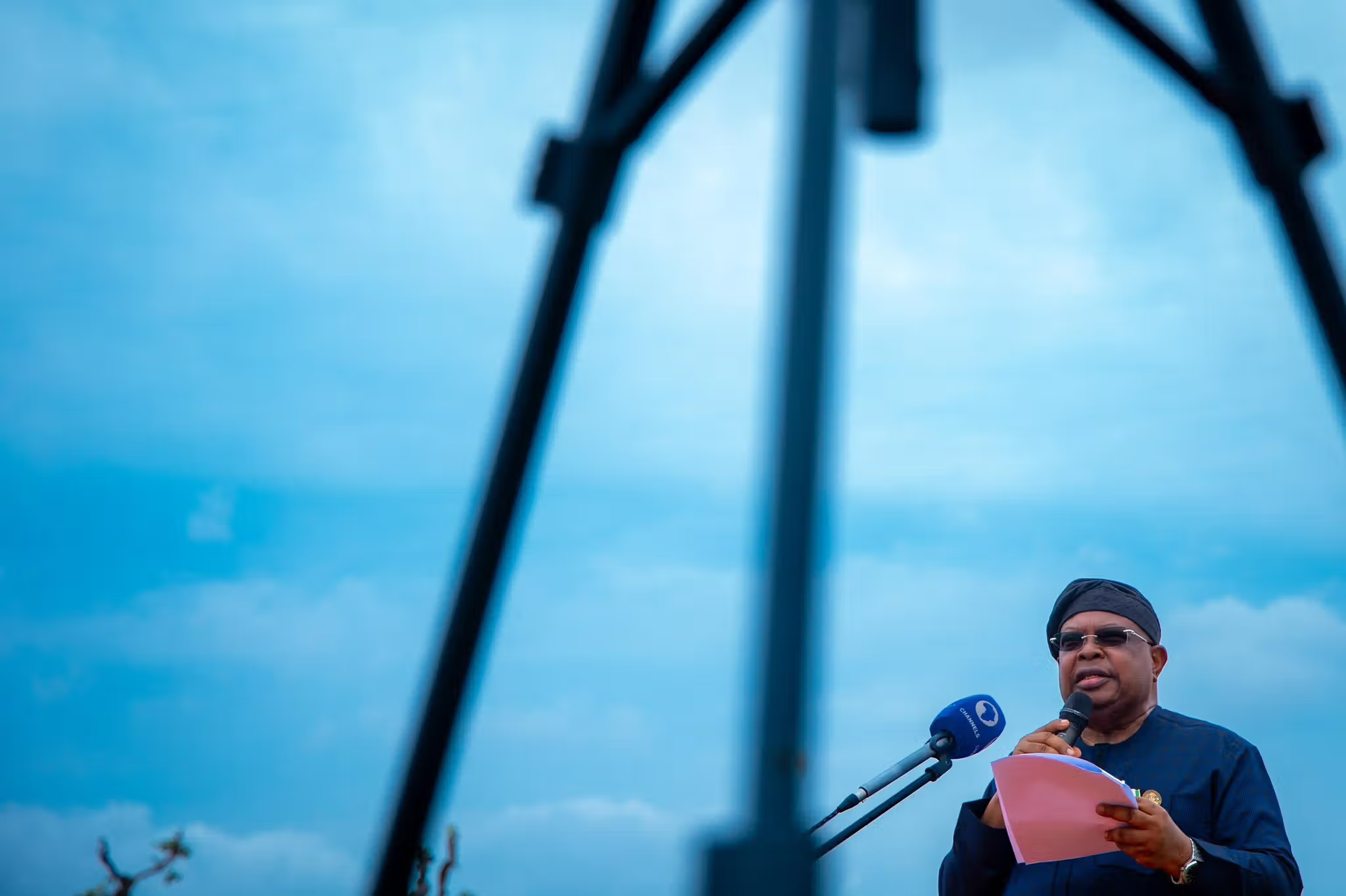
Minister of Power Joseph Tegbe disclosed this on Wednesday at the commissioning of a 3MW hybrid mini-grid project and Renewable Energy Workshop and Training Centre at Yakubu Gowon University, Abuja.
The initiative is under Phase 2 of the Energising Education Programme (EEP), an intervention covering seven universities and two teaching hospitals.
Tegbe said the proposed call centre would provide a central platform through which electricity complaints could be received and resolved, while creating opportunities for young Nigerians through the jobs expected to be generated by the initiative.
He said the government was also working to establish a dedicated channel for reporting vandalism of electricity infrastructure, with immediate action and remediation expected to follow such reports.
“My office is working on a call centre where electricity complaints across the country can be lodged and resolved. This initiative will provide sustainable job opportunities for our youth nationwide,” the minister said.
“In addition, we plan to provide a dedicated channel where vandalism of critical assets can be reported for immediate action and remediation.”
Tegbe added that the Federal Government was working with security agencies to strengthen the fight against vandalism of electricity infrastructure.
“We are also working through a joint team of the Nigeria Police Force, the Nigeria Security and Civil Defence Corps, and the EFCC to curb the vandalism of electricity assets across the country,” he said.
The project comprises a 3.3MWp solar array with 3MW AC output capacity and 2MWh battery storage, designed to support critical loads beyond solar hours. It also has a dedicated grid connection for non-critical electricity demand outside daylight periods.
According to Tegbe, the project will provide electricity to about 58,726 students, while 388 streetlights installed under the intervention will improve campus illumination and security.
He said reliable electricity would strengthen research and learning, reduce the university’s dependence on diesel generators and ease pressure on its budget.
“The connection between infrastructure and human capability is central to President Bola Ahmed Tinubu’s Renewed Hope Agenda. Under his leadership, investment in electricity is being directed towards services and productive activities that improve people’s lives,” he said.
Tegbe, however, charged the university community to protect the new infrastructure, warning that vandalism could undermine the benefits of the investment.
Other News
He urged students and other members of the community to report vandalism not only of the solar facility but also of transformers, transmission towers and other electricity assets.
Speaking on the long-term sustainability of the project, the Managing Director of the Rural Electrification Agency (REA), Abba Abubakar Aliyu, said the success of the EEP should not be measured by megawatts alone but by the benefits delivered to institutions.
“The true value of the EEP lies not merely in megawatts, but in functional laboratories, reduced budgetary pressure, and safer learning environments,” Aliyu said.
He said the REA had established the Renewable Asset Management Company (RAMCO) to address the challenge of sustaining renewable energy infrastructure after commissioning.
According to him, RAMCO is designed to manage, monitor, maintain and optimise renewable energy assets over their operational lifetime.
“Building infrastructure and managing it are two distinct responsibilities,” Aliyu said, stressing that the sustainability of the university project would depend on the commitment of all stakeholders.
The REA managing director disclosed that the EEP had so far delivered more than 100MW of electricity across 22 federal institutions and university teaching hospitals.
Beyond electricity generation, he said the agency had established the Renewable Energy Workshop and Training Centre at Yakubu Gowon University to develop local technical capacity.
Aliyu challenged the university to transform the facility into a research hub for distributed energy resources, develop new academic courses and use the installation to drive technological innovation.
The Vice-Chancellor of Yakubu Gowon University, Prof. Akinwunmi Babatunde Fawehinmi, said reliable electricity was indispensable to effective teaching, research and the creation of a conducive learning environment.
He pledged that the university would ensure the facility was fully utilised and properly maintained.
Also speaking, the Chairman of the Senate Committee on Power, Senator Enyinnaya Abaribe, commended the REA for the project, saying the intervention would contribute to improving the quality of education.
He also endorsed the establishment of RAMCO, noting that sustainability was critical to ensuring that public infrastructure continued to deliver benefits long after commissioning.