Follow Us on Google

From Aidoghie Paulinus, Abuja
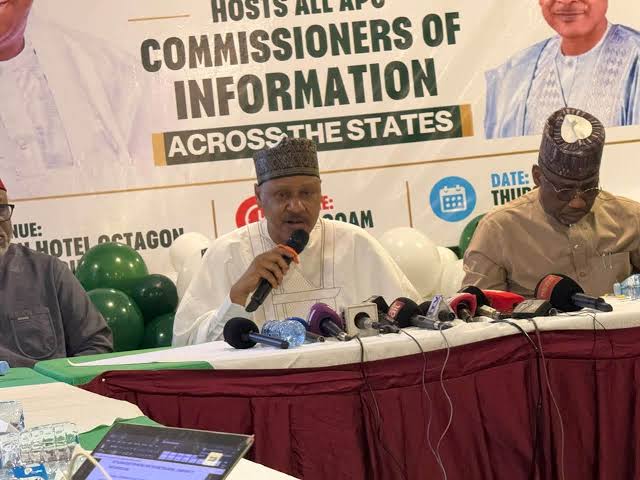
The Federal Government has charged commissioners of information across states controlled by the All Progressives Congress (APC) to strengthen the communication of government policies, programmes and activities, stressing that public confidence in governance can only be sustained through accuracy, transparency, consistency and responsible engagement with citizens.
Minister of Information and National Orientation, Mohammed Idris, who gave the charge while addressing APC commissioners of information in Abuja, said the rapidly changing information environment had made effective communication an indispensable instrument of leadership, governance and public engagement.
He noted that the speed at which information travelled, the growing influence of digital platforms and changing public expectations had fundamentally altered how citizens received, interpreted and responded to government policies and decisions, making it imperative for information managers to adopt more proactive, credible and responsive communication strategies.
Idris said the responsibility was particularly important for commissioners serving under the APC, who must ensure that their communication reflected a clear understanding of the party’s vision, values and policy direction without compromising factual accuracy or responsiveness to the concerns of Nigerians.
“For us in the All Progressives Congress, this responsibility carries an added dimension. We must ensure that our communication reflects a clear understanding of our party’s vision, values and policy direction, while remaining factual, responsible and responsive to the concerns of Nigerians.
“Under the leadership of President Bola Ahmed Tinubu, the Renewed Hope Agenda represents a programme of reforms and national repositioning aimed at strengthening our economy, expanding opportunities, improving infrastructure and building a more prosperous country.
“These reforms require effective communication at every level of government. Citizens must understand not only what government is doing, but why particular decisions are being taken, what challenges they seek to address and what benefits they are expected to deliver,” the minister said.
He explained that commissioners of information occupied strategic positions between government and the people, with the responsibility of translating policies into understandable messages, providing credible information, correcting misconceptions and ensuring that government activities were accurately communicated.
According to him, the effectiveness of government communication should not be measured merely by the volume of information released to the public, but by how well citizens understood government decisions and the extent to which their concerns were acknowledged and addressed.
Other News
“This is where your respective offices become particularly important. As Commissioners of Information, you occupy a strategic position between government and the people. You are responsible for translating policies into understandable messages, providing credible information, correcting misconceptions and ensuring that the activities of government are communicated accurately.”
He urged the commissioners to establish stronger communication networks across federal and state institutions, share experiences and verified information, improve media engagement strategies and make more effective use of traditional and digital platforms in reaching different segments of society.
“We must share experiences, exchange useful information, strengthen our media engagement strategies and make better use of traditional and digital communication platforms.
“We must also recognise the growing challenge of misinformation and disinformation. Political communication must not come at the expense of credibility. Our greatest asset is public trust, and that trust can only be sustained through accuracy, transparency, consistency and responsible engagement.” Idris cautioned that the increasing spread of misinformation and disinformation posed serious challenges to public communication, warning that political considerations must never be allowed to undermine the credibility of information provided to citizens.
He also stressed that effective communication must go beyond explaining government activities to include listening to citizens, understanding their concerns and ensuring that public feedback informed how government institutions engaged with the people.
“Beyond communicating government activities, we must also listen. Effective communication is a two-way process. We must pay attention to citizens’ concerns, understand public sentiment and ensure that feedback informs how government engages with the people.”
The minister further called on the commissioners to explore practical ways of coordinating their communication efforts, sharing credible information and amplifying development initiatives to ensure that Nigerians had access to reliable accounts of government activities at both federal and state levels.
He said cooperation among information commissioners would help strengthen institutional communication, improve public understanding of policies and promote a more coordinated approach to addressing emerging information challenges.
“As members of the same political family, we have a responsibility to foster unity, mutual respect and a common sense of purpose. Our different states and experiences should enrich our collective capacity rather than divide us.
“I am confident that the relationships established and strengthened here will contribute to a more coherent, effective and responsive information network across the country,” Idris stated.