Follow Us on Google
From Juliana Taiwo-Obalonye, Abuja
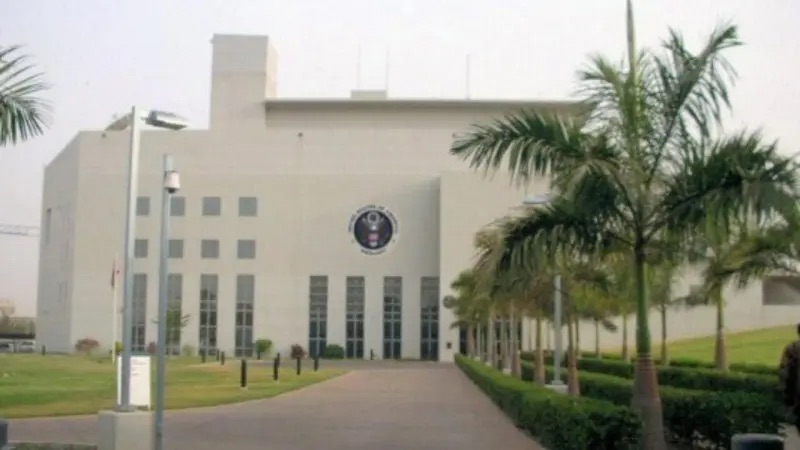
The Federal Government has urged United States Mission in Nigeria to stop orchestrating what it termed as a “relentless smear campaign” and “jaundiced narratives” and respect the diplomatic ground rules or risk further straining ties with Africa’s largest democracy.
Top government sources, who pleaded for anonymity, accused the US Mission of violating diplomatic norms and undermining bilateral goodwill.
The reaction followed allegations of the U.S. Mission sharing a report by The Africa Report, a Paris-based publication, which asserted that Nigerian political elites were “splurging state resources on buildings while citizens went hungry.”
The report highlighted Oyo and Gombe states for building new government houses, portraying the projects as examples of extravagance.
However, government insiders argue that The Africa Report misrepresented the situation and hinted at more troubling intentions behind the developments. “The governors they targeted are two of the country’s most prudent leaders,” one source told reporters.
“Governor Seyi Makinde in Oyo has been repeatedly recognised for performance and fiscal discipline, while Gombe’s Governor Inuwa Yahaya has managed state finances meticulously, ensuring salaries are paid, hospitals are built, and livelihoods are improving. These are hardly the faces of mismanagement.”
According to the sources, the animosity may have roots in a past business rebuff. The publisher of The Africa Report, who inherited the magazine from his late father, had allegedly lobbied the Nigerian Governors’ Forum to bankroll participation in its “Africa Roundtable” in Abidjan.
The governors refused, reportedly leading to sour relations and the unfavourable coverage the U.S. Mission is “gleefully amplifying.”
Beyond the publication, officials say the U.S. Mission had crossed a line. “This behaviour violates Article 41(1) of the Vienna Convention on Diplomatic Relations,” one senior diplomat noted.
“Diplomats have a duty not to interfere in the internal affairs of their host country. What we are seeing is the opposite,” said the source.
The officials recalled that Washington once predicted, incorrectly, that Nigeria would “disintegrate by the year 2000.” They also pointed to a July 15, 2025 US. State Department travel advisory warning Americans to avoid 18 Nigerian states because of terrorism, kidnappings and poor healthcare.
They described the advisory as “alarmist and context-free,” arguing it unfairly painted the entire country as unsafe while ignoring thriving urban centres like Lagos and Abuja.
“Roughly 47,000 Americans are projected to die from gun violence in the U.S. this year,” one analyst observed. “Yet the U.S. issues sweeping warnings about Nigeria without acknowledging that many of our regions are safer than high-crime American cities. It’s a distorted mirror.”
Despite the frustration, officials stressed Nigeria still values its longstanding partnership with the U.S. “We appreciate decades of U.S. support,” one of the sources said. “But this relationship cannot come at the cost of Nigeria’s sovereignty or our dignity.”