Follow Us on Google
From Okwe Obi, Abuja
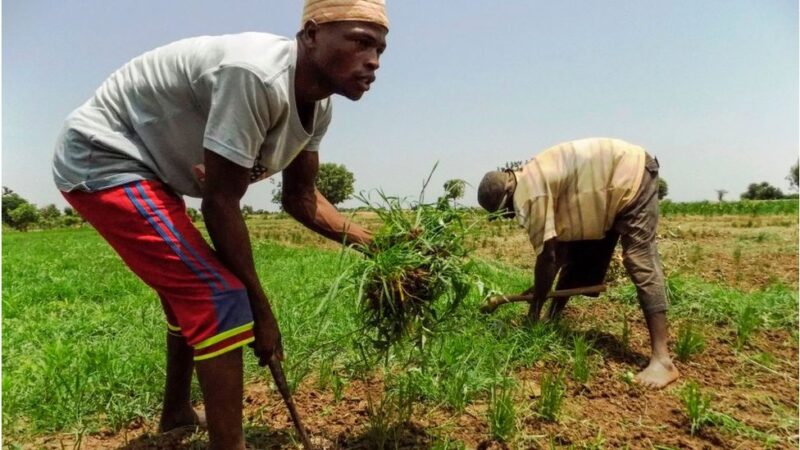
In a fresh push to tackle food insecurity and rural poverty, the Federal Government has rolled out N300,000 interest-free loans to more than 22,000 smallholder farmers nationwide, targeting beneficiaries across the country’s 774 local government areas.
The intervention, under the Government Enterprise Empowerment Programme (GEEP), was unveiled at the launch of the Farmer Monie Dry/Wet Season Programme in Abuja.
Minister of Humanitarian Affairs and Poverty Reduction, Bernard Doro, said the facility is designed specifically for vulnerable farmers operating at subsistence level, stressing that it is both interest-free and collateral-free.
“Under this particular scheme, which is one of the components of the National Social Investment Programme Agency, we are expecting that from today, our portal will be open for farmers, eligible farmers, to go and register to access our loans,” Doro said.
“And these loans are interest-free and collateral-free. The total sum for beneficiaries is N300,000, and we arrived at this looking at the economic protection of each farming activity. So we are targeting the vulnerable, poor farmers at the grassroots.
“This programme is not for big farmers. Those farmers that are doing it in acres are probably doing it at a very subsistence level.”
According to the minister, eligibility is restricted to Nigerians aged 18 and above who are already engaged in farming. Applicants must possess a Bank Verification Number (BVN), National Identification Number (NIN), a functional bank account, and must belong to a registered farming cooperative or association within their local government.
“First of all, you have to be a Nigerian. You have to be above 18 years of age. You must own a land or rent a land. So you have to be already into farming activity,” he said.
“We are not looking for new farmers. And then you have to have a bank account, NIN, National Identification, and you must belong to a farming cooperative or association in your local government. This programme covers the 774 local governments in Nigeria.
Other News
“Each local government will not be left behind. At the state level, we have our state programme managers who are working with our enumerators, who are working with the banks, who are working with the FinTech recovery agents, who will be working with the Agricultural Development Project and all farmer associations in each of the 37 states of the Federation.
“So how many farmers? We are targeting more than 22,000 farmers for this space.”
Doro described the initiative as a practical demonstration of the administration’s Renewed Hope Agenda.
“The Renewed Hope Agenda of this administration is more than a slogan; it is a promise to restore dignity, expand opportunity, and ensure that no Nigerian is left behind.
“Through the Government Enterprise and Empowerment Programme, we are opening doors for small businesses, artisans, and traders to access financial support that will enable them to grow, create jobs, and contribute to our national prosperity.
“This is financial inclusion in action bringing the underserved into the economic mainstream.”
National Coordinator and Chief Executive Officer of the National Social Investment Programme Agency (NSIPA), Badamasi Lawal, noted that women would form the bulk of beneficiaries.
“Across the care economy, the agro-economy, women are featured strongly. For example, the agro-economy, they represent 70% of our agro-workforce.
“So yes, we are gender-sensitive. Most of the beneficiaries are women, and I can assure you that they are going to use this properly because women, when being fostered with investments and systems, it’s a huge resource for the country.”