Follow Us on Google
From Juliana Taiwo-Obalonye, Abuja
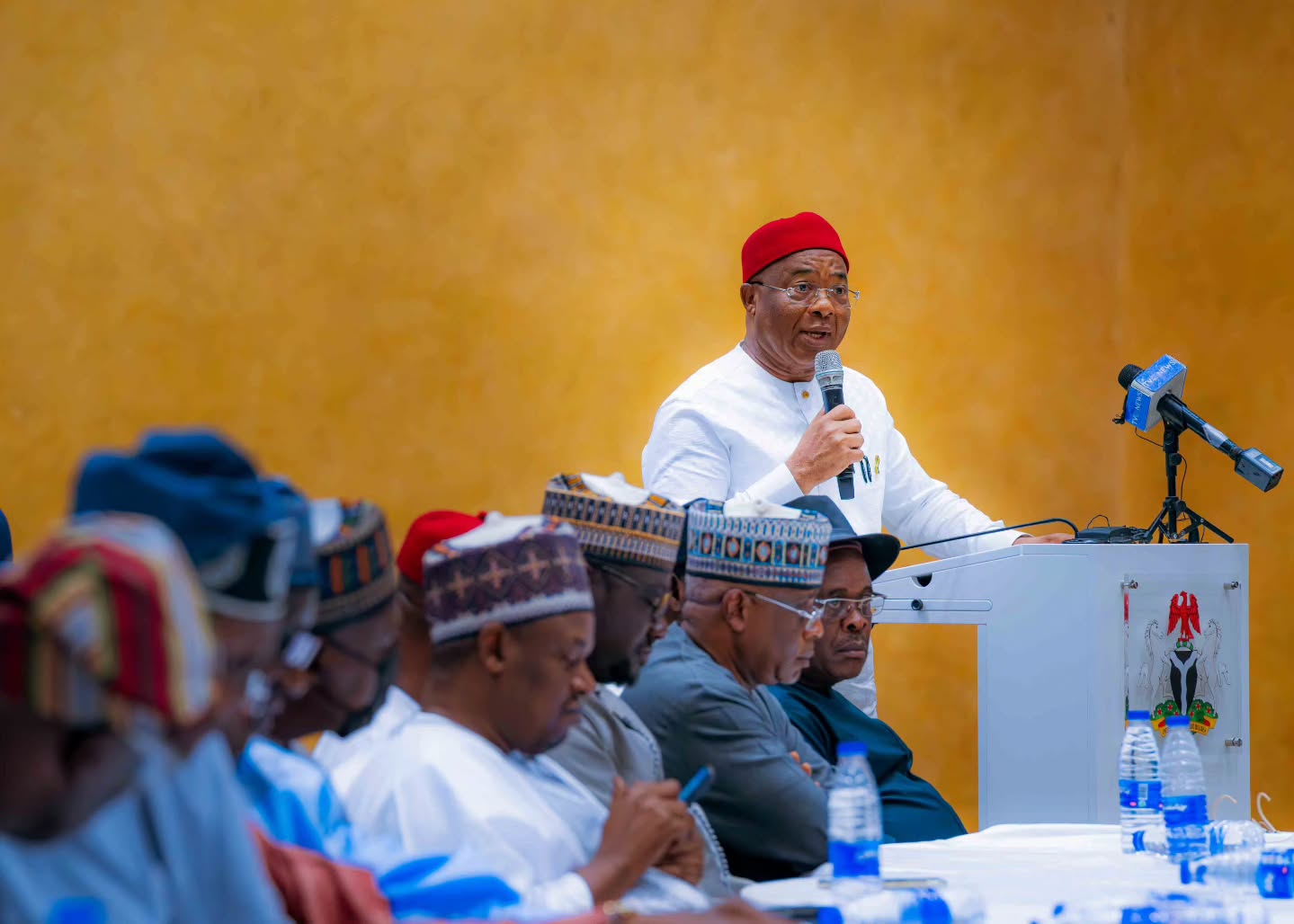
Governor of Imo State and Chairman of the Progressive Governors’ Forum, Hope Uzodimma has declared that amid gulf conflicts, Strait of Hormuz blockade, soaring oil prices and global inflation chaos, Nigeria is not only surviving but also thriving.
Uzodimma, who is also the Director General of Renewed Hope Ambassadors, made the declaration at an interactive session with members of the diplomatic community yesterday.
He noted that the country was emerging stronger from bold economic reforms under President Bola Tinubu.
He positioned Nigeria as Africa’s resilient giant, crediting Tinubu’s reforms for building macroeconomic shock absorbers.
“I want to address the global context now, because I know your governments have been watching how Nigeria, as one of the larger economies on the continent, is absorbing the shocks of the past few months,” Uzodimma said. “Recent conflicts in the Gulf and the Middle East, and the closure and blockade of the Strait of Hormuz that followed, have placed considerable pressure on global oil prices and shipping costs. Inflation has risen across most major economies. Currency volatility has been the rule rather than the exception in emerging markets.”
He cited grim forecasts: IMF’s 0.3-point cut to Nigeria’s 2026 growth due to war-related fuel and fertiliser woes; UNDP’s double-digit inflation warning for Nigeria, Egypt, Ethiopia and Angola. “Nigeria has held up well under these conditions,” Uzodimma countered. “Headline inflation, which peaked above 27 percent at the start of this administration, declined steadily through 11 consecutive months of disinflation, reaching 15.06 percent in February of this year, the lowest level since November 2020. March ticked up to 15.38 percent from Hormuz ripple effects, but the central point is that Nigeria entered a period of major external shock with a stable foreign exchange architecture, healthy reserves and an inflation trajectory that had already been bent downwards.
“We are absorbing the shock with the macroeconomic shock absorbers that this administration’s reforms put in place. That is the test of a stable economic architecture, and so far, we are passing it.”
According to him, growth backs the claim: “Real GDP growth tells the same story. The economy expanded by 4.07 percent in the fourth quarter of 2025, the second quarter in a decade, excluding the post-pandemic rebound. The full year 2025 closed at 3.87 percent, improving on 3.38 percent the year before.” Valued at N441.5 trillion (up from 372.8 trillion), IMF still eyes 4.1 percent for 2026. All sectors drove Q4—agriculture at 4.0 percent, industry, services with oil at 1.58 million bpd, rising to 1.546 million in March (peaks at 1.84 million).
Uzodimma singled out subsidy removal as a game-changer, calling it “the single largest organised corruption pipeline in our public finances” that functioned as an extraction system. He noted that subsidies were claimed on “imaginary volumes of petrol,” with huge volumes rerouted across borders and allocations inflated by cartels. “Successive governments knew this, commissioned reports about it but left the regime in place because dismantling it carried an immediate political cost. To his credit, President Tinubu dismantled it on his first day in office.”
Other News
This move, he said, eliminated over 60 percent of high-impact federal corruption, unlocking trillions of Naira. The Federation Account Allocation Committee (FAAC) disbursements have surged from N10.14 trillion in 2023 to monthly figures of N1.8 to N2.6 trillion recently, with states receiving N700 to N800 billion monthly. “State governments now receive net allocations in the order of N700 to N800 billion monthly, with February’s disbursement to states reaching N784 billion, a 23 percent increase over the allocation in the same month in the previous year,” Uzodimma highlighted. “The era of state governors travelling to the federal capital to ask for emergency bailouts to pay basic salaries is over.”
The governor detailed massive infrastructure gains, emphasising federal projects now benefiting states. The 700-km Lagos-Calabar Coastal Highway, connecting nine states, has its first 47 km operational since December 2025, slashing travel times from two hours to 30 minutes and boosting property values by 35 percent in areas like Ibeju-Lekki. The 1,068-km Sokoto-Badagry Superhighway, conceived 45 years ago, is 40 percent complete in key sections, with recent approvals for $516.3 million in loans.
Uzodimma shared a human story: “A few days ago, a video circulated on Nigerian social media in which a farmer described the difference one of these new highway sections had brought to his life. Before the road was reconstructed, transporting his farm produce to market took him 40 minutes. After the reconstruction, the same journey now takes him less than 10 minutes. He spoke about the saved fuel and the saved repair costs. Multiply that farmer by the millions along these corridors, and you begin to see what the freed resources are actually doing.”
He added that nationwide, over 440 road projects and 2,700 km of superhighways are underway, including the long-abandoned East-West Road. Ports are being refurbished with £746 million from a UK deal, and states are investing in power, roads, youth schemes and minimum wage hikes.
On foreign exchange, Uzodimma defended the Naira float against initial criticism. Reserves have climbed from $32 billion in mid-2024 to $49.4 billion by March 2026, 13 months of import cover. The Naira closed April at 1,374 to the dollar, with parallel market premiums under two percent. Diaspora remittances tripled to $600 million monthly, FDI commitments hit $50 billion and rating agencies like Fitch and Moody’s upgraded Nigeria.
“Predictability is key for investors,” he noted, saying, “An investor coming into Nigeria today can build a financial model that holds… The chaos that used to make Nigeria’s macroeconomic indicators effectively fictitious has been retired. That is the gift of the float.”
Despite global shocks like the Strait of Hormuz blockade, inflation fell to 15.06 percent in February, the lowest since 2020 and GDP grew 4.07 percent in Q4 2025, with the economy now at N441.5 trillion.
Uzodimma spotlighted citizen-focused gains: The Nigerian Education Loan Fund has disbursed N242.4 billion to 1.388 million students’ interest-free. Tax reforms exempt low earners (under N800,000 annually) and small businesses, with VAT at 7.5 percent. The digital economy is booming, with 107 million internet users and five unicorns. Security advances include recruitment drives, state police legislation and a US joint operation against ISIS affiliates.
In oil and gas, Dangote Refinery is operational, enabling domestic PMS refining after decades. Agriculture grew four percent, food inflation halved to 14.3 per cent and non-oil exports hit $3.2 billion in H1 2025.
He said: “A country that has absorbed an external shock of the magnitude caused by the closure of the Strait of Hormuz and continues to grow at four per cent is a country that is not merely surviving its reform period. It is moving through it. And what comes out on the other side will be a Nigeria more competent, more competitive and more credible than the one any of us has known.”