Follow Us on Google
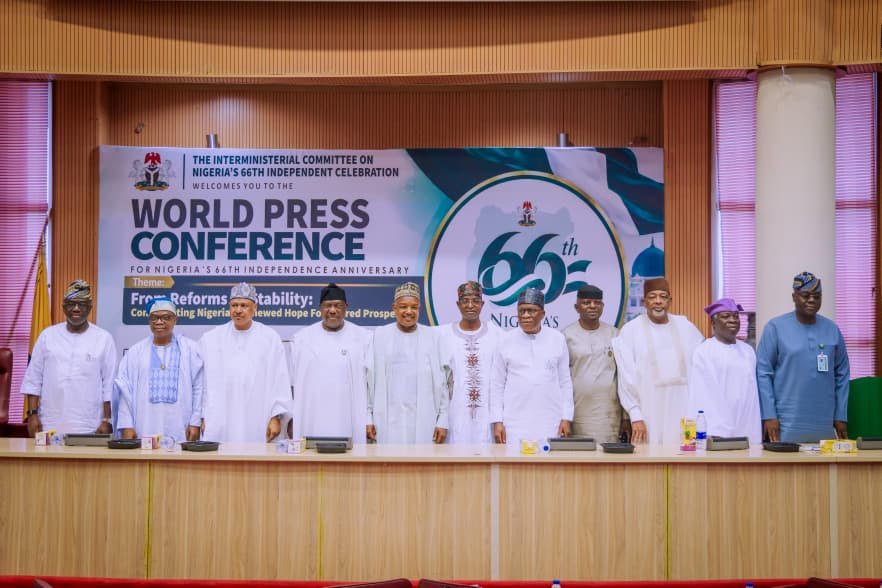
The Secretary to the Government of the Federation (SGF), George Akume, has stated that the next phase of President Bola Tinubu’s economic programme will focus on converting the gains of ongoing reforms into jobs, higher incomes, improved public services and wider economic opportunities for Nigerians.
Secretary to the Government of the Federation (SGF), George Akume, made this known on Thursday in Abuja while unveiling the activities for Nigeria’s 66th Independence Anniversary, with the theme: “From Reforms to Stability: Consolidating Nigeria’s Renewed Hope for Shared Prosperity.”
Akume, who chairs the Inter-Ministerial Committee for the anniversary, said the administration’s priority was no longer merely to implement difficult economic reforms but to ensure that the resulting stability produces measurable improvements in the lives of ordinary citizens.
“The task before us today, as leaders and citizens, is consolidation. We must ensure that the gains from reform translate into better opportunities for ordinary Nigerians,” he said.
The SGF’s declaration comes against the backdrop of continued pressure on household incomes and living costs, despite recent improvements in some macroeconomic indicators. Nigeria’s economy grew by 4.43 per cent year-on-year in the second quarter of 2026, according to the National Bureau of Statistics, while the Federal Government has continued to defend the structural reforms introduced since 2023.
Akume said the government’s reform programme, which included the removal of the petrol subsidy and unification of the foreign exchange market, was designed to restore fiscal balance, strengthen the economy, attract investment and establish the foundation for sustainable growth.
He, however, acknowledged that economic reform alone would not be sufficient if its benefits failed to reach households and communities.
According to him, Nigeria still faces major challenges, including poverty, insecurity, infrastructure deficits and gaps in healthcare and education, requiring sustained government intervention.
He said the Federal Government was therefore working to create additional fiscal space through increased revenue mobilisation, improved public financial management and stronger non-oil revenue collection.
The SGF said the additional resources would support investments in critical sectors capable of expanding economic activity and creating employment.
Akume identified infrastructure as one of the key pillars of the consolidation phase, listing investments in roads, railways, airports, seaports, electricity generation and transmission, as well as digital connectivity.
He said the objective was not simply to build physical infrastructure but to reduce the cost of doing business, improve movement of goods and people, connect farmers to markets and provide the foundation for industrial expansion.
The emphasis on infrastructure comes as the administration continues to position transport and energy projects as key components of its economic strategy. President Tinubu has similarly identified rail modernisation, improved domestic refining capacity and power-sector investments as part of efforts to strengthen economic integration and industrial activity.
On agriculture, Akume said government was supporting farmers with improved seeds, fertilisers, irrigation, storage and processing facilities.
He said the National Agricultural Development Fund and related interventions were intended to boost agricultural production while promoting agro-processing and local value addition.
He stressed that agriculture must move beyond primary production to become a major driver of jobs, investment and industrialisation.
The SGF also identified human capital development as central to the government’s consolidation strategy.
He said the administration was expanding access to education and improving the quality of schools and teachers, while the Nigerian Education Loan Fund (NELFUND) was providing more young Nigerians with opportunities to pursue tertiary education.
The Federal Government has previously said NELFUND had provided access to higher education for more than 1.5 million students, with over ₦282 billion disbursed under the programme.
Akume said the objective was to ensure that financial constraints did not permanently shut young Nigerians out of education and opportunities for economic advancement.
He also linked education, skills and access to finance to the broader objective of building a productive population capable of driving Nigeria’s transition from dependence on raw commodities to higher-value economic activity.
Other News
On security, Akume said the Federal Government remained committed to protecting lives and property, describing security as a necessary condition for sustainable economic development.
He said the armed forces and other security agencies were intensifying operations against terrorism, banditry, kidnapping, oil theft and other criminal activities.
According to him, the government was strengthening intelligence gathering, modernising equipment and improving coordination among the military, police, other security agencies and local communities.
The SGF said communities must also be able to participate in economic activity without fear, particularly farmers who need access to their farms and markets.
Akume further highlighted the Renewed Hope Ward Development Programme, which he said was designed to support small-scale projects in agriculture, trade, mining and other sectors at the grassroots.
He said the initiative would enable communities to participate more directly in economic development and ensure that the benefits of growth were not concentrated in major urban centres.
He maintained that the Federal Government’s consolidation strategy would be anchored on the Renewed Hope National Development Plan 2026–2030, with productivity, diversification, human capital development and resilience at its core.
“From reforms, we have built stability. From stability, let us now deepen growth and opportunity. And from growth, let us extend shared prosperity to every corner of Nigeria,” Akume said.
In his welcome address, the Minister of Information and National Orientation, Mohammed Idris, said Nigeria was moving from the phase of reform and stabilisation towards growth, production and shared prosperity.
Idris said recent economic developments indicated strengthening GDP growth, an improved external position, increased domestic refining capacity and rising investment and productive activity.
However, he said the central challenge was to translate those developments into concrete improvements for Nigerians.
“The next phase is to translate these gains into tangible improvements in the lives of Nigerians: more jobs, higher incomes, greater access to education and credit, lower costs and wider economic opportunities,” he said.
He said the Renewed Hope Agenda was pursuing these objectives through investments in infrastructure, agriculture, education, consumer credit, digital skills, energy and enterprise.
The minister cited student loans, consumer credit, major highways and reforms in agriculture, livestock, solid minerals and oil and gas as components of the administration’s strategy to expand production and local value addition.
The government’s claim of strengthening economic activity comes amid a mixed picture for households. While official data show stronger economic growth, recent reporting has also highlighted renewed cost-of-living pressure linked to rising petrol prices, underscoring the challenge of ensuring that macroeconomic improvements translate into household-level gains.
Idris formally unveiled the programme for the 66th Independence Anniversary.
The activities will begin with a Juma’at service on Friday, September 25, followed by a church service on Sunday, September 27.
An Independence Day public lecture will hold on Wednesday, September 30, while President Bola Tinubu will deliver a nationwide broadcast on Thursday, October 1, Nigeria’s Independence Day.
The Federal Government had earlier announced that this year’s anniversary celebration would be low-key, with emphasis on reflection on Nigeria’s journey since independence and the achievements and challenges confronting the country.
The anniversary theme therefore places the government’s economic programme under a new test: moving from the implementation of reforms and restoration of macroeconomic stability to demonstrating how those changes improve livelihoods, expand opportunities and deliver broader prosperity.