Follow Us on Google

From Isaac Anumihe, Abuja
The federal government has urged the Energy Commission of Nigeria (ECN) and the Rural Electrification Agency (REA) to deepen collaboration aimed at boosting local production of electrical components, as part of efforts to reduce import dependence and conserve scarce foreign exchange.
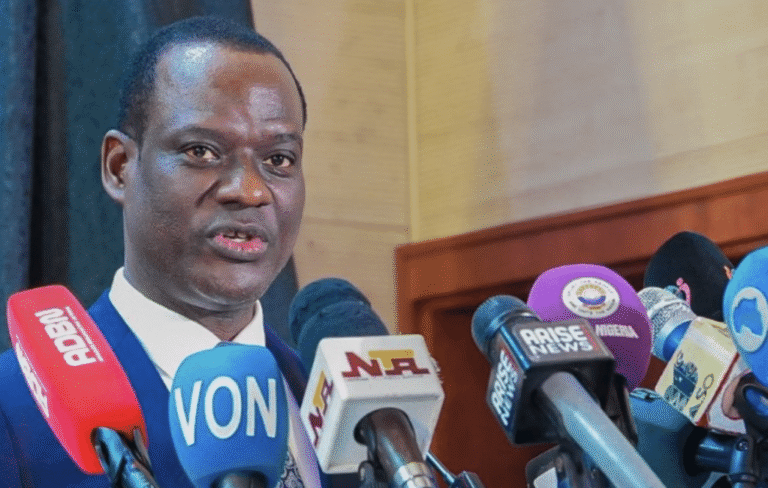
Minister of Power, Chief Adebayo Adelabu, made the call during a meeting with the management of the ECN in Abuja, stressing that stronger synergy between the two agencies would help reposition the power sector and support broader economic growth. According to him, the proposed collaboration would focus on research, data gathering, and coordinated planning to drive domestic manufacturing of critical electricity inputs.
Speaking at the meeting, Adelabu said it was the desire of President Bola Tinubu to put the power sector on a sustainable path, noting that stable electricity supply remains central to the growth of all other sectors of the economy.
“The ECN and REA need to synergise. They need to come together, share research, build data, that will help the sector in local production of the components of electricity. We must do everything possible in this regard as this will make the president to be happy that in his time, we are manufacturing meters and other critical inputs for ourselves,” the minister said.
He added that recent improvements in Nigeria’s trade performance made it even more important to sustain momentum by cutting avoidable imports.
“Today, we are happy that our export is growing higher than our imports and we must encourage this and conserve our foreign exchange,” Adelabu noted.
The minister identified poor data availability as one of the most critical challenges facing the power sector, arguing that effective planning is impossible without reliable information. He said the ministry was working towards establishing a central data pool that would capture inputs from all key stakeholders across the electricity value chain.
“We are going to have a central data pool and you must be part of this process. All the stakeholders in the power sector, including the generation companies (GenCos), the distribution companies (DisCos), will be brought into the data process and this is going to get around all the agencies of the ministry so that we can have reliable data for the sector,” he said.
Adelabu also underscored the importance of research, urging the ECN to work closely with the ministry’s Research Department to strengthen policy formulation and long-term planning. According to him, with better data and research coordination, many of the sector’s long-standing challenges could be tackled more effectively.
To institutionalise cooperation, the minister said the ECN would be integrated into the Power Sector Working Group (PSWG), a quarterly forum that brings together major industry stakeholders. “Although you deal with some other issues according to your mandate, your agency must be part of the working group of the sector,” he said.
Adelabu further highlighted the strategic importance of hydropower in Nigeria’s energy mix, describing it as one of the most reliable sources of electricity globally. He pointed out that Nigeria has over 300 small dams spread across the states, which remain largely underutilised for power generation.
“If we are talking of power generation, the hydro is still the most reliable all over the world. We have over 300 small dams scattered all over the states of the nation. These small dams are very important to us,” he said.
The minister stressed that local capacity in turbine production was critical to unlocking the potential of these dams. “We need local capacity in turbine production as this is the most critical element in the hydro power generation. These turbines are what we must lay emphasis upon. The ministry is ready to support it, as the turbine is the most important part of this process,” Adelabu added.
He also called on state governments to take greater responsibility for power generation, transmission, and distribution within their domains, arguing that decentralised efforts would help ease persistent electricity challenges.
Responding, Director General of the ECN, Dr. Mustapha Abdullahi, expressed the agency’s readiness to work closely with the Ministry of Power and other stakeholders. He said the commission was committed to supporting President Tinubu’s vision of using the power sector as a catalyst to turn around Nigeria’s economy.