Follow Us on Google
From Juliana Taiwo-Obalonye, Abuja
As the rainy season begins, the Federal Government has initiated proactive measures to prevent flooding by strengthening disaster preparedness and risk management nationwide.
In line with this effort, Vice President Kashim Shettima officially launched Nigeria’s anticipatory action framework yesterday. This innovative framework aims to transform disaster management from reactive responses to proactive preparedness by utilising early warning systems, empowering local communities and securing pre-arranged funding to protect lives and livelihoods.
A key component of the strategy involves establishing a dedicated trigger group, comprising meteorological and emergency management agencies that will synthesise data to enable forecasts up to two weeks in advance.
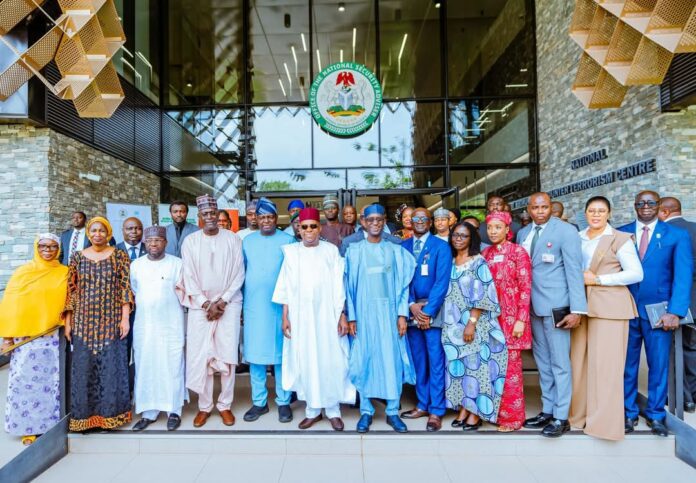
According to a statement by his spokesman, Stanley Nkwocha, the Vice President speaking at a framework validation workshop held at the National Counter Terrorism Centre (NCTC), Office of the National Security Adviser in Abuja, described the framework as a timely intervention to confront the rising threats of climate-induced disasters, such as floods, which affected over five million Nigerians in 2024.
“These disasters are no longer distant threats. They are here, knocking at our doors, sweeping through our streets, flooding our homes and testing not only our moral sensitivity but also the depth of our preparation,” he said.
He stressed the urgent need to dump the costly and inadequate reactive approach to disasters for a more proactive measure.
Shettima added: “For decades, our response has been reactive. We wait for the waters to rise, the homes to vanish and then we scramble for relief. This late arrival of support costs more and saves fewer lives.
“We lose close to five percent of our GDP every year to reactive disaster responses. This approach is not only unsustainable, it is also deeply unjust to the most vulnerable among us. This is why we must act before disasters unfold.”
He explained that the new framework was built on three strategic pillars, including “early warning systems powered by satellite technology and delivered through community-based networks to provide life-saving information in real time.
“The second is pre-triggered financing. No plan can succeed without resources made available before the storm arrives. The third is localised preparedness.
“Studies have shown that anticipatory action can reduce losses by up to 60 percent. That is not just statistics. It is hope. It is the future of millions salvaged before ruin.”
Shettima drew instances from Benue State, where trained volunteers, responding to early warning alerts, evacuated over 80,000 people within 72 hours.
“That is what it means to build early warning systems that work. It’s not just about integrating forecasting tools, but delivering timely alerts in languages our people understand,” the Vice President stated.
The VP further explained that the trigger group is composed of national agencies, including Nigeria Meteorological Agency (NiMet), Nigeria Hydrological Services Agency (NiHSA), National Emergency Management Agency (NEMA), National Space Research and Development Agency (NASRDA) and National Orientation Agency (NOA), working in collaboration with United Nations Office for the Coordination of Humanitarian Affairs (UNOCHA), World Food Programme (WFP), Food and Agricultural Organisation (FAO) and the International Federation of Red Cross (IFRC).
“We cannot leave here with only communiqués and good intentions. We must take ownership of this framework, embed it into our institutions and stay accountable to its promise,” the Vice President told participants at the workshop.
Earlier in his keynote speech, the Minister of Humanitarian Affairs and Disaster Management, Nentawe Yilwatda, emphasised the Tinubu administration’s dedication to advancing the implementation of Nigeria’s anticipatory action framework. He highlighted the need for response agencies and intervention organisations to leverage the national social register as a cornerstone for building a flood-resilient nation, describing the register as a vital component of the country’s resilience infrastructure.
The Minister also advocated for the passage of legislation on risk management and data sharing protocols, the creation of a national risk and sustainable coordination centre, the provision of early funding for anticipatory measures and the use of technology to facilitate real-time monitoring of situations nationwide.
On his part, the United Nations Resident and Humanitarian Coordinator, Nigeria, Mohamed Malick Fall, commended Nigeria for taking the bold step in leading the institutionalisation of coordinated humanitarian response to disasters in the region.
According to him, the rest of West Africa is looking up to what is being done in Nigeria, as successes recorded in the country would permeate the rest of the region.
In his welcome remarks, the National Security Adviser, Nuhu Ribadu, said the workshop is a crucial step towards building a resilient and progressive nation, emphasising that poorly managed disasters can exacerbate insecurity, enable displacement, disrupt critical infrastructure and deepen societal fragilities.
He also noted that efforts aimed at strengthening the anticipatory capacity of the nation are a priority of the Tinubu administration, as it is essential in sustaining lives and securing national assets, among other goals.
On her part, the Special Assistant to the President on Humanitarian Affairs and Development Partners, Inna Audu, said the workshop was designed to accelerate the country’s journey towards a national early warning system that is integrated, inclusive, and anticipatory.
She noted that President Tinubu and Vice President Shettima were deeply committed to building a disaster-resilient Nigeria, stressing that the time for piecemeal responses was over and that stakeholders must shift to systems thinking where data, people and policies are interconnected, and where foresight guides interventions.
There were also goodwill messages from the European Union and representatives of response agencies, development partners, civil society organisations and the private sector, among others.