Follow Us on Google
By Henry Uche
As Nigeria grapples with severe economic hardship, leading experts, industry leaders, and academics have outlined a potential path forward if the government and key stakeholders heed their advice.

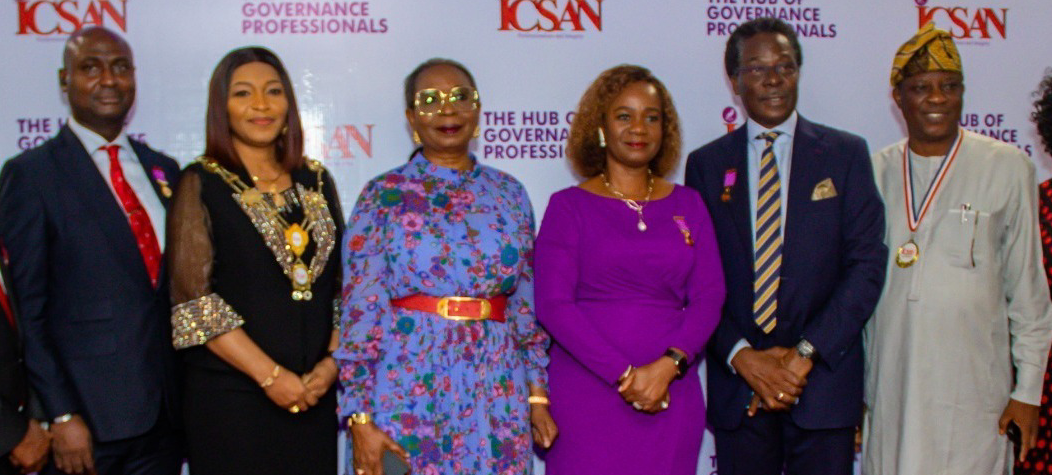
Mr. Francis Olawale, Honorary Treasurer, ICSAN; Mrs. Funmi Ekundayo, President & Chairman of Council, ICSAN; Mrs. Ibukun Awosika, Confab Chairman; Mrs. Uto Ukpanah, Vice President, ICSAN; Mr. Tunde Busari, Past President, ICSAN; Mr. Taiwo Gbenga Owokalade, immediate Past President, ICSAN, at confab.
At the 48th annual conference of the Institute of Chartered Secretaries and Administrators of Nigeria (ICSAN) held in Lagos, the Founder and Chief Executive Officer of The Chair Centre Group, Mrs. Ibukun Abiodun Awosika, emphasised the urgent need for courageous leadership to address the nation’s economic woes. Awosika, who chaired the conference, asserted that the pervasive culture of impunity perpetuates crime and corruption.
She contended that corruption could be eradicated within a year if wrongdoers were met with severe consequences. “Nigeria suffers from inadequate infrastructure and failing public services due to corruption.
We have the right policies, but we lack the will and courage to implement them effectively,” she stated. In her remarks m, ICSAN President, Mrs. Funmi Ekundayo, stressed the importance of professionalising the civil service and enforcing sound corporate governance as key reform strategies. She advocated for the private sector to exemplify ethical conduct and serve as a model of good practice. “The private sector must lead by example and commit to ethical practices,” Ekundayo urged.
Professor Fabian Ajogwu, delivering the keynote address, called for a rigorous intellectual approach to Nigeria’s socio-economic and political challenges.
He highlighted the need for increased transparency and accountability, particularly in procurement practices within the private sector, as corruption in these areas often trickles down to the public sector.
Ajogwu, referencing Nigeria’s high misery index of 73.05% from the 2023 National Bureau of Statistics report, emphasised the need for genuine federalism and a revised academic curriculum to align with global standards.
A Senior Economist and Partner at SPM Professionals, Paul Alaje, criticised Nigeria’s heavy reliance on imports for survival, asserting that such dependency hinders national progress. While acknowledging the government’s support for innovation, Alaje pointed out that Nigeria lags in the digital economy compared to other nations. “Government intentions may be right, but are they executing them effectively? If their efforts are not visible and impactful, then they fall short,” he observed.
Panelists at the conference unanimously urged the government to shift focus from politics to effective governance, particularly emphasizing support for micro, small, and medium-sized enterprises (MSMEs). They called for Nigerians to prioritize long-term benefits over short-term gains and to place competent individuals in key positions to drive progress. “We must define our goals and work diligently to achieve them. Properly positioning the right people in the right roles is crucial for our advancement,” the panel concluded.