Follow Us on Google
…How to avoid falling victim
By Maduka Nweke
Land grabbing has become a major obstacle to real estate development in Nigeria.
Disputed ownership, illegal sales, communal conflicts and weak enforcement of land laws continue to delay projects, raise property prices and discourage investors.
Experts say the problem has grown alongside rapid urbanisation and rising demand for land, particularly in major commercial centres such as Lagos, Abuja and Port Harcourt. As more people seek land for housing, commercial activities and investment, unscrupulous individuals and groups have exploited gaps in the land administration system to illegally acquire, sell or lay claim to properties.
Land grabbing generally refers to the controversial acquisition or control of land through ownership claims, leases, force, fraud or other unlawful means, often without the consent of legitimate owners or communities.
While land acquisition can support agricultural expansion, infrastructure and economic development when properly regulated, illegal land grabbing has the opposite effect. It creates uncertainty over property ownership, increases the cost of development and can leave investors with properties they cannot develop.
To avoid falling victim to Nigeria’s land crisis, experts say buyers should conduct thorough due diligence before paying for any property. Verify the title, ownership, survey plan and government acquisition status at the relevant state land registry. Engage a qualified lawyer and licensed surveyor, inspect the property physically and investigate its history. Avoid rushed transactions, unusually cheap offers and cash payments without proper documentation. Always ensure the transaction is legally documented and registered.
Land disputes create artificial scarcity
Dr Innocent Merckson Okoro, Principal Partner, MI Okoro and Associates, said the government has a major responsibility to prevent individuals and groups from taking control of land illegally.
He explained that under the Land Use Act, land in each state is vested in the governor, who holds it in trust for the people and administers it for the benefit of Nigerians.
According to him, individuals or groups cannot simply assume control of land and transact on it without the appropriate government authority.
He said where land grabbing persists despite government powers, the state must be held accountable for failing to enforce the law.
“If the government looks aside and allows it to continue, then, depending on the location and the purpose for which the land is meant, the government becomes culpable,” Okoro said.
He warned that the consequences are particularly severe when land earmarked for residential development is affected.
“If the land grabbing is getting too much on lands that were meant for residential purposes, what that means is that it will affect the supply of land available for residential development,” he said.
The implication, he explained, is straightforward: when the supply of developable land falls while demand remains high, the price of the available land rises.
“This means that the available lands, depending on the location, will become extraordinarily expensive because we now have very few lands, whereas so many people will be chasing the land for developmental purposes,” he said.
The pressure eventually spreads to house prices and rents, making accommodation more expensive for ordinary Nigerians.
Developers caught in the middle
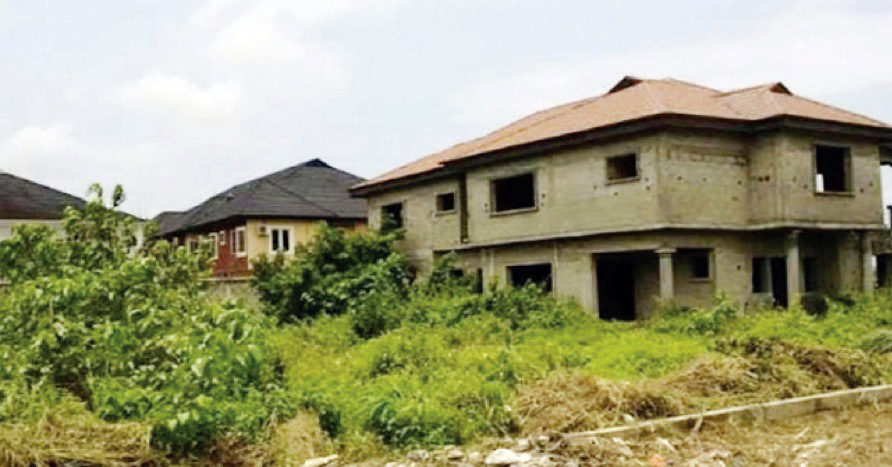
For real estate developers, the problem is not limited to the money lost when a disputed property is acquired. A development project can remain abandoned for months or even years while ownership disputes are resolved.
A developer may purchase a property, commence preliminary work and suddenly receive an order to stop construction because another individual, family, community or government agency has raised a claim over the land.
In such situations, funds already committed to the project become tied down. Construction materials may deteriorate, contractors may leave the site and financing costs may continue to accumulate.
The project may also lose value because of delays.
Dr Godwin Alenkhe, National President of the Estate Rent and Commission Agents Association of Nigeria (ERCAAN), said the activities of land grabbers, popularly known in some parts of the country as “Omonile”, have adversely affected property development, particularly in Lagos.
He said the activities of such groups create fear and uncertainty for genuine investors.
“They turn land into a risk asset instead of a development asset,” Alenkhe said, noting that the activities of land grabbers add cost and delay to property development.
According to him, some groups sell land that has not been properly approved or to which they have no legal title, often targeting investors who fail to conduct adequate due diligence.
The result is that a person who intended to invest in housing or commercial property could instead find himself locked in a lengthy ownership dispute.
Weak enforcement fuels the crisis
Although some states have enacted laws aimed at tackling land grabbing, experts say legislation alone cannot solve the problem.
Weak enforcement, bureaucratic delays, poor record-keeping and alleged corruption within land administration systems continue to provide opportunities for fraudulent activities.
Obtaining proper land documentation can sometimes be slow and cumbersome. Where land registries are not adequately digitised and records are difficult to access, it becomes easier for fraudsters to manipulate documents or create competing claims over the same property.
A developer who cannot quickly establish the ownership history of a property is exposed to considerable risk.
According to experts, modernising land registries and making property records easily accessible would significantly reduce disputes.
Digitisation would also make it easier for buyers, developers, surveyors, estate agents and financial institutions to verify ownership before committing money to a property.
Communal disputes worsen the problem
Another major source of land disputes is conflict between communities.
Okoro cited an example in Anambra State, where he alleged that more affluent and populated communities sometimes encroach on the land of smaller neighbouring communities.
He referred to a situation in Ayamelum Local Government Area involving Omor and Igbakwu communities, warning that prolonged disputes over land could degenerate into violent conflict if the government fails to intervene.
Such disputes do not only threaten peace. They also make large portions of land unavailable for legitimate development.
Where a developer purchases land in a disputed area, the project can become stranded until the underlying dispute is resolved.
This creates what experts describe as an artificial scarcity of developable land.
Unclear titles make matters worse
Moses Ogunleye, Managing Director of MOA Planners Limited, said the persistence of land grabbing raises questions about the effectiveness of the Land Use Act and land administration generally.
He argued that if the provisions of the law were effectively implemented, the widespread incidence of illegal land grabbing should be significantly reduced.
Ogunleye advised prospective property buyers and developers to conduct thorough searches and verify the status of land before paying for it.
“Anyone who intends to invest in a property should verify the status before putting down the money,” he said.
He added that where land disputes involve violence or the use of arms, the matter should be treated as a criminal offence rather than merely a civil disagreement.
Unclear boundaries, unregistered communal land and inheritance disputes also create openings for third parties to make fraudulent claims.
Experts say proper surveying, mapping and registration of properties would make it much harder for outsiders to invade or sell land that does not belong to them.
Multiple sales deepen investors’ problems
Multiple sales of the same property are another major problem in Nigeria’s real estate market.
In some cases, unscrupulous landowners or intermediaries sell one plot to several buyers, leaving the victims to fight over the same property.
Some fraudulent sellers also use different individuals or companies to execute separate transactions involving the same land.
By the time the fraud is discovered, several buyers may have valid-looking documents relating to the same property.
Such disputes can be difficult and expensive to resolve, particularly where documentation is incomplete or poorly recorded.
For investors, the lesson is that possession of a sale agreement or other transaction document does not automatically eliminate the need for comprehensive title verification.
Poverty and unemployment
Experts also link the rise of land-grabbing syndicates to unemployment and economic hardship.
In communities where job opportunities are limited, some youths may be recruited into groups involved in illegal land transactions, intimidation and encroachment.
While poverty does not excuse criminality, experts argue that the government must address the economic conditions that make young people vulnerable to recruitment by criminal networks.
The responsibility, however, does not rest solely on individuals.
Government agencies have the legal and institutional powers to identify, prosecute and dismantle organised land-grabbing networks.
Other News
Big investors and rural land
The land question extends beyond urban property development.
At the national level, large-scale acquisitions of rural land by investors and agribusinesses can also create tension where local communities believe they have been dispossessed of their traditional land.
Although large agricultural investments can generate employment, improve food production and provide infrastructure, experts say such projects must respect existing land rights and involve affected communities.
Where communities are excluded from negotiations or compensation arrangements are unclear, disputes can emerge and eventually affect investment.
A threat to housing supply
The impact of land grabbing goes beyond developers and property owners.
Nigeria already faces a significant housing challenge, and anything that reduces the supply of land available for legitimate development can make the situation worse.
When developers spend years resolving land disputes rather than constructing homes, the number of houses entering the market falls.
At the same time, demand continues to rise as Nigeria’s population grows and more people move into urban centres.
The combination creates pressure on rents and property prices.
Okoro said government intervention was therefore necessary to prevent land grabbers from creating artificial scarcity.
“The government is supposed to intervene seriously in order not to assist the so-called illegal speculators to create an artificial scarcity of land,” he said.
The way forward
Experts believe Nigeria needs a comprehensive reform of its land administration system.
First, state land registries must be fully digitised and interconnected where possible. Property ownership, survey plans, titles, transfers and encumbrances should be properly recorded and easily verifiable.
Second, government agencies responsible for land administration must reduce bureaucratic bottlenecks. Delays in issuing titles and processing property documents create opportunities for middlemen and fraudulent actors.
Third, anti-land-grabbing laws must be properly enforced. Perpetrators should face swift prosecution and meaningful penalties to discourage others.
Fourth, communities must be encouraged to properly document and register their land, while disputes should be resolved through established legal channels before they escalate into violence.
Fifth, prospective buyers and developers must carry out proper due diligence before committing funds. They should verify the ownership history, survey plan, title documents, government acquisition status and any existing encumbrances on a property.
Government ministries responsible for lands, housing and urban development also need stronger coordination to ensure that illegal developments and transactions are detected early.
Ultimately, the fight against land grabbing is not simply about protecting individual property owners. It is about creating an environment where housing projects can be completed, businesses can invest with confidence and land can serve as a productive economic asset rather than a source of endless disputes.
Until Nigeria strengthens land administration, improves transparency and ensures that those who illegally seize or sell land face consequences, developers will continue to face uncertainty, investors will remain cautious and valuable projects will remain stalled.
The country cannot achieve sustainable real estate growth when the very land on which development depends remains entangled in disputes, fraud and weak enforcement.
PeeDeep Arcade raises shop prices to N1.2m/square metre
PeeDeep Arcade Properties Limited (PAPL), owners of Acada Arcade Shopping Complex in Ojo, Lagos, has announced new prices for shop units at the complex, citing rising construction costs, statutory charges and ongoing infrastructure development.
The new price regime will take effect from August 17, 2026, according to a statement signed by PAPL’s Head of Marketing, Funmi Odetola.
Under the new pricing structure, ground-floor shop units will sell for N1.2 million per square metre, while first-floor units will cost N1.1 million per square metre.
The company said the revised prices reflect the increased cost of delivering the shopping complex and the infrastructure required to provide a functional and sustainable commercial environment.
“These prices are all-inclusive and reflect the enhanced scope of construction and infrastructure delivery at the Acada Arcade Shopping Complex,” the management said.
The company explained that the price adjustment was driven by prevailing economic conditions, particularly increases in construction costs and statutory charges.
It added that ongoing infrastructure upgrades were also necessary to improve the operating environment for businesses within the complex.
One of the major projects currently underway is the installation of a transformer, which the company said is aimed at providing a more reliable and stable electricity supply to businesses operating at the shopping complex.
“As part of ongoing development works, critical infrastructure—most notably the transformer installation project—is currently underway to ensure a reliable and stable power supply for businesses within the complex,” the company said.
PAPL said the new pricing was introduced with the aim of ensuring that subscribers continue to receive value from their investments despite the rising cost of delivering the project.
The company also thanked its subscribers and other stakeholders for their patience and continued support as development work progresses.
“PeeDeep Arcade Properties Limited appreciates the patience, understanding, and continued trust of its subscribers and stakeholders. We remain steadfast in our commitment to transparency, quality delivery, and long-term value creation,” the company said.
The latest price adjustment comes amid rising costs across Nigeria’s construction and real estate sectors, with developers facing higher expenses for building materials, labour, infrastructure and statutory approvals.
For prospective shop owners and investors, the new rates mean that the cost of acquiring commercial space at Acada Arcade will depend on both the size and floor of the shop unit.
PAPL said it remains committed to completing the ongoing infrastructure works and delivering a commercial complex capable of supporting businesses and providing long-term value to subscribers.
16 Alexander Tower: Developers assure safety, December 2027 delivery
The developers of 16 Alexander Tower, a 21-storey luxury residential development in Ikoyi, Lagos, have assured investors and prospective buyers that the project will be completed by December 2027.
The assurance was given during a facility tour of the project organised for members of the Property and Environment Writers Association of Nigeria (PEWAN), officials and other stakeholders.
Engineer Akin Ayankoya, accompanied by representatives of the contractors handling the project, led the tour of the high-rise development.
The project is being marketed by M.I. Okoro and Associates in partnership with Cappa D’Alberto.
Speaking during the tour, Dr. Innocent Okoro, Principal Partner of M.I. Okoro and Associates, said the project was being developed as a secure long-term investment and was built to meet strict international safety and structural standards.
Okoro said construction of the luxury residential tower had reached the 17th floor, leaving four more floors to complete the 21-storey building.
He said the development, which comprises 54 high-end residential units, sits on a 4,276.216-square-metre site in one of Lagos’ most sought-after residential districts.
According to him, the tower was designed to make efficient use of the available space while ensuring adequate movement and circulation within the premises.
The development is expected to offer a range of luxury facilities designed to provide residents with comfort, security and recreation.
These include a wellness and recreation clubhouse, infinity swimming pool, modern gymnasium, sauna and spa, squash court, yoga and meditation area, 24-hour concierge and security services, panoramic views of Lagos and dedicated parking spaces for residents and visitors.
Okoro said the recreational facilities would be located on the sixth floor.
“Recreational facilities would be located on the sixth floor to provide privacy and exclusive access for residents and their accredited guests,” he said.
He explained that the facilities were planned to give residents access to leisure and wellness services without compromising privacy and security.
Okoro also described the project as a premium investment opportunity, citing its location, construction quality and range of facilities as factors that could support strong rental demand and long-term returns.
He expressed confidence that the strategic location of the tower in Ikoyi, combined with its luxury features and construction standards, would make it attractive to both residents and property investors.
According to him, the developer is committed to completing the project to the expected standard and delivering a development that would contribute to the changing skyline of Ikoyi.
The assurance of safety is particularly significant for a 21-storey residential development, as prospective buyers and investors are increasingly demanding evidence that high-rise buildings meet approved structural and safety requirements.
The developers said the project was being executed with emphasis on structural integrity, quality construction and the provision of supporting infrastructure.
With construction currently at the 17th floor, the developers said they remain on course to complete the remaining four floors and deliver the project by December 2027.
The development is expected to add another luxury residential option to Ikoyi, where demand for high-end housing has remained strong due to the area’s location, infrastructure and proximity to major business districts.
Okoro said the combination of location, quality construction and luxury amenities would position 16 Alexander Tower as a valuable addition to the Lagos luxury property market.
He reiterated the commitment of the project team to delivering a world-class residential tower that meets international standards while providing investors with long-term value.