Follow Us on Google

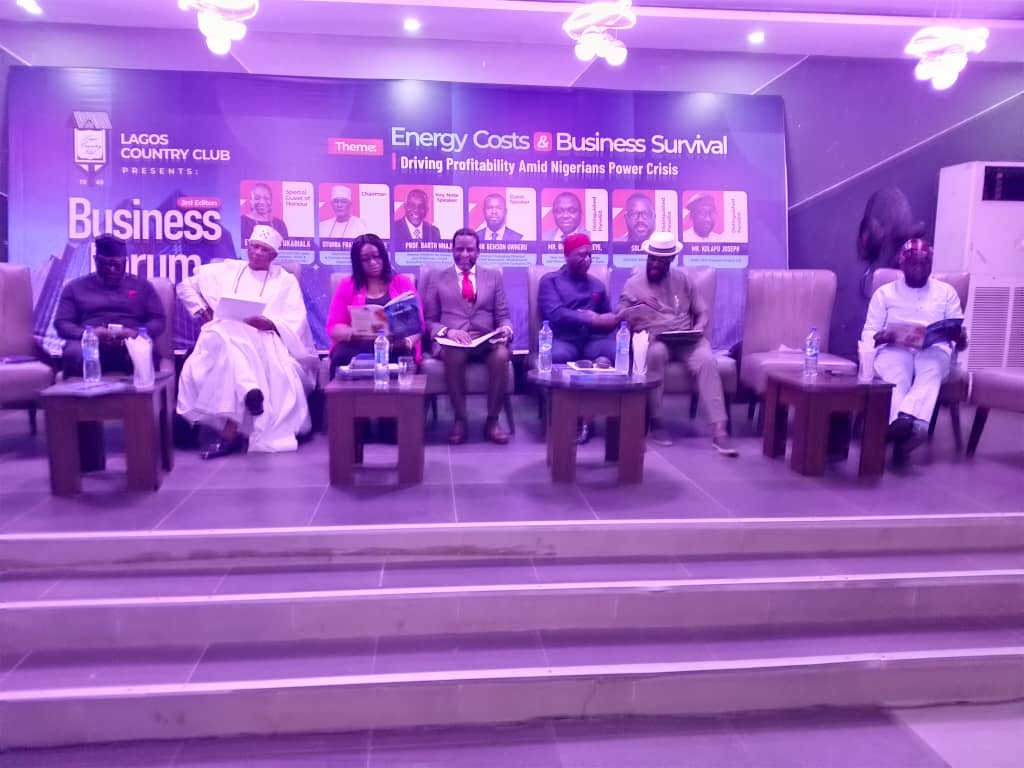
Former Minister of Power and Chairman of Geometric Power Group, Prof. Barth Nnaji, has blamed Nigeria’s persistent electricity crisis on flaws in the privatisation of the power sector, alleging that investors who acquired electricity assets were driven largely by expectations of quick profits without adequate technical expertise, financial capacity or appreciation of the long-term investment required to deliver reliable power.
Nnaji warned that the manner in which the privatisation was conducted also exposed Nigerian banks to enormous financial risks, with outstanding power sector loans reportedly exceeding N7 trillion, a situation he said could have threatened the stability of major financial institutions without government intervention.
Speaking at the Lagos Country Club’s Business Forum 3.0, themed “Energy Costs and Business Survival: Driving Profitability Amid Nigeria’s Power Crisis,” the former minister said many investors approached the acquisition of electricity assets with expectations similar to the windfall recorded in the telecommunications industry, only to discover that the power business required substantially more capital, technical competence and patience.
He maintained that the emphasis on immediate profitability, rather than the development of reliable electricity infrastructure, contributed to the difficulties confronting generation and distribution companies and, ultimately, the continued inability of the sector to meet the country’s electricity needs.
“The unethical manner the privatisation was carried out also threatened the Nigerian banking system. If not for the Federal Government’s intervention through subsidies, the power sector loans that now amount to over N7 trillion, according to the Association of Power Generation Companies of Nigeria, the major banks that participated in the privatisation would perhaps have gone under. The electricity business everywhere requires a huge capital outlay,” he said.
Nnaji explained that electricity infrastructure required long-term financing because investments could take between seven and 10 years to break even, making the sector unsuitable for investors primarily interested in immediate returns.
“The power business requires a long gestation period and therefore, patient investment. It can take between seven and 10 years for some power sector investments to break even and post a profit.
“So, passion rather than only profit motive is a critical driver in the electricity business, the passion to end a key national deficit and provide the required infrastructure,” he stated.
The former minister cited the Aba Integrated Power Project in Abia State as an example of how dedicated generation and distribution infrastructure could improve electricity reliability and support industrial activities.
According to him, more than 96 per cent of consumers within the project’s service area had been metered, while customers were benefiting from reliable electricity supply, which he described as a demonstration of the possibilities available when power infrastructure was developed with adequate technical planning and a long-term commitment.
He traced the origins of the Aba project to his experience in Abuja in 2001, when he led a team of engineers that developed the 22-megawatt Abuja Emergency Power Plant.
Nnaji said the facility supplied electricity to the State House, headquarters of the Nigerian National Petroleum Corporation and Central Bank of Nigeria, the Federal Secretariat and the Abuja Business District for 28 months without interruption.
He explained that the Abuja facility operated independently of the national grid, an experience that convinced him that a similar arrangement could be replicated on a larger scale to serve industrial and commercial consumers.
The decision to develop the Aba Integrated Power Project, he recalled, followed discussions involving former World Bank President James Wolfensohn and former Minister of Finance Ngozi Okonjo-Iweala, who visited Aba in March 2003 and interacted with manufacturers over the challenges confronting their businesses.
According to Nnaji, small, medium and large-scale manufacturers identified unreliable and poor-quality electricity as the greatest obstacle to their operations, prompting the two officials to encourage him to develop a dedicated power project for the industrial city.
He said the decision was motivated by the desire to address a major infrastructure deficit rather than maximise investment returns.
“At Geometric Power, we do not see ourselves as a team out to make maximum profit; we rather see ourselves as a group dedicated to enabling manufacturing firms, hospitals, laboratories, schools, markets and other stakeholders to do their businesses effectively and efficiently.
“By enabling industrialists and other stakeholders to operate well, our nation will record significant progress and there will be peace, harmony and stability in our society,” he stated.
Nnaji argued that a purely commercial assessment might have favoured locating the project in the industrial estates of Lagos or Ogun states, where returns on investment could have been higher.
“If it were for profit, we, perhaps, would not have established the integrated electricity project in Aba, but in more lucrative locations such as the industrial estates in Lagos and Ogun states, where return on investment would have been much higher,” he said.
The former minister warned that Nigeria’s ambition to build a trillion-dollar economy would remain difficult to achieve without reliable and affordable electricity, stressing that industrialisation, manufacturing, healthcare, education and other productive activities depended on adequate power supply.
He maintained that the country possessed sufficient natural resources, technical expertise and private sector capacity to overcome its electricity challenges if policymakers prioritised national development above personal interests.
According to him, reliable electricity was achievable “if we place the country above self-interest, if we take bold steps instead of small inconsequential ones and if we decide to wilfully lift our business community and our people from energy poverty.”
“We have all that it takes to achieve this within a short timeline. We have the fuel in abundance to be harvested, we have the talented private sector that can engage to build the infrastructure in collaboration with international investors. It is now up to our leaders to find the altruistic will to undertake the journey,” he said.
Earlier, the President of Lagos Country Club, Seyi Adewunmi, warned that repeated national grid failures, rising fuel prices and escalating energy costs had placed Nigerian businesses under severe financial pressure, threatening profitability, competitiveness and employment.
Adewunmi described electricity as indispensable to modern economic activities, noting that manufacturers, small businesses and large corporations were spending substantial resources on diesel, petrol, generators and alternative energy systems to remain operational.
“Where power is unreliable and energy is costly, businesses are compelled to spend heavily on diesel, petrol, generators and alternative energy systems. Manufacturers bear higher production costs; small enterprises watch their margins shrink and even our largest corporations find their competitiveness steadily eroded.
“For many, the question is no longer how to grow, but how to survive, how to preserve jobs and how to remain profitable,” he said.
He argued that Nigeria’s electricity challenge was no longer principally about identifying the problems confronting the sector but implementing practical solutions capable of translating the country’s energy resources into reliable and affordable supply.
The club president called for increased investment in electricity generation, removal of transmission and distribution bottlenecks, greater adoption of decentralised power solutions and improved commercial discipline, transparency and accountability across the electricity value chain.
He also urged businesses to embrace energy-efficient technologies, improved building designs and renewable energy solutions, including solar power and battery storage, to reduce their operating costs.
“We cannot afford to sit passively by. We must adopt energy-efficient technologies, smarter building designs and renewable solutions such as solar power and battery storage to bring our overheads under control,” he said.
Adewunmi stressed that resolving the electricity crisis required cooperation among government institutions, regulators, financial institutions, electricity companies and consumers, with the government providing consistent policies and investors committing resources to long-term infrastructure development.
Chairman of the occasion and immediate past President of Lagos Country Club, Francis Meshioye, described rising energy costs as one of the greatest threats to business survival in Nigeria.
Meshioye claimed that energy expenses were consuming as much as 60 per cent of operating profits in some businesses, while expenditure on alternative electricity generation exceeded N1.34 trillion in 2025.
He warned that the burden had moved beyond infrastructure concerns to become a direct threat to business sustainability, job security and economic competitiveness.
“It means that Nigeria’s power challenge has become a matter of business survival, far beyond infrastructure. Each litre of generator fuel burned, every hour lost to blackouts and every extra naira spent on electricity erodes business profitability and threatens sustainability,” he said.
He urged participants to move beyond identifying familiar problems and concentrate on practical solutions, including cost-effective energy options that businesses could implement to improve efficiency and reduce operating expenses.
“Let us share experiences, challenge assumptions, identify opportunities, and develop solutions that businesses can implement to advance sustainability in Nigeria. Let us also remember that the survival of Nigerian businesses has implications far beyond company balance sheets,” Meshioye stated.