Follow Us on Google
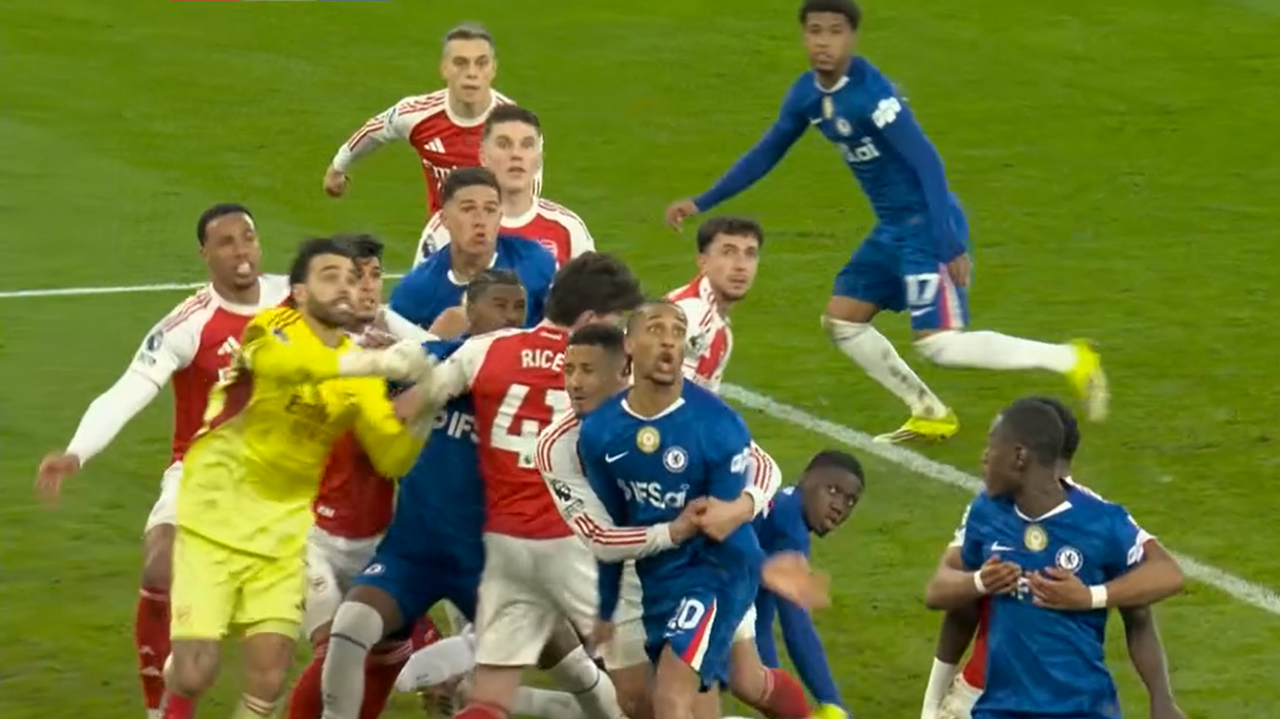
Premier League referees will take a tougher stance on holding and grappling during set pieces this season, with officials instructed to penalise actions that clearly affect play.
The laws of the game have not changed, but referees across the Premier League, English Football League and Women’s Super League have been told to act more decisively against deliberate holding.
The renewed focus is on what officials describe as “non-footballing holding actions” situations where players focus solely on restraining opponents rather than attempting to play the ball.
Players who use both arms to hold opponents, repeatedly grab them or pull their shirts could therefore face greater scrutiny, particularly during corners and free-kicks.
Defenders who deliberately turn their backs to an incoming delivery while holding an attacker to restrict his movement could also be penalised under the approach.
Premier League referees’ chief, Howard Webb, said officials had been encouraged to rely less on warnings and take action when they identify offences.
“We’re trying to get the officials to be as confident as they can be to penalise what they see,” Webb said.
“So fewer warnings, more actions penalised, and if there’s any reduction in offences being penalised it should be a result of a modification of player behaviour rather than us no longer applying it,” he added.
The tougher approach follows concerns over missed VAR interventions last season. Of the 20 missed interventions identified, five involved penalties that were not awarded after players were wrestled to the ground away from the ball.
However, Webb stressed that officials would not treat every physical challenge as an offence, particularly in situations involving goalkeepers. Ordinary contact will not automatically lead to a goal being disallowed.
A goalkeeper whose movement is clearly restricted, such as having an arm held back, could nevertheless see an offence given.
The change could have a significant impact on set-piece tactics, with Premier League clubs scoring a record 269 goals from set pieces last season, excluding penalties and direct free-kicks. Those goals accounted for 25.7 per cent of all goals scored in the league.
Arsenal led the league with 25 set-piece goals, followed by Manchester United with 21 and Tottenham Hotspur with 19. Liverpool, meanwhile, conceded a league-high 19 goals from set pieces.
Webb said the objective was not to remove physicality from football but to prevent players from using holding as a tactic unrelated to competing for the ball.
“If we start penalising offences, players have to adjust their tactics,” he said. “And then those kinds of situations reduce in number.”
The new approach will place greater responsibility on players and coaches to adjust their set-piece tactics, while referees will be expected to apply the standard consistently throughout the season.