Follow Us on Google
By Adewale Sanyaolu
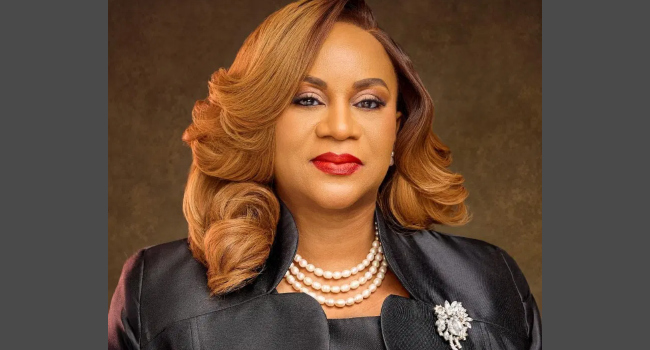
The Chief Executive Officer of Falcon Corporation Limited, Audrey Joe-Ezigbo, has urged Nigeria’s energy industry to strengthen its commitment to appointing more women to top leadership positions, particularly across the gas value chain.
Joe-Ezigbo said the growing number of women occupying strategic leadership positions across Nigeria’s energy sector signals an important shift in an industry historically dominated by men.
According to her, the emergence of female chief executives and managing directors in recent years demonstrates that the sector is gradually embracing merit-driven leadership and expanding its talent pool.
She pointed to several women who have risen to influential roles in the industry, including Olu Arowolo Verheijen, Special Adviser to the President on Energy, whose policy advocacy has elevated national conversations around energy reforms and investment.
She also cited Oritsemeyiwa Amanorisewo Eyesan, the Chief Executive Officer of the Nigerian Upstream Petroleum Regulatory Commission(NUPRC), describing her appointment as a historic development for regulatory leadership in the upstream sector.
Joe-Ezigbo also acknowledged other prominent female leaders shaping the industry, including Folake Soetan, Managing Director of Ikeja Electric; Jennifer Adighije, Managing Director of Niger Delta Power Holding Company; Wola Joseph-Condotti, Interim Chief Executive Officer of Eko Electricity Distribution Company; and Elozino Olaniyan, Chief Executive of Midwestern Oil & Gas Company.
The Falcon Corporation boss also highlighted leading figures in the upstream segment such as Catherine Uju Ifejika of Brittania-U Nigeria Limited and Seinye Lulu-Briggs of Moni Pulo Limited.
According to her, the readiness of boards and shareholders to entrust women with high-level operational and strategic responsibilities reflects a maturing industry that increasingly recognises competence, discipline and vision as qualities that transcend gender.
“Each of these appointments sends a powerful message beyond boardrooms and balance sheets,” Joe-Ezigbo said.
“It tells the world that Nigeria’s energy sector is prepared to compete on the strength of its full talent pool. It reassures investors that leadership selection is becoming more merit-driven and, most importantly, it sends a clear signal to the girl child that no part of the energy value chain—from the control room to the executive suite—is beyond her reach.”
She commended organisations that have made what she described as bold decisions to place women in charge of complex and capital-intensive operations, noting that such steps not only strengthen corporate governance but also enhance institutional credibility and long-term sustainability.
Shell emphasised that Nigeria’s gas sector is entering a defining period as the country seeks to deepen domestic gas utilisation to support industrialisation and energy security. She stressed that leadership diversity must grow alongside infrastructure expansion if the sector is to deliver sustainable and resilient growth.
“As we build pipelines, expand distribution networks and finance critical gas infrastructure, we must also build leadership systems that reflect inclusion and foresight,” she said.
“Gas is central to Nigeria’s energy transition story, and the leadership shaping that future must reflect the diversity of the nation it serves.”
She added that the current decade presents a rare opportunity for the industry to reset expectations about leadership in the energy sector, urging boards, regulators and investors to institutionalise inclusive succession planning rather than treat the appointment of women to top positions as isolated milestones.
“At Falcon, inclusion is not a campaign theme but a governance principle,” she said.
“The progress we are witnessing across the sector should not be episodic. It should be sustained, measurable and irreversible.”
Joe-Ezigbo noted that International Women’s Day provides the energy industry with an opportunity not only to celebrate achievements but also to reinforce momentum toward a more inclusive future, where the next generation of female engineers, economists and energy executives can thrive in a sector defined by merit, opportunity and equal access to leadership.
Established in 1994, Falcon Corporation Limited is a wholly indigenous energy company with operations across Nigeria’s midstream and downstream sectors. The company serves as the licensed Local Distribution Company responsible for developing and operating gas infrastructure supplying natural gas to industrial and commercial customers in Ikorodu, Lagos State. Falcon has also expanded into the liquefied petroleum gas market through trading, distribution and major infrastructure investments, including an LPG tank farm and jetty facility.
The company is part of Optimera Energy, a consortium implementing a 20-year gas infrastructure development project with the Lagos Free Zone Company to build and operate a gas distribution network for businesses within the zone. Falcon says its operations are anchored on strong corporate governance, operational excellence and sustainable value creation for stakeholders. Its financial strength has been affirmed by an ‘A’ long-term and ‘A1’ short-term credit rating from Agusto & Co.