Follow Us on Google


From Idu Jude, Abuja
Six years after the violent suppression of peaceful demonstrations in Nigeria, Corporate Accountability and Public Participation Africa (CAPPA) has called on the Federal and Lagos State Governments to tender an unreserved public apology for the Lekki Toll Gate massacre.
Alongside these, CAPPA listed its full official acknowledgement and redress for killings, injuries, and related abuses committed nationwide during the #EndSARS protests.
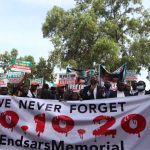
Marking the sixth anniversary of the October 20, 2020, shootings, the organisation maintained that the Nigerian state had to directly confront this legacy of bloodshed through independent prosecutions, comprehensive reparations, and structural police reforms, urging political parties and aspirants to make these non-negotiable commitments central to their platforms ahead of the 2027 general elections.
The organisation observed that the enduring tragedy of #EndSARS lay in the bitter irony that a civic movement organised to resist police terror was crushed by the very state violence it sought to dismantle.
Recall that the #EndSARS protests began as a nationwide outcry against systemic police brutality, especially the abuses of the now-disbanded Special Anti-Robbery Squad (SARS). Public outrage boiled over on October 3, 2020, after a viral video showed SARS operatives shooting a young man outside Wetland Hotel in Ughelli, Delta State, and driving off in his car. The footage quickly pushed anger from social media onto the streets, transforming the demonstrations into a broad movement demanding accountability and respect for human rights.
In her remarks, Zikora Ibeh, CAPPA’s Assistant Executive Director, stated that a peaceful protest against police brutality was answered with bullets, and that the state compounded that violence by disputing the suffering of its victims. She maintained that an unreserved apology had to begin with the government accepting responsibility, naming the wrongs committed, and bringing those responsible to justice.
CAPPA recalled that the Lagos State Judicial Panel of Inquiry, in its comprehensive 309-page report, had characterised the crackdown as a “massacre in context,” directly indicting the Nigerian Army and police for the deaths and severe injuries of peaceful demonstrators. The organisation rebuked state authorities for denying the truth and dodging accountability, noting that the Federal Government outrightly dismissed the panel’s findings, while the Lagos State Government issued an insensitive administrative White Paper disputing the casualty records.
CAPPA further highlighted the landmark July 2024 judgment of the ECOWAS Community Court of Justice, which found the Federal Republic of Nigeria liable for violating protesters’ fundamental rights to freedom of expression, assembly, association, and freedom from torture, ordering financial compensation for victims alongside fresh, independent investigations. CAPPA demanded the prompt, complete implementation of the regional court’s ruling and a transparent public report on compliance.
The urgency of judicial accountability was further underscored by the conclusion of the post-mortem examination of 20-year-old journalist Pelumi Onifade. Onifade was attacked and arrested by personnel of the Lagos State Task Force on October 24, 2020, while covering protest-related events at the Ministry of Agriculture Abattoir complex in Oko-Oba, Agege. Just four days earlier, on October 20, 2020, he had filmed political figure Abiodun Bolarinwa firing live rounds at unarmed #EndSARS demonstrators in the Abule Egba area of Lagos.
The official autopsy confirmed that Onifade died from a fatal gunshot wound to his lower torso. Although this medical finding was documented in late 2020, it was suppressed until its formal presentation before the coroner’s court in 2026. CAPPA demanded conclusive criminal proceedings and the immediate prosecution of the Task Force personnel and commanding officers responsible for his death.
The civil society organisation pointed out that its investigative publication, “Lies and the Hail of Bullets: #EndSARS—The Story of Lekki Shootings by Survivors,” preserved the lived experiences that official propaganda could never erase. Beyond administrative disputes over casualty tallies, the report documented how the violent assault shattered bodies, livelihoods, and families. The organisation observed that prolonged official denial and persistent intimidation had deepened disillusionment among young citizens who believed collective democratic action could reform the nation, forcing several participants into hiding or painful self-exile, while survivors continued to cope with unhealed physical and emotional trauma without state support.
CAPPA noted that subsequent events showed the underlying drivers of the #EndSARS demonstrations remained unaddressed, with the state maintaining a repressive posture toward peaceful assembly. This pattern was evident during the August 2024 #EndBadGovernance protests across several Nigerian states, where citizens, including minors, took to the streets over severe economic hardship and governance failures. Security forces met the demonstrations with tear gas, arbitrary arrests, and lethal force that resulted in at least 24 deaths documented across the country.
Ibeh warned that when government policies deepen hardship and security forces attack those who object, citizens are denied both a decent life and the means to demand one. She stressed that protest and free speech remained indispensable democratic tools for ordinary people confronting entrenched power, reiterating that no government earned democratic legitimacy by frightening its people into silence.
CAPPA also flagged the widespread abuses documented at Tiger Base—the notorious Anti-Kidnapping Unit of the Imo State Police Command in Owerri—including torture, extrajudicial executions, extortion, and prolonged arbitrary detention. These reprehensible acts, the organisation noted, reflect the persistent culture of police violence across Nigeria.
Addressing ongoing proposals for state police, driven largely by chronic and widespread insecurity, CAPPA warned that decentralisation alone cannot resolve Nigeria’s policing crisis. The organisation maintained that without dismantling the prevailing culture of impunity, such measures would fail to protect vulnerable citizens and instead multiply instruments of coercion across sub-national entities. Meaningful reform, it argued, requires decisive political will to fundamentally alter whom law enforcement serves, strictly regulate the use of force, and guarantee swift criminal consequences for abusive personnel.
To address the traumatic memory of the #ENDSARS protests, CAPPA called on the Nigerian government to institute a transparent national programme of acknowledgement, justice, and reparations, developed in close coordination with victims’ families, survivors, human rights and media-rights groups, civil society organisations, and the National Human Rights Commission (NHRC). This national agenda, it said, must encompass prosecution of implicated officers and the settlement of all unpaid compensation, including sustained medical and psychological rehabilitation for survivors.
The advocacy group also urged authorities to drop all outstanding charges against people prosecuted solely for participating in peaceful protests, including the #EndBadGovernance demonstrations, and formally designate the Lekki Toll Gate as a national historic memorial site.
To strengthen police accountability, CAPPA called for the mandatory deployment and use of body-worn cameras by frontline police personnel, backed by secure and independently supervised storage, access to recordings for lawful investigations, and penalties for deliberate deactivation and tampering with footage. The organisation demanded prompt and transparent investigations into allegations of misconduct, insisting on disciplinary sanctions and criminal prosecution for culpable security agents.