Follow Us on Google
Manufacturers in Ogun State have appealed to the federal and state governments to urgently harmonise taxes, improve infrastructure, ensure reliable power supply and create a more predictable business environment, warning that the country’s industrial sector cannot continue to thrive under mounting fiscal and regulatory pressures.
The call came at the 41st annual general meeting of the Manufacturers’ Association of Nigeria (MAN), Ogun State branch, held at the Olusegun Obasanjo Presidential Library, Abeokuta. The event, themed, “Building a Resilient Manufacturing Sector: Surmounting the Challenges of Fiscal and Regulatory Policies and Tariffs,” brought together top government officials, captains of industry, development partners and manufacturers to chart a path towards industrial growth.
In his welcome address, the outgoing Chairman of MAN, Ogun State branch, Mr. George Onafowokan, painted a grim picture of the operating environment, saying manufacturers were grappling with the exchange rate volatility, soaring inflation, rising energy costs, high lending rates, multiple taxation and increasing regulatory burdens.
“The combined effect of these challenges has been declining consumer purchasing power, shrinking profit margins and delaying investments in new technologies and factory expansion,” Onafowokan said.
He added that unreliable electricity and escalating tariffs had forced many manufacturers to rely heavily on self-generated power, significantly increasing production costs and weakening the competitiveness of locally made products.
Onafowokan also identified access to foreign exchange as a major obstacle, saying many manufacturers continue to struggle to source forex needed to import raw materials, machinery and essential industrial inputs. Despite the challenges, he commended the Ogun State Government for investments in infrastructure, security and policies that have helped position the state as Nigeria’s leading industrial destination.
However, he urged Governor Dapo Abiodun’s administration to institutionalise regular consultations with MAN before introducing new taxes, levies or regulations affecting businesses. He also called for the revival of the quarterly government-industry dialogue, describing it as an effective platform for resolving disputes and strengthening collaboration.
He further expressed concern over environmental charges imposed by agencies such as the Ministry of Environment, Ogun State Waste Management Authority (OGWAMA) and Ogun State Environmental Protection Agency (OGEPA), saying many of the fees lacked clarity in their legal basis and implementation.
According to him, threats of factory closures over alleged non-compliance undermine investor confidence and put thousands of jobs at risk.
Despite the difficult business climate, Onafowokan said manufacturers had remained resilient by increasing local sourcing of raw materials, embracing technology, investing in alternative energy and adopting production optimisation strategies.
“Resilience alone is not enough. Sustainable industrial growth requires deliberate government support, affordable finance, reliable electricity, better infrastructure and a business-friendly regulatory environment,” he stressed.
MAN president, Otunba Francis Meshioye, acknowledged that recent economic reforms were introduced to stabilise the economy but argued that they had also significantly increased production costs for manufacturers. He said a resilient manufacturing sector must be capable of adapting to policy changes while remaining competitive, productive and profitable.
Other News
Meshioye identified predictable fiscal policies, smart regulation and a competitive operating environment as the three pillars needed to reposition Nigerian manufacturing.
“Taxes and levies should promote competitiveness, not simply become instruments of revenue generation. Government must prioritise affordable energy, better infrastructure, access to single-digit interest loans and protection against unfair imports,” he said.
Responding to the concerns, Governor Dapo Abiodun, represented by the Commissioner for Industry, Trade and Investment, Adebola Sofela, assured manufacturers that the government recognised the challenges posed by multiple taxation and regulatory overlaps. He said the administration remained committed to creating a business-friendly environment through continuous engagement with the private sector.
“There cannot be multiple taxes,” Sofela declared. “Where different agencies impose similar charges under different names, we will review them. We are setting up a committee to harmonise sub-national taxes and levies before the end of this administration.”
He added that the government would also review concerns over environmental charges while improving coordination among regulatory agencies.
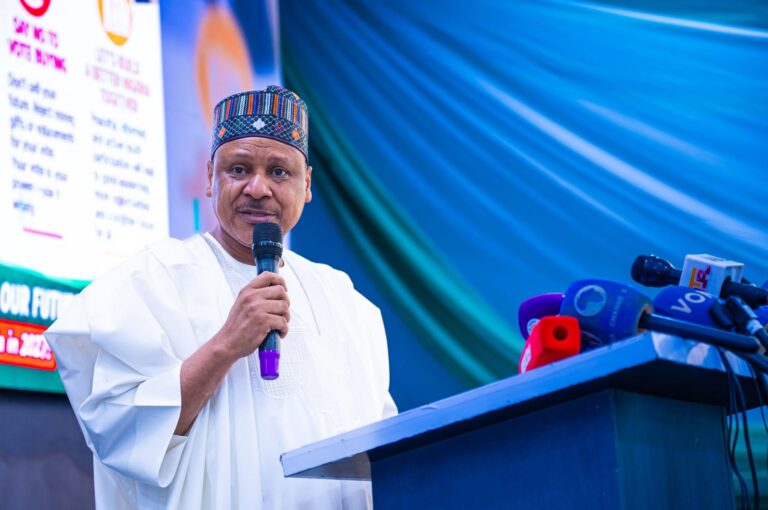
Delivering the keynote address on behalf of the Minister of Finance and Coordinating Minister of the Economy, Director of Technical Services, Federal Ministry of Finance, Basheer Abdulkadir, reaffirmed the Federal Government’s commitment to strengthening manufacturing through fiscal reforms and investment incentives.
He disclosed that manufacturing contributed about eight percent of Nigeria’s real Gross Domestic Product (GDP) and recorded 3.29 percent real growth in the first quarter of 2026.
Abdulkadir highlighted several government’s initiatives designed to improve industrial competitiveness, including the import duty exemption certificate, the national list under chapter 99 of the Common External Tariff, the Nigeria Tax Act 2025 and the National Single Window Project aimed at reducing cargo clearance delays and lowering trade costs.
He also defended tariff protection measures for strategic industries, while urging manufacturers to prepare for opportunities under the African Continental Free Trade Area (AfCFTA).
The MAN president welcomed progress made through engagements with the Ogun State Government, including concessions on safety audit fees and consultations on environmental charges. Nevertheless, he insisted that manufacturers still face multiple taxation, duplicated regulation, deteriorating industrial roads and high compliance costs, particularly in Agbara, Ota, Sagamu and other industrial corridors.
Meshioye urged both federal and state governments to move beyond promises and implement practical reforms that will strengthen local manufacturing, create jobs and improve Nigeria’s competitiveness.
He also called on the Central Bank of Nigeria to settle outstanding foreign exchange obligations owed to manufacturers and appealed for greater patronage of Made-in-Nigeria products, insisting that a stronger manufacturing sector remains critical to sustainable economic growth, industrialisation and national prosperity.