Follow Us on Google
From Adesuwa Tsan, Abuja
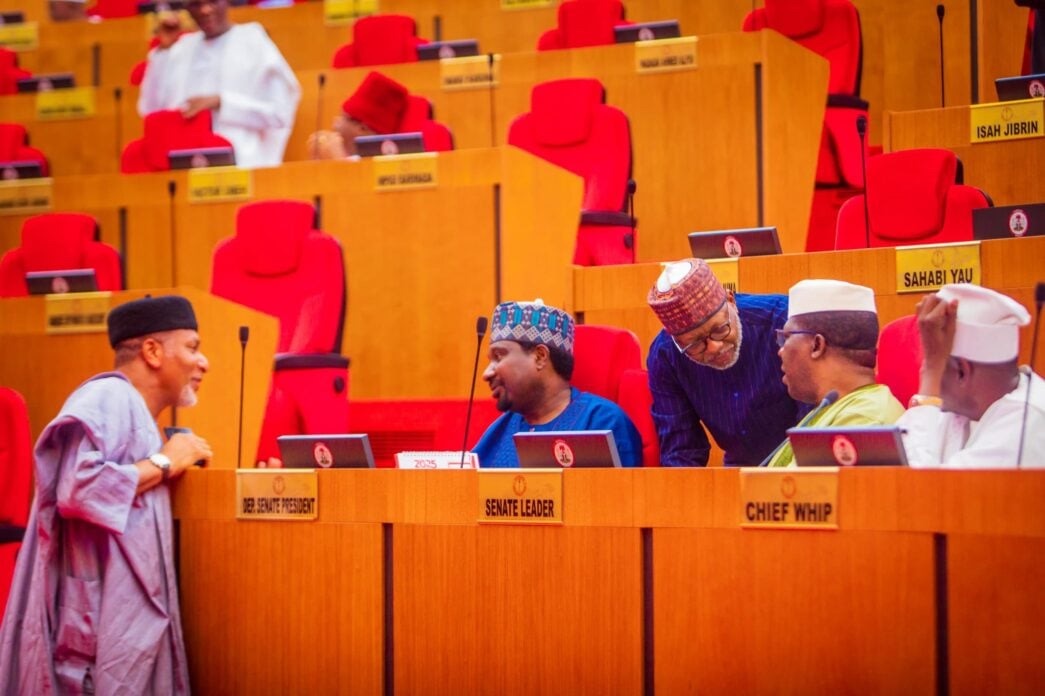
The Senate has stepped down consideration of the Electoral Act Amendment Bill, following disagreements among lawmakers over the clarity of its provisions and the need for wider consultation before proceeding with the second reading.
The joint committee of the Senate and House of Representatives, on Monday held a public hearing on the Electoral Act Amendment Bill 2025, which among others, proposed the conduct of presidential and governorship elections for 2027 in November 2026.
The move came after a heated debate on the general principles of the bill, which seeks to amend the Electoral Act 2022 to strengthen Nigeria’s electoral process and address identified loopholes from previous elections.
Earlier, Chairman of the Senate Committee on Electoral Matters, Simon Lalong, had led debate on amendments before opening the floor for the general debate. Despite observations from some senators that copies of the Bill were not made available to them, the presiding officer, Deputy Senate President Barau Jibrin, gave the nod for the debate to continue.
He explained that the second reading of any bill was meant to focus on its general principles, not the detailed provisions. “The second reading of every bill does not entail going into the nitty-gritty. It’s about the general principle of the bill, the need to amend the electoral act to Withheld Osun LG funds: State AG can sue on behalf of LGs, Abuja court rules
A Federal High Court sitting in Abuja on Thursday, ruled that state Attorneys-General has locus standi (legal right) to file suits on behalf of their Local Governments.
Justice Emeka Nwite gave the ruling in a case brought by the Attorney-General of Osun State against the Central Bank of Nigeria (CBN) and the office of the Accountant General of the Federation (OAGF) on the withheld funds of Osun State Local Governments.
The judge, in the ruling dismissed an application brought by the defendants seeking the dismissal of the case on the ground that the Attorney-General of Osun State lacked locus standi to sue on behalf of the local governments.
Other News
Relying on the Supreme Court decision in A.G. FEDERATION V. AG ABIA STATE & 35 ORS. (2024) 17 NWLR (PT. 1966) 1 AT 107 PARAS E – G; 142 PARAS B – C., Justice Nwite held that, the plaintiff, as the chief law officer of the state, has the duty and authority to act in the public interest, including protecting local government allocations.
The judge further held that the ongoing suit challenging local government allocations “does not constitute an abuse of court process.”
Justice Nwite noted that while parallel proceedings “may lead to unnecessary and duplicative objectives and judicial resources,” there was no evidence that the plaintiff had “misused, perverted, or abused the expression of justice.”
He emphasised that the plaintiff did not act in “a biased or deliberate manner in seeking the present action.” and adjourned the matter till October 17 for continuation of hearing.
On the transfer of case from the Osogbo judicial division of the court to Abuja division, Justice Nwite said he had carefully considered the positions of both parties and came to the conclusion that Section 21(1) of the Federal High Court Act provides that a Chief Judge of the court may, “at any time or stage of the proceedings before final judgment, either on the application of any of the parties to transfer any cause or matter before him to any other judge of the court.
“Accordingly, this application challenging the transfer of the case from the Osogbo Division to the Abuja Division of the Federal High Court lacks merit and is hereby dismissed”, the judge ruled.
On the allegation of bias, the court held that, the accusation is wholly unfounded and speculative, saying that, bias denotes a disposition or inclination of the mind that prevents a judge from making an objective determination based solely on the law and evidence.
“A mere administrative act by the Chief Judge transferring a case cannot, by any stretch, amount to bias. The plaintiff has not produced any credible evidence to support such a grave allegation”, he said.