Follow Us on Google
By Adewale Sanyaolu
Egypt has signed deals worth a combined $1.8 billion in a move to attain a 42 per cent renewable energy target and electricity generation mix by 2030, state TV reported on Sunday.
The latest deal dwarfs Nigeria’s recent renewable energy deployment agreements worth $500 million with five state governments and the Netherlands Development Organisation (SNV) to boost solar power generation and expand local production of solar panels and battery storage systems in Nigeria.
As at 2024, Egypt was generating over 35,000 megawatts for a population of 119 million people as against Nigeria’s 5,300MW for over 200 million citizens.
Among the Egypt deals were contracts with Norwegian renewable energy developer Scatec (SCATC.OL)
But officials say the goal will be at risk without more international support.
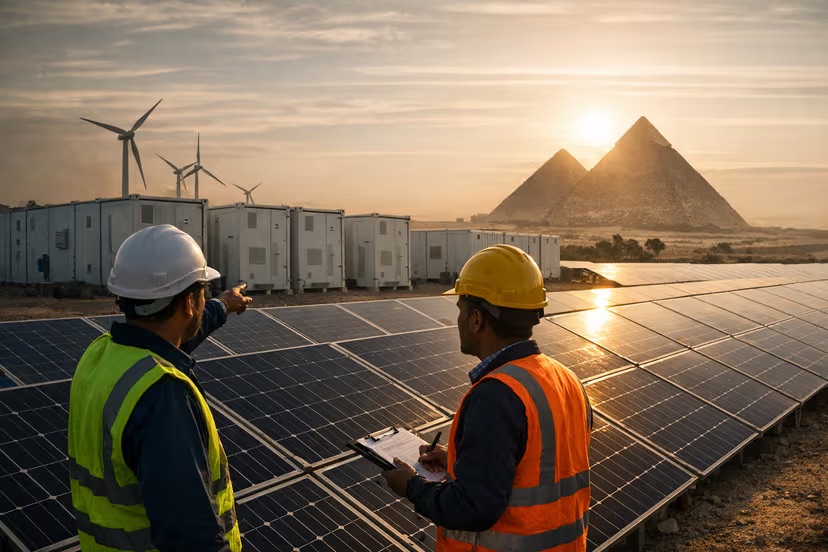
The first project will be the construction by Scatec of a solar energy plant to generate electricity and energy storage stations in Upper Egypt’s Minya, an Egyptian cabinet statement said.
It would have a generation capacity of 1.7 gigawatts supported by battery storage systems with a total capacity of 4 gigawatt hours.
A second project will be a Sungrow factory to manufacture energy storage batteries at the Suez Canal Economic Zone. A share of the factory’s output would be supplied to the first project, the cabinet said.
The deals also include power purchase agreements, with Scatec signing a deal for total capacity of 1.95 gigawatts and 3.9 gigawatt hours of battery storage systems, the Norwegian company said in a statement.
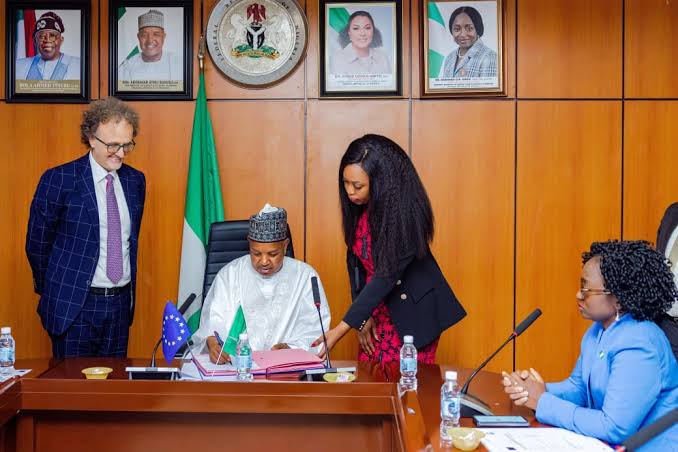
The Nigerian agreements, facilitated through the Rural Electrification Agency (REA), were signed with Bayelsa, Ogun, Lagos, Akwa Ibom, Kano, and the Federal Capital Territory. The initiative is expected to add about 3,950 megawatts of renewable energy capacity across the country.
Speaking at the Nigeria Renewable Energy Innovation Forum (NREIF) held in Abuja last October, Vice President Kashim Shettima, said Nigeria’s ongoing energy transition represents an estimated $410 billion investment opportunity between now and 2060.
Shettima reaffirmed the Federal Government’s commitment to creating an enabling environment for private sector participation in clean energy production, emphasizing that local content development and technology transfer are central to the administration’s energy strategy.
The forum, themed “Implementing the Nigeria First Policy: Facilitating Local Content Development and Manufacturing in the Renewable Energy Ecosystem,” brought together government officials, investors, and industry stakeholders to discuss strategies for deepening local participation in the renewable energy value chain.
According to the Vice President, over $23 billion will be required to expand electricity access and connect millions of Nigerians still living in energy poverty.
“But beyond access lies the grander ambition: to deliver a power system capable of 277 gigawatts of total installed capacity by 2060, driven by renewables, storage, grid expansion, and clean technology infrastructure.
“These are not just figures; they are opportunities for job creation, industrial expansion, private capital mobilization, and inclusive growth”, Shettima noted.
He stressed that the government alone cannot address the nation’s energy challenges, calling for greater involvement of private sector players and development partners.
In his remarks, the Managing Director/Chief Executive Officer of REA, Abba Aliyu, said under the new deals, Ogun will get 1,100MW, Lagos 150MW, Akwa Ibom 1,100MW, Kano 1,100MW, and the FCT 500MW.
He disclosed that the REA currently manages an active and expected project portfolio of about $3 billion in the renewable energy sector.
“The theme, ‘The Nigeria First Policy,’ captures our collective aspiration to domesticate the technologies, industries, and capabilities that will power our energy future,” Aliyu said.
To secure our long-term sustainability and economic competitiveness, we must ensure that what we deploy is increasingly designed, assembled, and manufactured in Nigeria.”
Aliyu emphasised that the REA’s mandate now extends beyond electrification to fostering local manufacturing and value-chain development in renewable energy technologies.