Follow Us on Google
• Declares out-of-school children national emergency, calls for private sector co-investment
From Juliana Taiwo-Obalonye, Abuja
Nigeria’s education budget has surged dramatically to ₦3.52 trillion in 2025 under President Bola Tinubu, more than doubling from ₦1.54 trillion in 2023, signaling a major push to transform the sector.
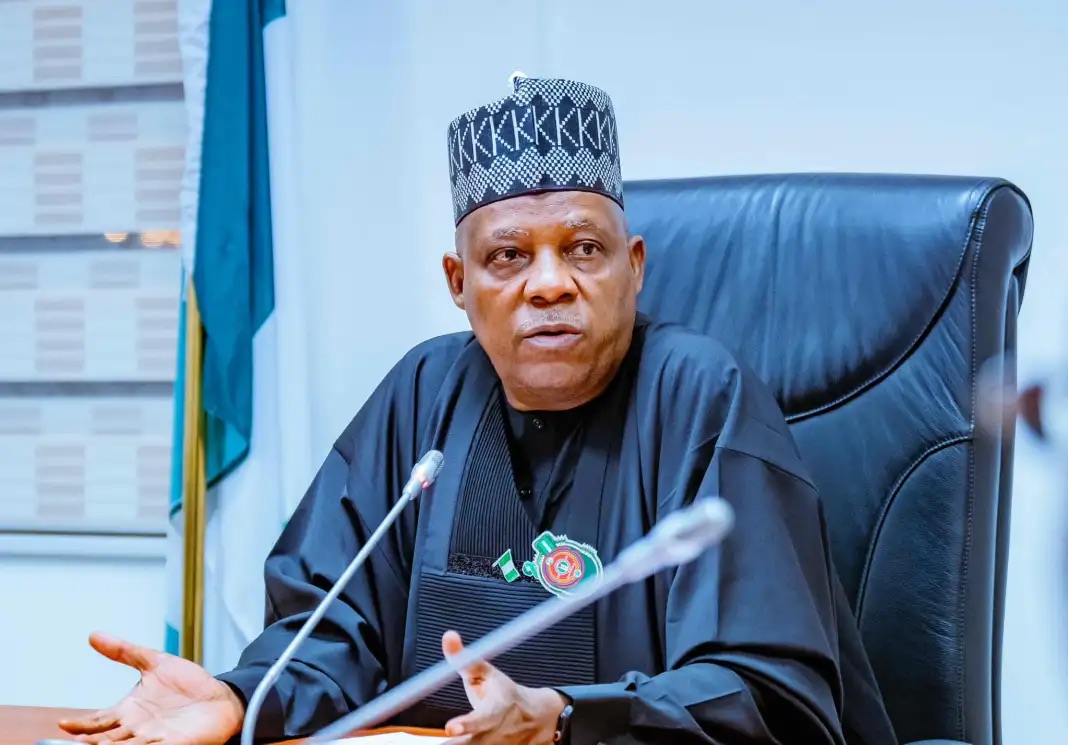
Vice President Kashim Shettima, disclosed yesterday at the 2025 Nigeria Education Forum in Abuja.
Shettima, who was represented by his Special Adviser on General Duties, Aliyu Modibbo, declared the country’s out-of-school children crisis a “national emergency.” He stressed the urgent need for government and private sector collaboration to tackle this challenge.
“Nothing threatens a civilisation more than an uneducated generation. Nations rise when the people, regardless of circumstance, are equipped with the knowledge to imagine a better future and the skills to build it.”
The forum organised by the Nigeria Governors’ Forum, the Federal Ministry of Education, and the Committee of States’ Commissioners of Education, centered on “Pathways to Sustainable Education Financing: Developing a Synergy Between Town and Gown in Nigeria.”
Shettima emphasised that Nigeria has reached a pivotal moment where relying solely on government funding is unsustainable. He called for innovative, collaborative financing models involving private sector investors, philanthropists, alumni, and communities.
“The burden cannot rest on government alone. We must enlist private sector actors, industry leaders, alumni networks, philanthropists, and communities to co-invest in laboratories, research centres, vocational hubs, innovation clusters, and endowment funds,” he said.
He listed that under President Tinubu’s Renewed Hope plan, funding for education bodies has grown substantially. The Tertiary Education Trust Fund (TETFUND) budget soared from ₦320.3 billion in 2023 to ₦1.6 trillion in 2025. The Universal Basic Education Commission (UBEC) has distributed over ₦92 billion in grants to states and significantly expanded support for teacher development and local communities.
Additionally, the Nigerian Education Loan Fund (NELFUND)—established under the 2024 Student Loans Act—has already disbursed ₦86.3 billion to more than 450,000 students nationwide, marking a new era of accessible tertiary education.
Shettima stressed, “The learning crisis cannot be solved without safe and well-equipped schools, from basic classrooms to technical laboratories.” He urged governments at all levels to work together, ensuring timely funding, transparency, and strong local engagement, especially in infrastructure, security, and teacher welfare.
The Vice President concluded by saying, “We are here today because we do not treat education as just a line item in the national budget. We treat it as the foundation of our national identity, the engine of our economic transformation, and the shield of our collective security.”
In his opening remarks, the NGF Chairman and Governor of Kwara State, AbdulRahman AbdulRazaq, represented by the NGF Director-General, Abdulateef Shittu underscored the critical role states play in education financing and reform.
He stressed the urgent need for smarter financing and efficient execution to bridge the persistent gap between budget allocations and actual spending.
Other News
“States collectively increased education budgets by 53% in 2025, from ₦2.4 trillion to ₦3.6 trillion, driven largely by a 69% rise in capital allocations. However, the impact is constrained by execution—only 67% of budgeted funds were utilized in 2024, resulting in an ₦800 billion shortfall due to unexecuted capital projects,” he revealed.
The DG stressed that with 43% of Nigeria’s population under 14 years and 33% between 15 and 24, investing wisely in education is a national imperative. He pointed out that while national education spending remains at 3% of GDP, below the global benchmark, many states are closing the gap with projected increases in budgetary allocations for 2026.
Noting the NGF’s strategic focus areas, he said states are expanding access and continuity, improving learning and skills development, and adopting innovative financing mechanisms, including partnerships with industry and development institutions.
“Our financing strategy must incorporate improved domestic revenue mobilization, innovative instruments such as pooled funds and education bonds, and strong partnerships with industry and philanthropists to protect and deliver capital investments effectively,” the DG highlighted.
He concluded by calling on all stakeholders to close the financing and execution gaps and stressed that education reform is not optional but a national security and economic priority.
“NEF 2025 marks the beginning of a new era where financing matches ambition, execution matches commitment, and education becomes the engine powering Nigeria’s socio-economic renewal,” he declared.
Minister of Education, Tunji Alausa, represented by the Minister of State, Suwaiba Ahmad described the Nigeria Education Sector Renewal Initiative (NESRI) as a “unified national blueprint jointly shaped” with all 36 states, the FCT, and key stakeholders, rather than a top-down federal imposition.
He outlined NESRI’s reforms across six priority areas—Technical & Vocational Education and Training (TVET), STEMM (Science, Technology, Engineering, Mathematics, and Medical Sciences), Out-of-School Children (OOSC), Girl-Child Education, Education Quality Assurance, and Data/Digitization (NEDI)—emphasising that “no learner must be left behind.” She highlighted achievements through federal-state collaboration, including digitization of 202,000 schools via NEDI with 21 states uploading data, reintegration of 35,000 OOSC, training of 1,400 Tsangaya teachers, and accreditation of over 1,600 TVET centres serving 250,000+ students.
Under AGILE in 18 states, 577,863 girls received scholarships and 95,341 got life skills training, while LUMINAH 2030 launched in 12 pilot states for adolescent girls’ reintegration.
Additional milestones include training 76,350 teachers for professional standards, 6,000 in AI for STEMM, nationwide school safety frameworks, and N9.7 billion in bursaries plus NELFUND support for over 580,000 students across state institutions.
Addressing the dropout crisis—where only 6 million of 30 million primary entrants reach senior secondary, the minister urged states to build more JSS/SSS schools, expand 12-year compulsory education, and strengthen teacher deployment.
She called on governors and commissioners to align state reforms with NESRI, scale teacher training, integrate NEDI data fully, and partner privately for TVET/STEMM growth, including the new Student Venture Capital Grant (S-VCG) for student innovators.
“NESRI is not a federal programme; NESRI is Nigeria’s programme,” Ahmad declared, echoing the NGF’s earlier call for closing financing gaps. She positioned NEF 2025 as the launchpad for accelerated implementation, ensuring education drives national security and economic renewal under President Tinubu’s Renewed Hope Agenda.