Follow Us on Google

By Sunday Ani
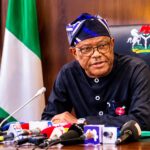
For those who have followed political events in Nigeria especially the buildup to the 2023 general elections, one man who has been in the eye of the storm is the Delta State governor, Dr Ifeanyi Okowa. Not many would envy the medical doctor-turned politician considering the deluge of challenges to his administration which will come to an end in barely a month’s time. However, like they say, uneasy lies the head that wears a crown.
Many critical observers argue that Okowa’s headache worsened with his emergence as the vice presidential candidate of the Peoples Democratic Party(PDP). Rather than improve his profile, his choice as the running mate to the PDP presidential candidate, Atiku Abubakar made him a target of all manner of attacks from political opponents and the opposition.
In the estimation of analysts, the climax of Okowa’s battle was the PDP’s loss of the recent presidential election to the Labour Party in the state.
There are those who argue that the PDP lost the presidential election in Delta because Okowa in about the last eight years has not lived up to expectation in the delivery of dividends of democracy to the people of his state.
But the question is, as Okowa leaves the stage as governor in the oil-rich state, will he be remembered as a failure or a success story?
Despite the position of the opposition, his teeming supporters believe that his greatest legacy was ensuring the emergence of Sheriff Oborevwori as his successor. In their estimation, that would lead to continuity in government with all its inherent advantages.
On assuming office in 2015, Governor Okowa saw the need to effect some policy reforms to drive home the mantra of his administration, the SMART Agenda and Prosperity for All Deltans. The mantra include the enactment of the Delta State Capital Territory Development Agency Law to plan and manage the physical development of the capital territory; enactment of the technical and vocational Education Board Law which later metamorphosed into the ministry of Technical Education; and the establishment of the office of Chief Job Creation officer, which was subsequently converted by law into the Delta State and Wealth creation Bureau to plan, design, implement and coordinate customized job creation programmes and initiatives to tackle unemployment.
The SMART Agenda also include the enactments of the Delta State Investment Development Agency Law to attract, midwife and foster public-private partnership(PPP) investments; Delta Contributory Health Commission Law to develop and manage the universal Health Coverage and Delta State Public and private properties Protection Law, 2018 to enhance ease of doing business in the state. The law is expected to greatly improve access to land for business and private development essential for attracting and retaining private investors.
Part of the SMART Agenda include the enactment of the Delta State House of Assembly Fund Management(financial autonomy) reforms and rationalization of project management to streamline resource allocation and public spending, ensure efficient and timely project delivery and promote accountability.
For those conversant with activities in Delta in the last eight years, one area the state government has excelled is in education. For instance, the state has established three new universities. The story behind Delta State’s three new universities is traced to 2016.
When Governor Ifeanyi Okowa assumed office in 2015, he made a commitment to leave an enduring legacy in the education sector and brought his wealth of knowledge to bear in the sector.
The three new universities namely: University of Delta, Agbor; Dennis Osadebey University, Asaba and Delta State University of Science and Technology, Ozoro.
The University of Delta, Agbor was a college of education while the Delta State University of Science and Technology, Ozoro was a polytechnic and the Dennis Osadebey University, a former campus of the Delta State University, Abraka.
A tour of the three new universities shows that the Okowa administration has done so much in upgrading facilities in the three new institutions since they were established by the state government over a year ago.
Okowa had emphasized the upgrade of facilities in the institutions was in line with his administration’s commitment to the development of education in the state.
In recent years, the premier State university, DELSU, Abraka had been over-burdened with the problem of admission. Qualified students from the state were denied admission into the university and into federal and other public universities across the country. Therefore, the need for the three universities came up as a result of the deficit.
In 2018, the Joint Admissions and Matriculation Board (JAMB) released a report, which indicated that a total of 80,131 Deltans, representing 4.85 per cent of admission seekers nationwide sat for the board’s examination while only 26 per cent were offered admission due to inadequate entry space.
Also, out of 25,000 candidates from the State who applied for admission in the 2020/2021 academic session at the State university, Abraka, over 20,000 candidates qualified for admission, but only 4,000 were admitted.
Also in the academic session before, 25,896 candidates from the state chose DELSU as their first choice. Out of this number, 22,358 qualified but only 4,854 candidates could be admitted.
Peeved by the development, the education summit of 2016 was held with far-reaching recommendations, one of which is the steps taken by the Okowa administration to birth the three universities.
Also, there are about 500 public secondary schools in Delta State. Private secondary schools in the state are higher in number. All of them turn out students every year; thus increasing the population of admission-seekers.
Similarly, there was consideration for those graduating from the over 10 technical colleges in the State. A University of Science and Technology provides a better option for them. It is in furtherance of this that the state is establishing a technical college in each of the 25 council areas of the state. The Okowa administration has established four of these.
Following the development in education, admission seekers in Delta State were no longer interested in National Certificate in Education (NCE) programmes, judging from the admission charts of the colleges of education in the state.
To put this into perspective, admission into the then College of Education, Agbor in 2021 was as low as 25 students. This is despite the fact that there are over 400 qualified lecturers in the institution with most of them Ph.D holders and a monthly wage bill of N206 million.
The Delta State government was aware that the Federal Government had reached decisions to abolish Higher National Diploma (HND) programmes from polytechnics nationwide, hence it planned to upgraded the three polytechnics in the state after their National Diploma programmes?
Governor Okowa’s decision to establish the three universities came with the signing into law of three executive bills establishing the three institutions and thus setting a record of four public universities in a State.
The executive bills originally sent to the State House of Assembly were for the University of Education, Agbor; University of Science and Agriculture, Asaba and Delta State University of Science and Technology, Ozoro. During a public hearing organised by the legislature to take stakeholders’ contributions into the creation of the universities, the idea was fine-tuned, despite opposition from different quarters that the universities were politically motivated.
However, the fine-tuning resulted in changing the names of the institutions from what was enshrined in the bills.
After inputs from stakeholders during the public hearing, the lawmakers saw reasons to change the names of the institutions to Delta State University, Agbor, to run a full-fledged university system, instead of education courses alone which it inherited from the education college it evolved from.
The legislators were also of the view that the State should immortalise the late Premier of the Midwest region, Sir Dennis Osadebe, an indigene of Asaba by renaming the university in Asaba after him, while the University of Science and Technology, Ozoro remains to hopefully absorb students graduating from the remaining two other polytechnics at Ogwashi Uku and Oghara after their national diploma programmes and also students from the technical colleges spread across the State.
Recall that it was in January 2021 that Governor Okowa first announced plans to convert the College of Education, Agbor and the two other new schools into full-fledged universities. The bills establishing the institutions had their first reading during plenary at the Delta State House of Assembly on the 28th of January 2021. In February 2021, the bills were passed into law after going through the House Committee on Education.
While assenting to the bills, Governor Okowa said: “What we have done today is in the best interest of the state because it is a futuristic thing and people will come to appreciate it in the future”.
Subsequently, Governor Okowa set up a Project Management Committee for the universities headed by Professor Patrick Muoboghare to bring the three universities to a functional state.
The University of Delta, Agbor currently offers undergraduate and postgraduate courses covering five faculties: Agriculture, Arts, Education, Information Technology and Law.
For the Delta State University of Science and Technology, Ozoro, it offers undergraduate and postgraduate courses covering seven faculties: Agriculture, Science, Earth Science, Engineering, Environmental science, Information technology and Management technology; Dennis Osadebay University offers undergraduate courses and currently comprises six faculties: Agriculture, Science, Management and Social Sciences, Environmental Science, Arts and Computing.
Originally, the Delta State University of Science and Technology, Ozoro was first established as a College of Agriculture which was turned into a Polytechnic on January 1, 2002, by law during the administration of James Ibori.
A recent tour by Daily Sun showed that all three new universities in Delta State are up and running even as facilities in the institutions are state of the art.
However, the University of Science and Technology, Ozoro; and the University of Delta, Agbor have more facilities on ground. Dennis Osadebay University, Asaba, which was in a more critical state due to the dearth of infrastructure on the campus, currently has a lot of projects under execution.
Some of the projects nearing completion include s 500-seater and a twin 250-seater auditorium, Faculty of Agriculture buildings, lecture theatres and Halls of Residence and there is no doubt that by the time the projects in Dennis Osadebay University are completed, the institution will wear a new look.
Despite the criticism from his distractors, many would agree that the Okowa administration has done so much in upgrading facilities in the three new universities since they were established over a year ago.
In their first year, Dennis Osadebay University, Asaba admitted no fewer than 650 students, while the University of Delta, Agbor admitted 2,000 students and Ozoro, 1,800 students.
Defending its stand on the financial implications of running the three new universities, the State government made it clear that there will be no financial burden on the State as such, stressing that the new institutions were upgraded from existing and functional institutions with enough manpower.