Follow Us on Google
By Adewale Sanyaolu
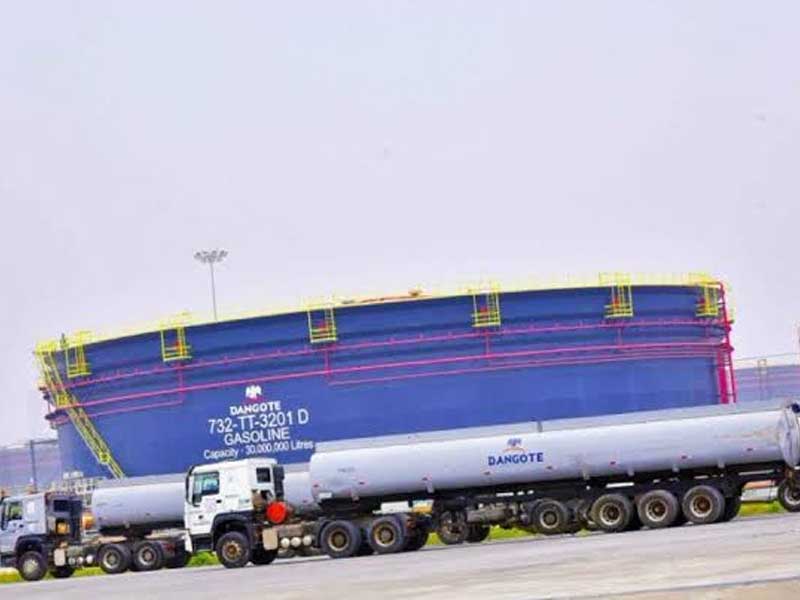
The downstream sector is witnessing a gradual spike in the ex-depot price of petrol over maintenance works and upgrades at the Dangote Refinery.
Vice President, Dangote Industries Limited, Mr. Edwin Devakumar, said the refinery has begun a planned turnaround that will pause its main gasoline unit, the residue fluid catalytic cracker, and briefly halt all crude processing in early 2026.
In comments to Platts, part of S&P Global Energy, Edwin said that maintenance on the RFCC began in the week of December 6 and will end in late January.
Contrary to previous comments on the scope of the works, the executive confirmed plans to suspend the site’s crude distillation unit, but said the process would only last “a few days” in January.
However, findings by Daily Sun have revealed that the maintenance works have pushed petrol ex-depot price to N805 per litre at some private depots outside Lagos, as against N699 per litre at the Dangote Refinery.
The implication of this would mean a gradual hike of petrol retail prices at the pumps.
In its latest Competency Centre Energy Bulletin released by the Major Energies Marketers Association of Nigeria (MEMAN), petrol ex-depot price at Calabar, Warri and Port Harcourt has risen to N800–N805 per litre, while Lagos is selling between N701–N800 per litre.
Speaking at a press conference in Lagos in December, Dangote assured Nigerians that the pump price of PMS would decline further, stating that petrol would sell at no more than N740 per litre, starting in Lagos.
He disclosed that MRS, which operates over 2,000 filling stations nationwide, would be the first to implement the new price.
He also announced that the Dangote Petroleum Refinery had reduced its minimum purchase requirement from two million litres to 500,000 litres, a move designed to enable more marketers, including members of the Independent Petroleum Marketers Association of Nigeria (IPMAN), to participate in product offtake.
Other News
“So if you come to the refinery today, you will get PMS at N699 per litre,” he stated.
Dangote maintained that Nigerians would be the ultimate beneficiaries of domestic refining, as the refinery was working round the clock to ensure that recent reductions in gantry prices were fully reflected at the retail level.
The turnaround will take the size of the CDU — already the world’s largest — from 650,000 b/d to 700,000 b/d.
The expansion will also see Dangote surpass the capacity of South Korea’s Onsan refinery, making it the eighth-largest complex on the international stage.
Work on the RFCC follows growing international focus on the key gasoline unit after a year of intermittent operations. In an interview with Platts in October, company founder Aliko Dangote said the company was still working to resolve problems with the unit, which it hopes to address with the upcoming work.
According to figures published by Nigeria’s downstream regulator, the Nigerian Midstream Downstream Petroleum Regulatory Authority (NMDPRA), on Nov. 30, the Dangote refinery supplied the market with an average of 18 million litres of gasoline per day (around 113,000 b/d) through 2025, below a planned 35 million litres per day (220,000 b/d) and equivalent to roughly 36 per cent of domestic demand.
In August and September, when the RFCC was mostly out of service, Nigeria’s entire refining sector produced 110,000 b/d of gasoline, according to NMDPRA figures.
Dangote accounts for the majority of the output, although three modular refineries — Edo, Waltersmith and Aradel — with a combined capacity of 28,000 b/d, also contributed, the regulator said.
Stabilising the RFCC has been a key objective for Dangote since it began operating in 2024, providing its primary means of producing gasoline and serving Nigeria’s largest fuel deficit.
Yet, after an extremely fast ramp-up, the unit has suffered from “design issues” and other technical challenges, Dangote’s leadership has said.
Without the RFCC running, the refinery can still make gasoline from its reformer, albeit in lower volumes. Other secondary units, including the hydrocracker, can also run independently, leaving supplies of diesel and jet fuel largely unaffected.