Follow Us on Google
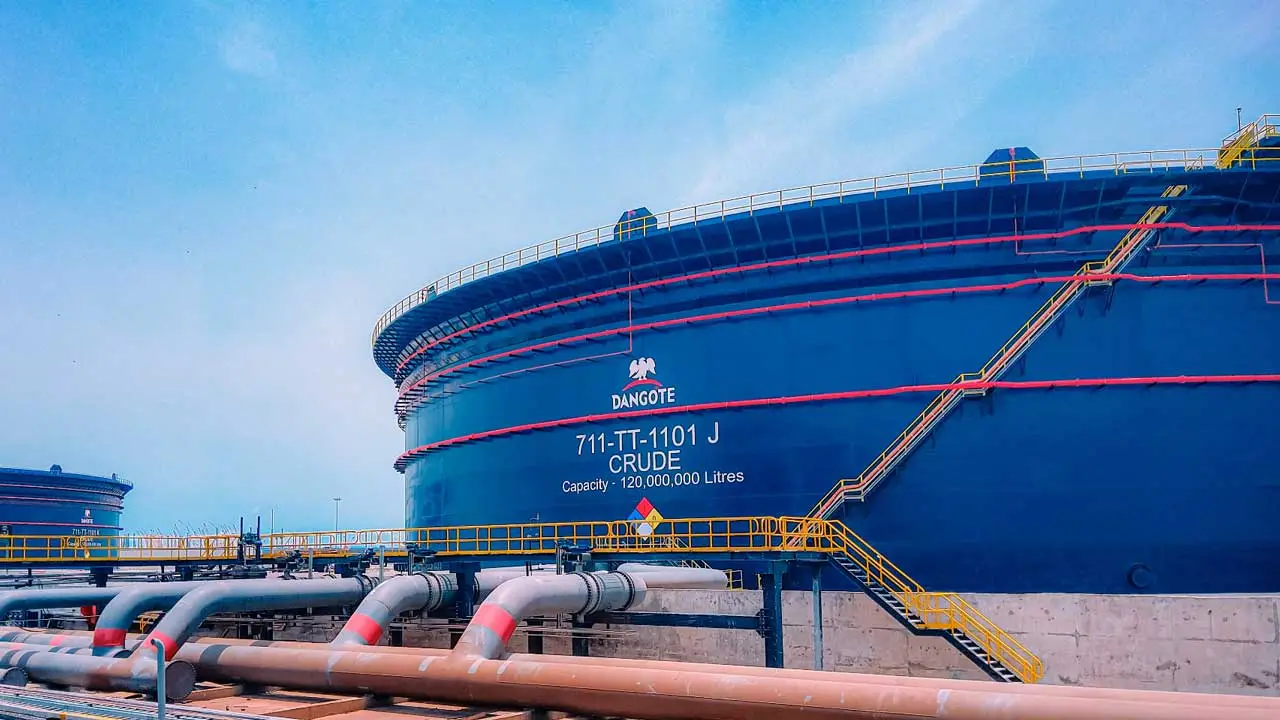
Nigeria’s long-standing paradox of being Africa’s biggest crude producer yet a major fuel importer is quietly fading off the coast of Lekki.
There, a steady stream of ocean-going tankers now lifts refined petroleum products bound for Europe, Asia and North America.
This signals a remarkable reversal in the country’s trade narrative. At the heart of that shift is the $20 billion Dangote Refinery, whose marine infrastructure has rapidly positioned it as a dominant force in Africa’s maritime energy trade.
Since commencing operations in 2024, the 650,000 barrels-per-day refinery has recorded nearly 800 tanker calls, with projections hovering around 600 vessels annually as crude intake and product exports stabilise. Industry experts say the scale of maritime traffic generated by a single private facility is unprecedented on the continent.
Unlike conventional refineries tied to fixed pipelines, the Dangote complex was conceived as a merchant refinery, one that relies on global shipping lanes for both supply and distribution. Crude oil arrives via Very Large Crude Carriers at offshore Single Point Mooring (SPM) buoys, while refined products depart through the same maritime gateway. The result is a self-contained energy port operating 365 days a year.
The facility’s five SPM buoys, two for crude and three for products, are connected to onshore storage through 48-inch pipelines buried beneath the seabed.
Natural water depths of up to 40 metres allow some of the world’s largest tankers to berth without the need for constant dredging, ensuring cost efficiency and operational speed. Most vessels complete discharge or loading within 24 hours.
Its shipping milestones have come in rapid succession. The refinery’s maiden crude cargo of one million barrels marked the beginning of commercial operations. By May 2024, it began exporting naphtha and jet fuel to international markets. In October 2024, its first seaborne gasoline cargo of 500,000 barrels signalled a shift from truck-only distribution to marine-based logistics.
The breakthrough moment arrived in mid-2025, when over one million tonnes of Premium Motor Spirit were exported to Asia within two months. On August 26, 2025, a 320,000-barrel gasoline cargo meeting United States specifications sailed out, an historic development for Nigeria, which had never before exported refined petrol to the US market.
For maritime stakeholders, the implications stretch beyond cargo volumes. Increased tanker traffic means higher revenues for pilotage, towage and port services. It also strengthens Nigeria’s standing under the African Continental Free Trade Area (AfCFTA), offering new opportunities for regional coastal shipping and transshipment.
Other News
During a recent visit to the facility, the Group Chief Executive Officer of NNPC Limited, Bayo Ojulari, described the refinery as a game-changer capable of deepening collaboration across Nigeria’s downstream and maritime sectors. Observers say such collaboration could unlock indigenous participation in vessel ownership, crewing and marine services.
Experts argue that marine evacuation of refined products presents a strategic advantage. A single 5,000-tonne coastal tanker can transport the equivalent of roughly 150 fuel trucks, reducing congestion, road damage and distribution delays. With Nigeria maintaining tank farms along its coastline, products can be shipped by sea and discharged into depots before inland distribution, an approach considered safer and more cost-effective.
The refinery’s maritime capacity also extends to fertiliser exports, with shipments reaching markets such as Brazil. Analysts believe the diversification of cargo streams enhances Nigeria’s trade resilience and broadens its foreign exchange base.
Expansion is already underway. Plans include four new tanker jetties dedicated to LPG, gasoline, diesel and aviation fuel, alongside draft deepening to 14.5 metres to accommodate vessels of up to 100,000 deadweight tonnes. Industry watchers say these upgrades could further increase annual vessel calls and consolidate Nigeria’s emergence as a refined-products export hub.
Beyond infrastructure, the facility’s existence has triggered conversations about enforcing cabotage laws and strengthening local content. Maritime professionals insist that as export volumes grow, Nigerian-owned vessels and crews must be positioned to capture a greater share of the freight market, ensuring that earnings remain within the domestic economy.
Investors see broader macroeconomic gains. Prominent businessman Femi Otedola has described the refinery as transformative, projecting that its proposed expansion to 1.4 million barrels per day would boost the naira and expand Nigeria’s export earnings. Analysts note that doubling capacity would effectively double maritime throughput, amplifying job creation and port revenues.
For decades, Nigeria’s coastline symbolised lost value, crude sailing out, refined fuel sailing in. Today, that pattern is reversing. The Lekki shoreline has become a corridor of outbound energy flows, with Nigerian-refined gasoline, jet fuel and diesel finding buyers far beyond West Africa.
In a region seeking industrial anchors, the Dangote Refinery’s maritime ecosystem stands out as a privately driven model of scale, integration and export ambition. If supported by consistent policy and local shipping development, experts say it could redefine Nigeria’s position in global energy logistics.
What was once an oil-exporting nation dependent on imported fuel is now charting a new course, one tanker at a time.