Follow Us on Google
“Why does it bother you so much that I don’t want blonde tresses? My hair grows fast. I just like my face.”
This is the girl with seven powerful names, most of them Nigerian: Cynthia Chinasaokwu Onyedinmanasu Amarachukwu Owezuke Echimino Erivo.
If the names feel like a mouthful, you may call her simply Cynthia Erivo. The world already does.
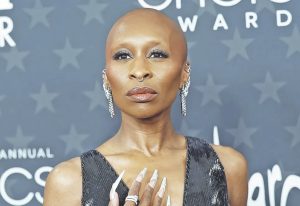
British-born. Nigerian-rooted. Globally honoured.
Until recently, to many Nigerian movie lovers, the name Cynthia Erivo rang a faint bell only because of Wicked—that long-running Broadway and now cinematic phenomenon that has conquered the world. But behind that neat, two-word stage name lies a deeper story: one of Igbo bloodlines, civil-war displacement, artistic defiance, shaved hair, and now, official recognition by the British Crown.
I caught her being interviewed on the BBC and decided to follow up her story. My eureka moment came when in the course of my research, I found her surprisingly to be a Nigerian by parentage—even though she has never set foot on Nigerian soil. Yet Nigeria lives loudly in her name, her history, her spirit, and her audacity.
Born on January 8, 1987, in Stockwell, South London, Cynthia is the daughter of Igbo immigrants who arrived in Britain in the shadow of Nigeria’s Civil War. It was not migration as adventure; it was migration as survival.
As she once said of her mother’s journey: “She’s not necessarily a refugee, but her home was ravaged, and they were on the run to find safety.”
That history sits quietly behind her brilliance.
Her official name is not ornamental. It is philosophical.
Each Igbo word carries weight:
• Chinasaokwu — God is watching, God is active.
• Onyedinmanasu — Leave what is behind; face what is ahead.
• Amarachukwu, Owezuke, Echimino — gratitude, mercy, mystery, continuity.
Cynthia herself admits she remembers the meaning of only a few of them, laughing about it. But names, especially Igbo names, do not require constant translation to work their magic. They operate like ancestral GPS. She has never denied her roots. In 2018, she posted a photograph of herself in a Nigerian-inspired attire and wrote simply:
“I am Nigerian. I am a woman. I am a Queen. I am everything I need and more.”
She grew up British, educated at La Retraite Roman Catholic Girls’ School, raised largely by her mother Edith after her father left the family. Out of gratitude, she named her production company Edith’s Daughter—a quiet monument to maternal endurance.
The signs came early. At five, she was singing “Silent Night.” Youth theatre followed. Then came the Royal Academy of Dramatic Art (RADA), where raw talent met discipline. Her Broadway breakthrough as Celie in The Color Purple was seismic. She didn’t just perform; she conquered. A Tony, a Grammy, and an Emmy followed. For theatre people, that is holy trinity territory.
But global fame arrived with green skin. When Cynthia Erivo was cast as Elphaba—the misunderstood witch—in Wicked, she didn’t merely step into a role. She surrendered herself to it. She shaved her head. Not for fashion. Not for shock value. For truth. Because Elphaba’s scalp had to be green. Because wigs have partings. Because authenticity matters to her more than vanity. She shaved her eyebrows too.
“This is not a gimmick,” she insisted later. “This is intention.”
And intention became identity.
When she first saw herself fully bald, she felt exposed—then liberated.
“I saw my face with no hair at all,” she said. “It felt like a black canvas. Nothing but my eyes.”
That canvas has now become her signature.
My first impression was that Cynthia Erivo has cancer but she is not bald because of cancer. Her baldness is not illness. It is something she did on her own. She has addressed critics directly: “Why does it bother you so much that I don’t want blonde tresses? My hair grows fast. I just like my face.”
That sentence alone is rebellion.
Now, the Wicked story does not end with the first film. In fact, it deepens.
Cynthia Erivo reprises—and expands—her role as Elphaba in Wicked: For Good, the second cinematic chapter of the musical, where innocence gives way to consequence, and power demands sacrifice. Those who know the stage version understand this: For Good is not just a song; it is a reckoning. In this sequel, Erivo’s Elphaba is no longer simply misunderstood. She is fully formed—political, moral, dangerous to false power. The role demands emotional weight, vocal authority, and spiritual maturity. It is no coincidence that Cynthia Erivo, now older, sharper, and more certain of herself, carries it. And as if art was not affirmation enough, the establishment has finally spoken.
In the latest King’s Honours List, Cynthia Erivo has been formally recognised by King Charles III for her services to drama and music. The girl with seven Igbo names—born to parents who fled the Biafran War—has been acknowledged by the British Crown.
Empire—or the establishment—notices excellence eventually. Cynthia Erivo did not beg to be included. She did not dilute herself to be accepted. She did not change her voice, her baldness, her intensity, her Africanness. She kept delivering performances so powerful that the system had no choice but to look.
First Broadway bowed.
Then Hollywood nodded.
Then the awards followed.
Then the King’s Honours List came calling.
Empire did not create Cynthia Erivo.
Empire recognized her — late, reluctantly, but finally.
So in relation to Cynthia, Empire is the massive cultural machine that eventually had to admit:
“We cannot ignore this woman anymore.”
That is what makes her story so potent.
She did not rise because Empire was kind.
She rose because her excellence made Empire yield.
The King’s Honour is not just a medal. It is a full circle: from immigrant child to national asset. From shaved-headed defiance to royal validation. Britain has claimed her, but Nigeria may smile knowingly and say, “She was always ours.”
Beyond Wicked, Cynthia’s résumé is formidable. She embodied Harriet Tubman in Harriet. She starred in Widows, Bad Times at the El Royale, The Outsider, and astonished television audiences in Poker Face by playing multiple characters in a single episode—an acting high-wire act she described as “totally insane.”
She sings like a cathedral. She acts like a storm. Check her on Apple Music or YouTube.
She is also slated to host the Tony Awards, perform in Jesus Christ Superstar, and continue blurring the line between stage, screen, and song.
For Nigerians—home and diaspora—her story matters. It is a reminder that identity is not erased by distance. That you can be born in London and still carry Igboland in your name like a drumbeat. That you can shave your head and still command the room. Cynthia Erivo walks into spaces bald, unflinching, fully herself—and the room adjusts.
Her full name whispers prophecy: God watches. The future matters more than the past.
She is living that prophecy.
Cynthia Erivo is not just bald for a reason.
She is bald for a purpose.
And now—honoured by a King, immortalised by Wicked: For Good, and anchored by seven ancestral names—she stands as proof that when identity is fully embraced, it does not diminish beauty.
It becomes art.