Follow Us on Google

From Taiwo Oluwadare, Ibadan**
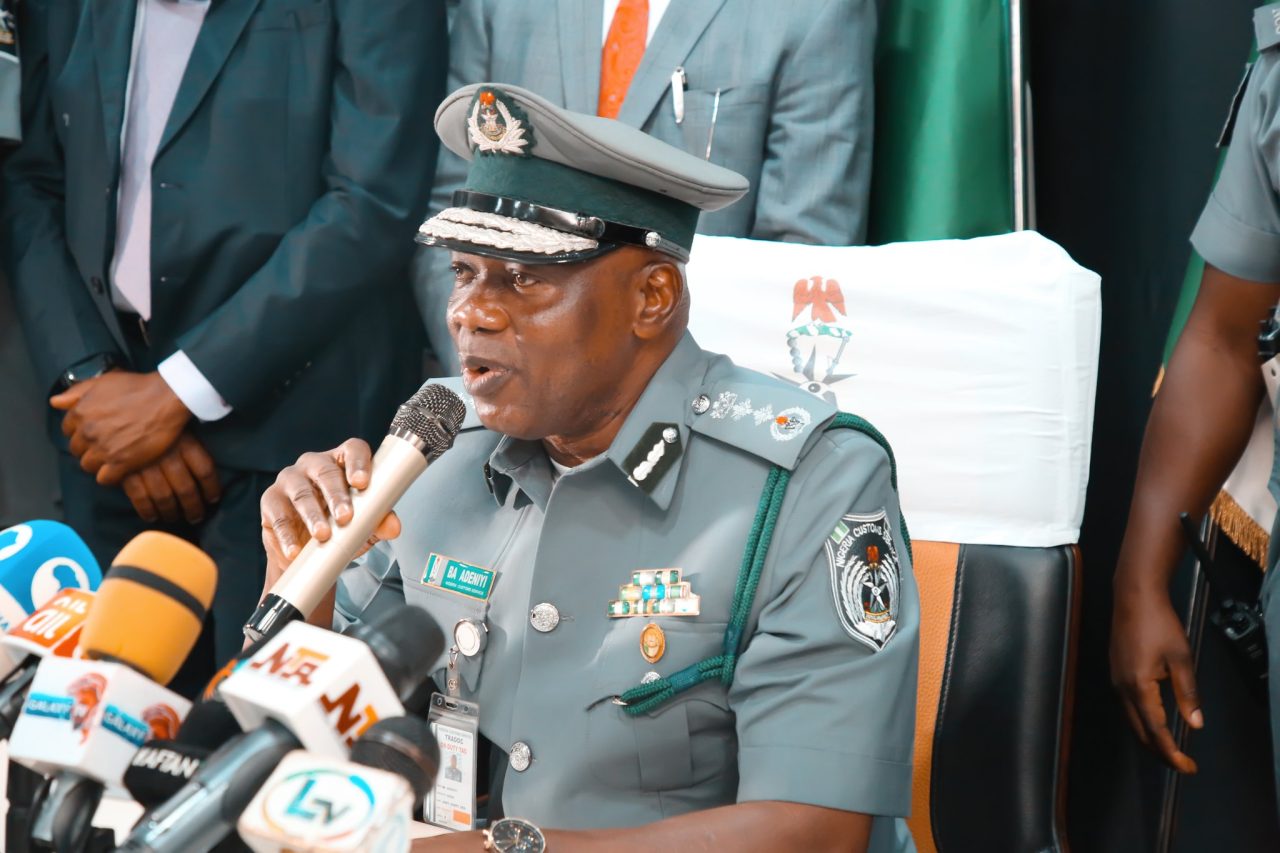
The Comptroller-General of the Nigeria Customs Service (NCS), Bashir Adeniyi, has disclosed that the Service intercepted 399 pump-action rifles and hundreds of firearm components concealed in a shipping container at the Tin Can Island Port, Lagos, in July 2026.
Adeniyi made the disclosure yesterday while delivering the 3rd Distinguished Personality Lecture of the TETFund Centre of Excellence in Security Management (TECESM), University of Ibadan, Oyo State.
The lecture, held at Trenchard Hall, was titled, “Why Customs Matters: Revenue, Security and Nationhood in a Borderless World.”
He said the seizure underscored the importance of technology-driven intelligence and risk-management systems in detecting prohibited goods and strengthening national security.
According to him, the intercepted weapons had been handed over to the National Centre for the Control of Small Arms and Light Weapons, while suspects linked to the case were facing trial at the Federal High Court.
The Customs chief argued that, contrary to the widespread belief that globalisation was making national borders less relevant, increasing international trade and interconnectedness had made effective border management more critical.
He identified revenue generation, national security and nationhood as the three fundamental pillars underpinning the operations of the Nigeria Customs Service.
Adeniyi explained that customs duties contributed to funding public infrastructure, education, healthcare and other essential services through revenue allocations to the three tiers of government.
He disclosed that the Service collected approximately N3.2 trillion in 2023, N6.105 trillion in 2024 and N7.28 trillion in 2025, surpassing its revenue target of N6.58 trillion for the latter year. The Comptroller-General said the Service had set a revenue target of N11.07 trillion for 2026, adding that improved compliance, digitalisation, risk management and effective enforcement would be critical to achieving the goal.
He, however, stressed that revenue growth should not come at the expense of legitimate trade, noting that the Service was working towards a system that would facilitate compliant businesses while preventing revenue leakages.
On security, Adeniyi cited previous seizures of firearms, counterfeit medicines, illicit drugs and wildlife products as evidence of the Service’s contribution to protecting lives, property and the environment.
He said effective customs enforcement was essential to curbing arms trafficking, the circulation of dangerous medicines and other illicit activities that threatened public safety.
The Customs boss also highlighted the need to treat border communities fairly, particularly traders whose family, cultural and economic ties extended across Nigeria’s international boundaries.
He said the objective should be to enforce the law while providing legitimate channels for small-scale cross-border trade.
“A border that only punishes will be evaded; a border that also serves will be used,” he said, advocating intelligence-led enforcement, data analysis and cooperation with neighbouring countries rather than relying solely on border closures.
Adeniyi described B’Odogwu, the Service’s indigenous digital clearance platform, as an evolving process rather than a one-off innovation.
He said the platform had promoted paperless trade, improved document security and strengthened revenue accountability, while helping to modernise cargo-clearance procedures.
According to him, the next phase would involve integrating the platform fully with the National Single Window to enable traders to submit import- and export-related documents through a unified system.
He explained that technology would also help officers identify smuggling patterns and predict illicit movements through unmanned border routes, enabling the Service to deploy personnel and resources more effectively.
The Comptroller-General stressed, however, that technology alone could not guarantee effective border management without officers of integrity who possessed the necessary skills to interpret intelligence and enforce the law professionally.
He added that the Service was strengthening staff training, institutional accountability and cooperation with other security agencies.
Other News
Adeniyi called for closer collaboration between the Nigeria Customs Service and Nigerian universities, particularly the University of Ibadan, to promote evidence-based policymaking and improve border security.
He proposed a Border Economies Research Partnership to study cross-border trade, compliance costs and the factors driving smuggling in communities such as Idiroko, Seme, Jibia and Illela.
Other proposals included Customs Data and Analytics Fellowships, an Illicit Trade Observatory at TECESM, postgraduate programmes on borders and illicit trade, and independent evaluations of the Service’s reforms.
He said researchers could work with properly anonymised customs data to develop analytical models for detecting undervaluation, tariff misclassification and smuggling.
The Customs chief also invited scholars to assess the implementation of the Nigeria Customs Service Act 2023, the Authorised Economic Operator programme and the National Single Window initiative.
He pledged to direct his team to engage TECESM’s leadership on developing and prioritising the proposals.
In his remarks, the Vice-Chancellor of the University of Ibadan, Professor Kayode Adebowale, described Adeniyi’s career as an example of the intersection of revenue generation, national security and institutional transformation.
Adebowale said the Customs Service had recorded significant revenue growth under Adeniyi’s leadership, attributing the progress to systematic reforms, improved compliance and the adoption of digital platforms.
He stressed that customs administration went beyond revenue collection, describing it as a practical expression of national sovereignty.
According to him, every interception of illicit weapons and counterfeit goods reinforced the state’s responsibility to protect the economy and safeguard citizens.
The Vice-Chancellor urged students pursuing security governance to develop the capacity to understand criminal networks, emerging threats and the relationship between security institutions and national identity.
Earlier, the Director of TECESM, Professor Benjamin Aluko, said the lecture formed part of the Centre’s efforts to deepen collaboration between academia and security institutions.
Aluko explained that the Centre was established by the Tertiary Education Trust Fund (TETFund) to expand knowledge of early warning systems and security management for sustainable peace and development.
He said TECESM commenced its master’s degree programme in Security Management during the 2024/2025 academic session, with about 40 students drawn largely from security agencies. Its doctoral programme, he added, was expected to admit its first set of students in the next academic session.
The director disclosed that the Centre was developing a specialised curriculum in collaboration with relevant university units to train senior Customs officers.
He said the proposed programme would draw expertise from disciplines including economics, accounting, sociology, business administration and psychology.
Aluko appealed to the Comptroller-General to support the Centre with a 30-seater bus for students’ field research and to establish a dedicated research and training facility to be named the Bashir Adewale Adeniyi Research and Training Hub.
The event also featured the presentation of the Centre’s 54-chapter book, *Perspectives on Security Management in Nigeria*, and the *Ibadan Security Review*, Volume 1, Number 1, published in May 2026.
Professor Abel Idowu Olayinka, a former Vice-Chancellor of the University of Ibadan, chaired the occasion.
The Executive Secretary of TETFund, Arc. Sonny S. T. Echono, was represented by the Director of Research and Development/Centres of Excellence Development, Dr Suleiman Zangina.
The lecture brought together university scholars, students, Customs officials and representatives of security agencies to examine the relationship between trade, national security, revenue generation and border governance.