Follow Us on Google
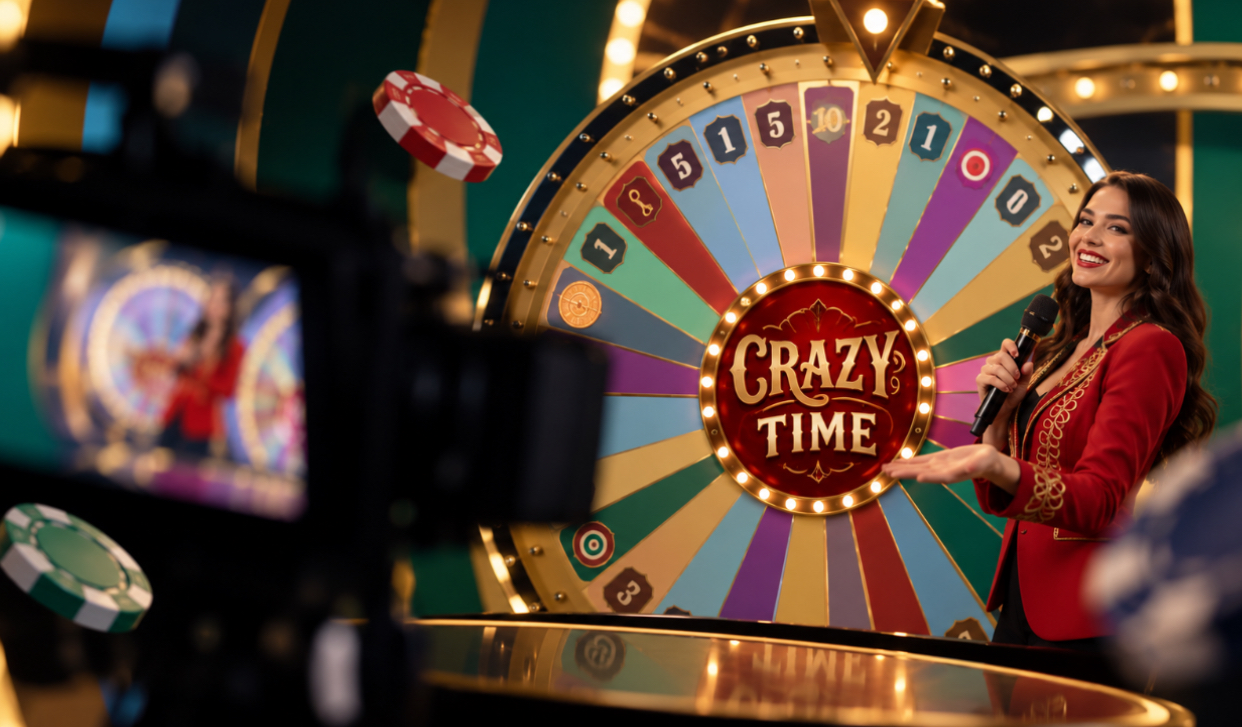
Crazy Time Looks More Like a TV Studio Than a Slot Machine
Crazy Time does not begin with spinning reels. It begins with a presenter under studio lights, speaking to a camera while a large physical money wheel dominates the set. Evolution launched the game in July 2020 as part of its live game-show category, and its production language is closer to television than to a conventional slot: a host controls the pace, cameras frame the action, graphics mark transitions and bonus segments interrupt the main round.
That distinction matters. The game combines a live studio event with digital multipliers, augmented visual elements and four separate bonus features. Understanding those layers is more useful than treating Crazy Time as a slot with a presenter attached.
Casino games learned the grammar of television
Traditional live dealer tables already borrow heavily from broadcast production. Roulette and blackjack streams need cameras, lighting, dealers and a clear view of physical equipment. A game show extends the formula: the presenter also fills the gaps between decisions, announces transitions and turns each result into a small piece of live programming.
Evolution explicitly designed Crazy Time around that idea. The company said at launch that it wanted a game people could enjoy watching in much the same way as a television game show. Multi-camera production, augmented reality and game-show pacing are therefore part of the product itself rather than decorative extras.
The wheel is only the first layer
The centerpiece is a 54-segment money wheel. Players can back four numbered outcomes — 1, 2, 5 and 10 — or one of four bonus positions. Above the wheel sits Top Slot, a two-reel feature that selects bet spots and attaches random multipliers before the wheel resolves the main round.
That sequence is easier to understand when it is separated into stages. A player chooses a position, Top Slot determines whether a multiplier applies, and the presenter spins the wheel. The rules for casino online Crazy Time are therefore more useful as a mechanics reference than trying to learn everything from the moving live screen. The GuideBook separates the wheel, Top Slot, payouts and bonus features instead of presenting them as one burst of animation. A multiplier appearing on screen does not automatically apply to every wager. The stream shows the event; the rules explain how the displayed outcome becomes a payout.
Four bonus rounds change the shape of a session
Cash Hunt, Pachinko, Coin Flip and Crazy Time are not simply different graphics placed over the same calculation. Each creates a separate phase of play once the main wheel lands on the relevant bonus segment.
Cash Hunt uses a shooting-gallery format with hidden multipliers. Pachinko sends a puck through a peg board toward multiplier positions. Coin Flip assigns multipliers to two coloured sides before the coin resolves the round. The Crazy Time feature replaces the studio wheel with a large virtual wheel containing multiplier and modifier segments.
Entry depends on two things: the main wheel must stop on the relevant bonus segment, and the player must already have a wager on that position. A sequence of earlier missed bonuses does not make the next one due.
Live does not mean predictable
A visible wheel encourages a different kind of attention from a slot. Viewers see the presenter, the wheel and the previous results, so it is tempting to imagine that enough observation might expose a pattern.
The product mechanics do not support that conclusion. Evolution describes the game as one with random outcomes and random multiplier elements, while its official materials state that previous results cannot be used to predict the next round. The main wheel is part of a live studio event; digital features add RNG-generated multipliers around it.
That combination also explains why Crazy Time is not simply an RNG slot in another skin. A conventional slot generates the game result in software and then renders symbols or reels. Crazy Time broadcasts a live wheel and presenter while adding digitally generated game-show features around that physical event.
The stream can lag behind the studio
“Live” does not mean zero-delay video. Any internet stream must be captured, encoded, transmitted and rendered on the viewer’s device. Network conditions, buffering and the streaming protocol can add latency; Cloudflare’s technical documentation notes that even live video commonly involves measurable delivery delay.
That delay is not a betting advantage. Evolution’s own game instructions state that the betting period lasts 15 secondsbefore the round begins. Whether a wager is still accepted is determined by the betting interface and game state, not by whether the player’s video happens to be a fraction of a second ahead of or behind another device.
The practical issue is therefore usability. A slow connection can make a live session harder to follow, but it does not reveal the next result.
For players at the MelBet online casino, it is worth noting that Crazy Time is often discussed as though it has a single universal RTP. Evolution’s detailed rules instead give a theoretical range of approximately 94.41% to 96.08%, depending on the selected bet. The numbered positions and four bonus bets do not all produce identical long-run mathematics.
RTP also describes long-run theoretical return, not the expected result of one evening. A 96% theoretical RTP does not mean that staking $100 in a short session should return $96. Actual results over a limited number of rounds can sit far above or below the theoretical percentage.
Before playing, the useful checks are straightforward:
A guide can stop where the presenter cannot
Broadcast design has a constraint: it must keep moving. A presenter cannot halt the show for several minutes to explain the RTP of every position, the operation of Top Slot and all four bonus mechanisms. Putting every rule permanently over the live video would turn the broadcast into a technical manual.
A separate knowledge layer solves the problem. Someone browsing the MelBet documentation can move from general casino categories to individual game pages without asking the live screen to carry the entire explanation. GuideBook works here as a rules and mechanics reference rather than a prediction service. It gives the player time to inspect interfaces, game categories and individual features before entering a live session. The television-style production supplies pace; the documentation supplies detail.