Follow Us on Google
By Philip Nwosu
The International Maritime Institute of Nigeria (IMION) has said that the success of Nigeria’s blue economy agenda depends on the collective action of agencies involved in implementing the policy.
The institute stressed that no single government agency or sector can successfully drive the implementation of the initiative alone.
The Director General of IMION, Dr. Thaddeus Udofia, stated that achieving success in the blue economy requires cooperation, strategic alignment, and a shared vision for sustainable development.
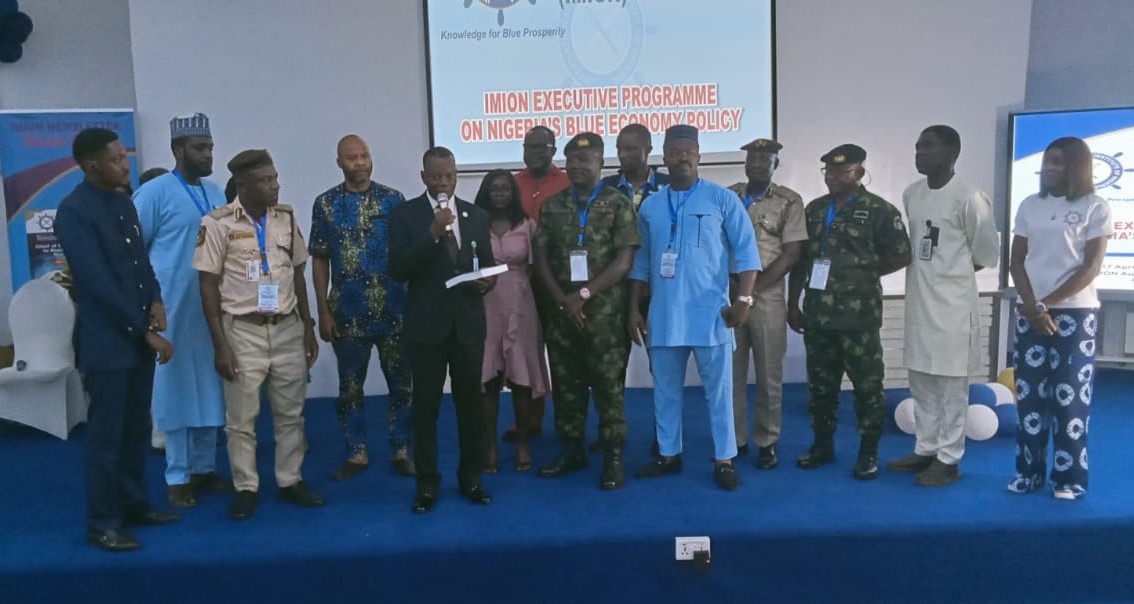
Udofia made this known at the close of a three-day executive programme on Nigeria’s Blue Economy Policy, organised by the institute. He noted that the programme also reflects IMION’s commitment to leveraging technology in positioning itself as a centre of excellence for maritime affairs in Nigeria.
According to him, the institute’s programmes span key areas such as maritime security, the blue economy, ocean governance, environmental sustainability, and energy security. He added that participants engaged in rich and thought-provoking discussions on the opportunities and challenges associated with Nigeria’s blue economy.
“We have examined policy frameworks, explored innovative approaches, and emphasized the importance of collaboration across sectors—government, academia, civil society, maritime industries, and the security community—thereby exemplifying the concept popularly known as the Triple Helix,” he said.
Udofia further explained that the blue economy encompasses a wide range of industrial and service sectors, involving diverse stakeholders, including those in the knowledge industry engaged in marine research, as well as operators in aquaculture and biotechnology.
Other News
Earlier, a consultant to the institute, Dr Mfon Usoro, highlighted the importance of marine organisms to the health sector. She also underscored the need for coordination and collaboration within the blue economy ecosystem, particularly in areas such as seabed mining.
Usoro noted that the absence of marine spatial planning in Nigeria poses significant challenges to effective coordination among stakeholders.
“Since numerous stakeholders have been identified within the blue economy ecosystem and its services, there must be proper coordination. Some of this can be achieved through marine spatial planning, which Nigeria currently lacks,” she said.
She explained that without such planning, conflicts may arise among agencies and operators. For instance, one ministry may restrict activities such as deep-sea mining or oil exploration in certain coastal areas, while other operators may already hold licenses issued by petroleum regulators for related activities in the same locations.
According to her, marine spatial planning would harmonise the activities of various stakeholders by clearly designating specific areas for particular uses, including protected marine zones.
She added that effective coordination would require the involvement of multiple sectors, including national and economic planning, environment, technology, marine and blue economy, petroleum resources, education, and gender-focused institutions, to ensure social sustainability.