Follow Us on Google
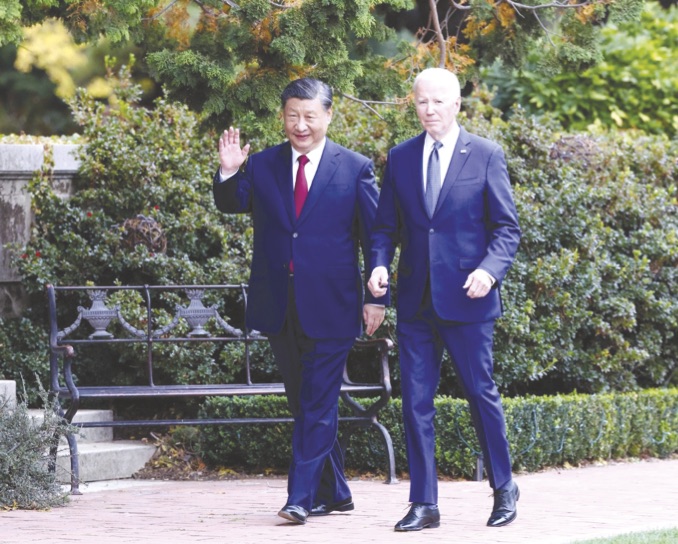

Chinese President Xi Jinping and his United States counterpart, Joe Biden, on November 15, local time, held a summit meeting at he Filoli state, San Francisco, United States. During the meeting, the two leaders eld a andid and n-depth exchange of views on strategic and overarching issues critical to the direction of China-United States relations and on major issues affecting world peace and development.
Xi noted that China and the United States ere faced with two options in the era of global transformations unseen in a century: One is to enhance solidarity and cooperation and join hands to meet global challenges and promote global security and prosperity; and the other is to cling to the zero-sum mentality, provoke rivalry and confrontation, and drive the world toward turmoil and division. The two choices, according to Xi, point to two different directions that will decide the future of humanity and Planet Earth.
Xi added that the China-United States relationship, which is the most important bilateral relationship in the world, should be perceived and envisioned in that broad context, while also saying that for China and the United States, turning heir back on each other is not an option. “It is unrealistic for one side to remodel the other. And conflict and confrontation has unbearable consequences for both sides. Major-country competition cannot solve the problems facing China and the United States or the world. The world is big enough to accommodate both countries, and one country’s success s an opportunity for he other,” Xi stated.
Xi also pointed out that mutual respect, peaceful coexistence and win-win cooperation were the lessons learned from 50 years of China-United States relations, as well as the conflicts between major countries in history. China and the United States, Xi also said, should put in a lot of efforts to follow them.
In San Francisco, i said the two sides hould assume a new vision and build together, five pillars for China-United States relations. The five pillars included: jointly developing a right perception; jointly managing isagreements ffectively; jointly advancing mutually beneficial cooperation; jointly shouldering responsibilities as major countries and jointly promoting people-to-people exchanges.
Xi further elaborated on China’s principled position on the Taiwan question. He pointed out hat the Taiwan question remains the most important nd ost sensitive ssue in China-United States relations, stating that China takes seriously, the positive statements made by the United States in the Bali meeting.
On his part, Biden extended a warm welcome to Xi to the United States for the meeting upon invitation. He noted that he has always believed that the China-United States relationship is the most important bilateral relationship in the world.
While saying that conflict between the two countries is not inevitable, Biden also said a stable and growing China is good for the United States and the whole world.
According to Biden, “When the Chinese economy grows, it benefits the United States and the world. When the United States and China keep their relations stable, prevent conflict, manage differences, and cooperate in areas of shared interest, they will be better able to handle the issues facing themselves and common challenges.”
Biden reaffirmed the five commitments he made in Bali, i.e., the United States does not seek a new Cold War, does not seek to change China’s system, does not seek to revitalize its alliances against China, does not support “Taiwan independence,” and has no intention to have a conflict with China.
Following the meeting, Biden hosted a luncheon in honor of Xi. The two heads of state exchanged views on the Palestinian-Israeli conflict and other international and regional issues of mutual concern.
Biden invited Xi for a walk in the Filoli Estate, and he escorted Xi to his limousine and bade him farewell.

Chinese President Xi Jinping (l) and United States President Joe Biden, taking a walk in the Filoli Estate, San Francisco, United States on the invitation of Biden after a bilateral meeting between China and United States and luncheon held in honour of Xi.
Chinese Modernization: Leaving No One Behind
Modernization is not a luxury for the privileged few. It is the common pursuit of all people around the world. As a developing country with 1.4 billion people, China pursuits a modernization process that features common prosperity, and that is key to the Chinese path to modernization.
Besides the grand vision and blueprints, to realize modernization of the country, China also need concrete measures that are in line with the general rules and the Chinese realities. The Chinese path to modernization features development for the people and by the people, and the development fruits are shared by all. The widely acclaimed victory against poverty is a good example of its significant progress toward common prosperity. The following are some typical measures taken in this process:
First, targeted poverty alleviation; second, blood making rather than blood transfusion; third, all-out efforts by governments at all levels.
First, targeted poverty alleviation. This is to maximize the use of limited resources. A primary-level government identifies each and every poor household under its jurisdiction, creates a file for it and starts the ongoing process of lifting it out of poverty.
Second, blood making rather than blood transfusion. Poor households are encouraged to seek sustainable development on their own, by tapping into their unique location advantages and local resources.
Third, all-out efforts by governments at all levels. Poverty alleviation performance is a key criterion in the evaluation, appointment and promotion of public servants at all levels of government, the county and township all the way to the CPC Central Committee departments and state organs.

Chinese Premier Li Qiang participates in the sixth China International Import Expo
Chinese Premier Vows Further Opening Up At High-Profile Import Expo
Chinese Premier, Li Qiang, on November 5, 2023, vowed efforts to further expand opening up and share China’s development opportunities with the rest of the world. Li made the remarks during his keynote speech at the opening ceremony of the sixth China International Import Expo (CIIE) and the Hongqiao International Economic Forum in Shanghai, China.
Li said China will continue to promote the greater opening up of market opportunities, adding that China has a population of over 1.4 billion people and a middle-income group of over 400 million people, presenting huge potential in terms of market demand.
Noting that China has always been willing to share its market opportunities, Li said the country will actively expand imports, promote coordinated development of trade in goods and services, implement negative lists for cross-border service trade, support innovation in foreign trade formats and models, and boost digital trade.
“China’s imports of goods and services are expected to reach 17 trillion U.S. dollars in cumulative terms in the next five years,” Li said.
The premier also vowed that China will continue to ease market access and implement policies to remove all restrictions on foreign investment’s access in the manufacturing sector.
Li further said China will protect foreign investors’ rights and interests in accordance with the law, and continue to provide a business environment that is market-oriented, law-based and up to international standards.
In his speech, he reiterated China’s commitment to pushing forward, opening up with stronger innovation momentum.
Belt And Road Initiative: A Road Of Openness For The New Era
Spanning thousands of miles and years, the ancient Silk Road brought together, people of various civilizations, religions, nationalities and races across Asia, Europe and Africa. It opened up windows of friendly engagement among nations, and added a splendid chapter to the history of human progress.
As a key measure to advance opening up, the Belt and Road Initiative (BRI) grows from China, but serves the world. Over the past decade, an open China has joined hands with more and more partners for a better world.
Boosting benefit sharing and inclusiveness through opening up, the BRI welcomes all countries with open arms, following the Silk Road spirit of peace and cooperation, openness and inclusiveness, mutual learning and mutual benefit.
The BRI is not ideologically driven, still less with values-related strings attached. It is not created for the sake of power confrontation or forming blocs. In contrast to those “small circles” or “exclusionary groups” pieced together by some countries, Belt and Road cooperation is a big family guided by the principle of extensive consultation and joint contribution for shared benefit. As of June this year, more than 150 countries and 30-plus international organizations have signed over 200 Belt and Road cooperation documents with China.
China, Africa See Bright Prospect For Comprehensive Agricultural Cooperation
The agricultural cooperation between China and Africa has yielded fruitful results with a prosperous future for a comprehensive win-win partnership, officials have said at the second Forum on China-Africa Cooperation in Agriculture.
Themed “Food Security for Africa: a New Chapter for China-Africa Agricultural Cooperation,” the forum was held in Sanya, South China’s Hainan Province, from 13th to 15th November.
In a keynote speech, China’s Minister of Agriculture and Rural Affairs, Tang Renjian, said that over the past decade, China has set up 24 agricultural technology demonstration centers in Africa, and popularized more than 300 advanced agricultural technologies, which have increased local crops yields by an average of 30 to 60 percent, benefiting more than one million farmers in African countries.
Tang also said by the end of 2021, the agricultural investment by Chinese enterprises in Africa reached 12.8 billion RMB (1.77 billion U.S. dollars), growing at an average annual rate of 11.4 percent and creating more than 30,000 jobs.
China Issues White Paper On CPC Policies On Governance Of Xizang In New Era
China’s State Council Information Office, on 10th November, released a white paper on the policies of the Communist Party of China (CPC) on the governance of Xizang Autonomous Region in the new era.
The white paper, titled “CPC Policies on the Governance of Xizang in the New Era: Approach and Achievements,” highlighted that the CPC’s guidelines for governing Xizang in the new era have brought about all-round progress and historic success in various undertakings in the region.
Since the 18th CPC National Congress held in 2012, Xizang has experienced a period of unprecedented development and huge change, bringing more tangible benefits to the people, China’s State Council Information Office said in the white paper.
Xizang’s gross domestic product reached 213.26 billion yuan (about 29.3 billion U.S. dollars) in 2022, representing an average annual growth rate of 8.6 percent since 2012.
The length of the region’s railway network had almost doubled during this period and 5G network has covered all counties and main townships there. The region had also eradicated absolute poverty and average life expectancy of Tibetans had increased to 72.19 years by 2021.