Follow Us on Google

…As over 3,200 exhibitors from 24 countries, regions unveiled nearly 300 new products
The application of artificial intelligence in Chinese manufacturing sector, took centre stage at the 26th China International Industry Fair in Shanghai, China.
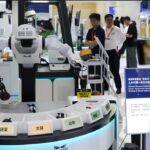
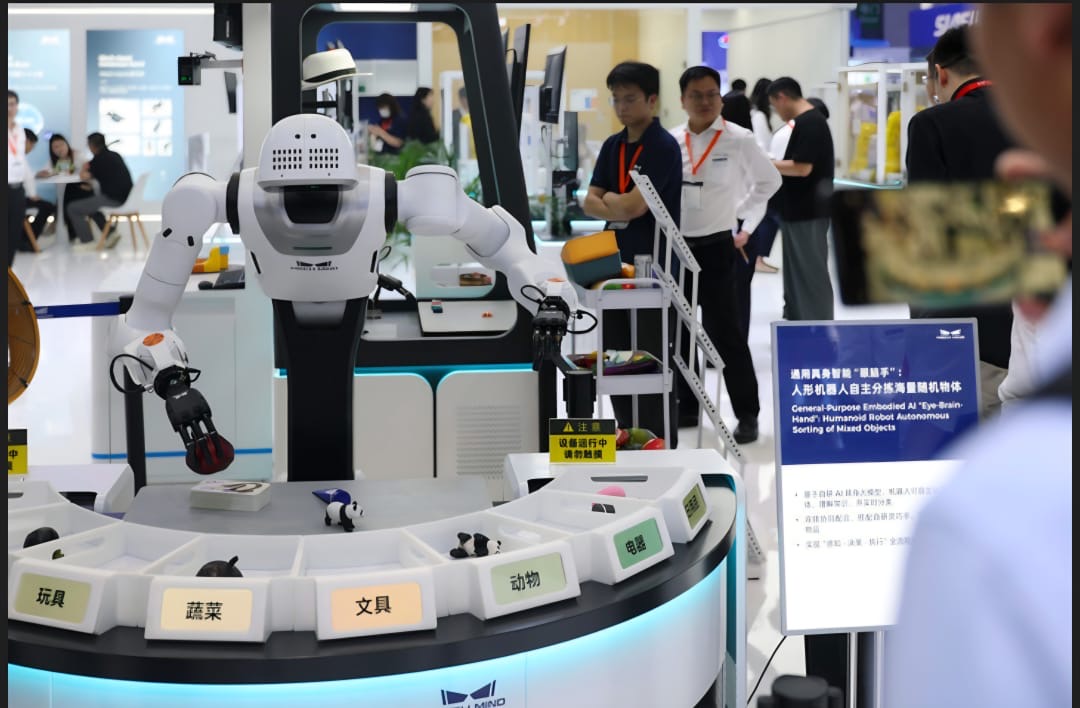
A wheeled humanoid robot picked its way through tightly stacked bins mimicking real factory conditions at an exhibition booth in Shanghai last week, identifying targets, choosing gripping points, and placing items without human intervention.
The event reported by Xinhua News Agency, highlighted how the use of artificial intelligence from staged demonstrations to real production processes, has become a major shift in the Chinese manufacturing industry.
During the fair, over 3,200 exhibitors from 24 countries and regions unveiled nearly 300 new products.
Speaking during the fair, Head of Solutions at the Robot’s Developer, JAKA Robotics, Li Zhipeng, said: “The system has already been validated in a real production environment.”
Li further said at a headlight factory of a leading auto-parts maker, the cycle time per bin fell from 105 seconds to 28 seconds after on-site iteration, while the deployment period for new scenarios was cut from 12 months to 57 days.
The state-owned news agency also stated that beyond physical machines, artificial intelligence agents are beginning to take part in production decisions.
Black Lake Technologies, a leading industrial AI company, it added, displayed more than 10 decision-making agents covering quotation, engineering, scheduling and order tracking, which share information around a single order, enabling downstream plans to adjust as conditions evolve.
Black Lake Technologies’ Founder and Chief Executive Officer, Zhou Yuxiang, said with the development of AI agents, industrial knowledge and production experience are no longer solely dependent on individual accumulation, but can be consolidated within systems for faster replication and application.
At the Siemens booth, more than 20 new products were unveiled, including 13 developed in China.
President of Siemens China, Xiao Song, said the country was one of the world’s most important industrial markets and a key application field for future industrial AI.
“As host city, Shanghai has cultivated two national pilot-level smart factories and 28 national excellence-level smart factories, the most among Chinese cities. Its smart manufacturing system integration industry exceeds 60 billion yuan (about 8.9 billion U.S. dollars), and smart manufacturing equipment output surpasses 150 billion yuan.
“This momentum was further supported by Shanghai’s newly released action plan to accelerate next-generation smart manufacturing, with four major projects and 19 key tasks aimed at deepening the integration of AI and manufacturing.
“At the national level, AI is becoming a key force reshaping China’s manufacturing sector, with the large-scale adoption of smart factories, industrial robots and the industrial internet helping to improve quality and efficiency.
“According to the Ministry of Industry and Information Technology, by the first half of this year, China had built more than 56,000 basic-level, over 9,000 advanced-level, more than 500 excellence-level and 15 leading-level smart factories on a cumulative basis. Meanwhile, during the same period, more than 30 percent of manufacturing firms above designated size had adopted AI technologies.
“The momentum sits inside a broader AI boom. In 2025, China had more than 140 humanoid robot developers and was also home to more than 6,000 AI enterprises. Humanoid robot shipments reached 14,400 units, or 84.7 percent of the global market, according to an industry research report,” Xinhua News Agency wrote.
It also stated that in deepening the integration, China has advanced initiatives, including an “AI Plus” action plan, industrial internet innovation and industrial foundation rebuilding, aiming to push manufacturing toward higher value-added, smarter and greener production.
President of the China Academy of Industrial Internet, Lu Chuncong, said: “China is well positioned to deepen the integration of AI into manufacturing’s vast application scenarios and build a virtuous cycle between technology supply and industrial demand.”