Follow Us on Google
From Tony John, Port Harcourt
The Corporate Accountability and Public Participation Africa (CAPPA), has raised the alarm over the increasing danger of excessive salt consumption in Nigeria.
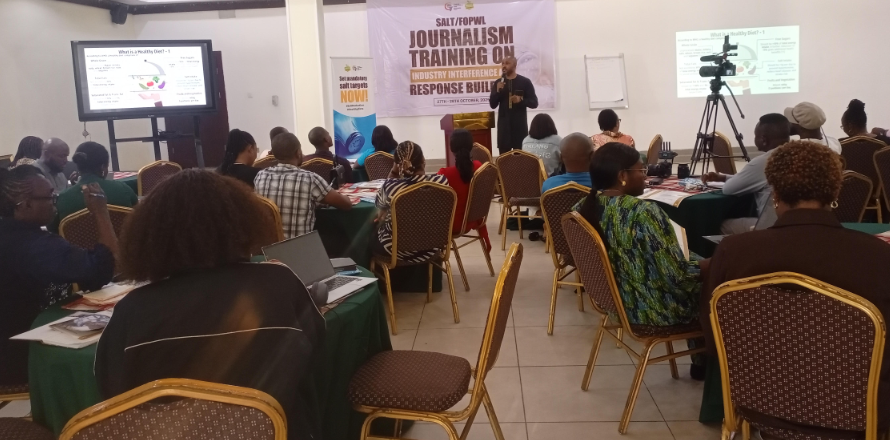
Executive Director, Akinbode Oluwafemi, CAPPA, expressed this during a two-day Salt/FOPL Journalism Training on Industry Interference and Response Building in Port Harcourt, Rivers State on Monday.
He stated that the training was organised within the broader context of Nigeria’s ongoing efforts to advance healthy food policies, particularly in the areas of salt reduction and front-of-pack labels (FOPL).
Oluwafemi emphasized that session seeks to strengthen the media’s understanding of, and capacity to respond to “a critical public health concern, which is the growing influence of food corporations on policymaking and advocacy processes that are central to reducing our country’s growing burden of non-communicable diseases (NCDs).”
According to him, around the world, governments are taking steps to reduce diet-related diseases, and Nigeria is part of this global movement.
He expressed worries that there are intensified attempts by powerful corporate food actors to influence, delay, or dilute these public health policies.
He expressed: “Unfortunately, Nigeria today faces an alarming rise in NCDs such as hypertension, cardiovascular diseases, and kidney failure, and the responsibility to combat these diseases cannot be left to the same food industry whose products and marketing practices help to sustain them.
“Evidence consistently shows that many of these life-threatening and costly conditions are linked to unhealthy diets and the unchecked consumption of ultra-processed foods high in salt, sugar, and unhealthy fats.
“Regarding the excessive consumption of salt, the World Health Organisation (WHO) recommends no more than five grams of salt per day. Yet, studies show that the average Nigerian consumes far more. Most of this salt is hidden in items such as snacks, instant noodles, bouillon cubes, and other pre-packaged products that have become part of our daily diet and urban life. These products are attractively branded and heavily marketed, often without clear nutritional information to guide consumer choices. The result is the vicious public health crisis that we are now dealing with.
Other News
“Excess salt intake raises blood pressure, which in turn increases the risk of hypertension, heart attack, and stroke. Over time, high sodium diets also damage the kidneys and place immense strain on the body’s vital organs.
“These diseases, once considered illnesses of older people, now affect younger populations at alarming rates, imposing both emotional and financial strain on families and stretching an already burdened health system.”
Oluwafemi stated that the consequences of these unhealthy dietary patterns are also visible in the growing number of sudden deaths across the country, which Nigerians locally refer to as the “slump and die” scourge.
He continued: “Unsurprisingly, the United Nations’ (UN) latest global health report for 2025, places the average life expectancy in the country at 54.9 years, meaning Nigeria has the lowest life expectancy in the world, compared to the average global benchmark of 74.7 years.
“This troubling figure reflects a combination of factors, including weak health systems, poverty, and persistent social and economic inequalities. It also underscores the rising contribution of non-communicable diseases to the country’s overall health burden.”
He stressed that addressing this crisis requires, in part, deliberate and evidence-based interventions that strengthen prevention, improve public awareness and promote healthier food environments.
“When it comes to NCDs, health experts have identified several proven, cost-effective policy tools that can significantly reduce risks and improve public health outcomes. Two key measures are the implementation of mandatory salt targets for processed and pre-packaged foods, and the introduction of front-of-pack labels.”
He noted: “Nigeria has begun to make progress in these areas. A few months ago, the Federal Ministry of Health and Social Welfare launched the National Sodium Reduction Guideline which you will hear more about as the training proceeds. This policy commits the country to gradually lower the amount of salt in processed and pre-packaged foods to meet national benchmarks. The goal is to encourage the reformulation of food products, make them safer, and regulate consumers salt intake. It is, in essence, a preventive health measure.
“The Federal Ministry of Health and Social Welfare also inaugurated a National Technical Working Group on Front-of-Pack Labelling (NTWG-FOPL) earlier this year in order to empower Nigerians to make healthier food choices. Front-of-Pack Labels are simple visual tools that use clear text, colour codes, or symbols to show when a product contains unhealthy levels of salt, sugar, or fat. The idea is to ensure that people can make informed decisions around their food choices regardless of their literacy level.”