Follow Us on Google

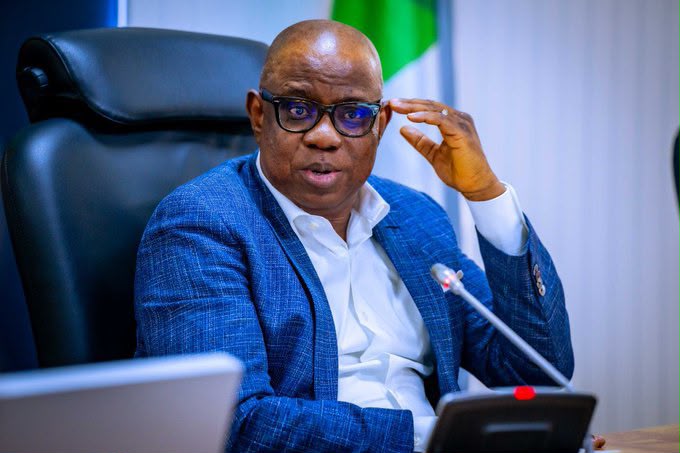
Deputy Spokesman of the House of Representatives, Rep. Philip Agbese, has told a select committee of the British Parliament at the House of Lords in Westminster that the leadership of Engr. Bashir Bayo Ojulari has repositioned the Nigerian National Petroleum Company Limited (NNPCL) to serve the interests of ordinary Nigerians rather than a privileged elite.
Agbese, who spoke while addressing the lawmakers on the Tinubu administration, described the ongoing reforms at the national oil company as a significant departure from years of opacity, elite capture and systemic waste.
He said Ojulari’s leadership was transforming NNPCL from what he described as an elite conspiracy of corruption into an institution capable of delivering tangible economic benefits to the wider population.
“Ojulari has migrated NNPCL from an elites’ conspiracy of corruption to the saving grace of common citizens,” Agbese said.
“What we are witnessing is not cosmetic reform. It is a deliberate effort to dismantle entrenched interests and rebuild the company as a national asset that serves the Nigerian people.”
The lawmaker cited improved oil production, cost reductions through contract reviews and more consistent remittances to the Federation Account as evidence of the reforms, noting that the gains could translate into more resources for infrastructure, security and essential social services.
He highlighted the reported rise in output from NNPC Exploration and Production Limited to multi-decade highs, the restoration of monthly financial and operational reporting, and progress on critical gas infrastructure, including the Ajaokuta-Kaduna-Kano (AKK) pipeline.
Agbese also said timely cash-call payments and improved transparency had helped rebuild confidence among joint-venture partners and international investors.
According to him, previous practices characterised by delayed financial obligations, opaque contracting and underperforming assets had weakened the company and deprived the country of resources needed for development.
He said the current management was introducing stronger commercial discipline, accountability and long-term value creation in line with the Petroleum Industry Act.
“When NNPCL operates as a true commercial entity instead of a political patronage structure, every Nigerian stands to gain,” he said.
“Higher crude and gas production generates more foreign exchange and stronger Federation Account inflows that support the public services ordinary citizens rely on.”
The deputy spokesman further commended the management’s approach to loss-making refineries, contract reviews and the public disclosure of audited results, describing these measures as evidence that entrenched interests were being challenged.
He said the reforms demonstrated how decisive leadership could reposition a troubled public institution to contribute more effectively to national development.
Agbese also pointed to growing investment interest in Nigeria’s energy sector, citing potential investments worth tens of billions of dollars associated with gas supply agreements and deepwater projects.
He linked the developments to broader efforts to unlock the country’s gas resources, attract international capital and reduce excessive dependence on crude oil revenues.
The lawmaker urged international partners to strengthen engagement with NNPCL, arguing that greater transparency and commercial credibility would provide a stronger foundation for cooperation with global energy companies.
“What is happening at NNPCL today shows that meaningful reform is possible when leadership places the collective interest above sectional advantage,” he said.
“The company is no longer structured primarily to serve a narrow elite. It is being repositioned as an engine that generates revenue, creates jobs and advances the aspirations of the wider citizenry.”
Agbese called on international stakeholders to recognise the changes and explore opportunities for collaboration, saying an efficient and commercially focused national oil company would strengthen energy security and support Nigeria’s economic ambitions.
He, however, stressed the need to sustain and deepen the reforms to ensure that the gains recorded translate into lasting improvements in national revenue, energy production and citizens’ welfare.
According to him, continued progress in upstream production and gas commercialisation would help ensure that the benefits of Nigeria’s hydrocarbon resources extend beyond privileged networks to ordinary households.
“The true test of leadership is whether institutions serve the many or the few,” Agbese said.
“Under Bayo Ojulari, NNPCL is beginning to pass that test. The shift from elite conspiracy to citizen-centred value creation is underway and must be sustained. Nigeria’s energy future depends on protecting this trajectory.”