Follow Us on Google
By Omoniyi Salaudeen
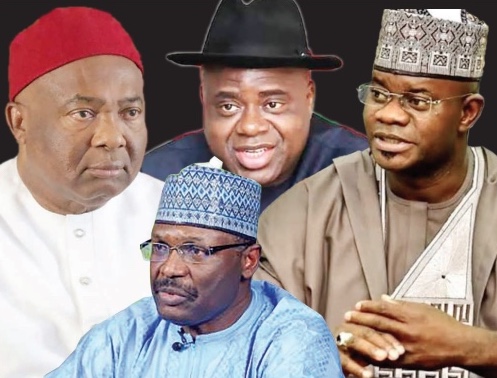
IT’S now less than a month before
the Imo, Bayelsa, and Kogi states
governorship elections. Except for
any change of arrangement, the three
off-season elections will be held on
November 11.
This is according to the timetable
and schedule of activities released by
the Independent National Electoral
Commission (INEC). The release is
in line with Sections 178(1) and (2)
of the Constitution of the Federal
Republic of Nigeria 1999 mandating
the Commission to conduct such
elections not earlier than 150 days
and not later than 30 days before
the expiration of the term of the last
holder of the office.
Constitutionally, the tenure of the
incumbent governor of Imo State ends
on January 14, 2024, while those of
Kogi and Bayelsa states will end on
January 26, 2024, and February 13,
2024, respectively. Though with much
skepticism, preparation is gradually
building toward the conduct of the
elections. Ahead of the D-day, the
Commission has released the final list
of candidates participating in the polls
following voluntary withdrawal and
substitution of candidates by political
parties. Section 32(1) of the Electoral
Act 2022 requires the publication of the list not later than 150 days
before the election. The list shows
that all the 18 political parties are
fielding candidates in Kogi State,
17 in Imo State, and 16 in Bayelsa
State. Two political parties are said
to be fielding female candidates in
Bayelsa State, one in Kogi State,
and none in Imo State.
Having concluded all
arrangements regarding the schedule
of activities, the highlight of public
discussion is now the transparency
of the process.
The umpire has had to grapple
with a huge trust deficit following its
inability to transmit the results of the
Presidential and National Assembly
elections to the IReV portal in
real-time. The introduction of
BVAS technology had raised public
excitement about the credibility and
transparency of the electoral process
before the conduct of the February
25 presidential poll, but the backlash
of non-transmission of results has
resulted in a huge public distrust.
As a result, both the candidates
of the Peoples Democratic Party
(PDP), Atiku Abubakar, and Peter
Obi of the Labour Party have been
entangled in a prolonged legal
battle seeking to upturn the victory
of President Bola Ahmed Tinubu.
One of the grounds of their petitions
against the INEC at the tribunal
is the refusal to transmit results
electronically to the server for public
viewing as earlier promised, citing
technical glitches as the reason for
opting for manual transmission.
However, the five-man panel
led by Justice Haruna Tsammani
in a unanimous judgment held that
there was “nothing in the Electoral
Act 2022 specifically states that
BVAS should be used to transmit
election result,” adding that neither
the Electoral Act nor INEC manual
specifically provided for electronic
transmission.
Against this background,
concerned stakeholders have
engaged in the debate about the
imperative or otherwise of the
need for the umpire to adhere to
electronic transmission during the
conduct of the forthcoming off-
season elections in Imo, Bayelsa, and Kogi states.
The National Publicity Secretary
of the Labour Party, Obiora Ifoh,
who dismissed the excuse of
technical glitches as a deliberate act
of sabotage in a telephone discourse
with Sunday Sun, maintained that
challenges experienced in the last
election must be avoided in the
coming elections.
He said: “Let me first say that
the technology of transmitting
results to IREV is good and there
is no problem with it. It worked
perfectly during the last election
only that they tried to stop a
particular candidate from winning
by not transmitting the result.
Everything went perfectly during
the National Assembly election,
but when it came to the presidential
election, it stopped working. It was
purely a human fault. Don’t forget
that Nigeria spent N350 billion
to procure the BVAS technology,
and it was proven to be sound and
infallible by technology experts. So,
the glitches you saw that day were
manmade. It has nothing to do with
the machine.
“Having said that, the challenge
we had in the last election should
be avoided in the coming off-season
elections, particularly in Imo State.
As I talk to you now, INEC has put
up a staff structure that is loyal to
the governor and willing to work
for the state government. By next
week, we are going to make a formal
appeal to the police service. We will
address a press conference on this
next week. So, the problem is not
going to come from IReV, it is from
the same character that truncated the
effort of the Nigerian government in
bringing forth a reliable election.”
Chief Okorie Chekwas, in a
counter opinion, insisted that there
is no enactment to compel INEC to
transmit any result electronically to
the server in the coming elections.
He said: “One lesson political
parties and their candidates must
have learned from the recent
judgment of the Appeal Court on
Peter Obi and Atiku petitions is that
INEC is not compelled by law to
transmit results even when they have
promised to do so. Failure to do so will not make them liable for any
breach of the law. So, until the
electoral law is amended, which is
one of the challenges of the National
Assembly, INEC is not under
obligation to transmit results.
“What I will advise political
parties to do is to ensure that they
have agents accredited by INEC to
monitor the election at every polling
unit, collect the form EC8A and
diligently follow the results to the
collation centre and report to their
principals.
“In 2003, when I was the
National Chairman and founder of
the All Progressives Grand Alliance
(APGA), we made sure we had our
agents in all the polling units in
Anambra State. The result showed
that Peter Obi won that election, but
PDP went to somewhere to write a
different result which was declared
as authentic by the INEC and Chris
Ngige as the winner. However, it
was easy to detect that APGA result
sheets were authentic because we
had our agents in all the polling
units. That was how Peter was able
to win the case at the tribunal. In
spite of the fact that the people
who contested the election with us
had far larger war chess in terms
of money than our candidate, the
tribunal had no choice, but to give
judgment to the rightful winner. I
had said it earlier before the Appeal
Court gave the recent judgment that
other parties didn’t have enough
evidence to prove that they won the
election. One of them didn’t even
have agents in certain locations. It
is the form EC8A that is superior to
results on the IReV portal. So, they
lost from the beginning.
“The bulk of responsibility is
on the political parties rather than
the INEC because it is the political
parties that will file petitions that
they have been cheated and the
Court of Appeal has already said
that the onus is on the petitioners
to prove his allegation. INEC that
declared result will always be there
to defend it. It has become clear that
there are still certain things to be
amended in the Electoral Act and the
constitution to make it mandatory
for the INEC to transmit results electronically so that the idea of
giving excuses will not arise again.”
Chief Kokori Frank also joined
the fray, accusing the Labour Party
of unjustly castigating the INEC.
He said: “It is a pity that the Labour
Party and Peter Obi have decided to
wage a war of calumny against the
INEC. I think the INEC has done its
best in the history of elections in this
country. The reason is because of the
introduction of BVAS technology
into our electoral process which has
significantly reduced the incident of
rigging. If not for the BVAS, how
could he (Obi) have come close to
the figures recorded by Tinubu and
Atiku? To me, BVAS is a game
changer. In my area here, Obi did
not even have agents in any polling
unit. Yet, he won the majority of
votes in most of the states in the
South-south. But there is so much
propaganda by his mob followers
that the election was rigged.
“The judgment of the Appeal
Court is so sound that it does
not need any explanation from
any lawyer. Even a layman can
understand the judgment because
the judges dissected every issue
one by one. I wonder what they are
taking to the Supreme Court for,
giving the country a lot of tension.
Supreme Court will be more ruthless
on them in its ruling this time around
for coming with frivolous claims
wasting the time of judges.”
Arguably, INEC has a huge
responsibility to conduct free, fair,
and credible elections in these
states to reduce the tension in the
country. Since the conduct of the
last general election, the polity has
been inundated with inflammatory
comments, innuendoes, and
incendiary remarks threatening the
integrity of the judiciary. In extreme
cases, some unrestrained individuals
have even instigated military
intervention dismissing the last
election as an aberration to genuine
democratic governance.
The electoral umpire will do a lot
of good to the country by restoring
confidence in the system and
ensuring a transparent and credible
process during the forthcoming
elections in the affected states.