Follow Us on Google

•WHO to improve global coordination during future outbreaks
By Doris Obinna
At the annual gathering of the World Health Organization (WHO) in Geneva, Director General, Tedros Ghebreyesus delivered what amounted to both a progress report and a warning; the world has made measurable gains in public health, but many of those gains remain fragile.
Addressing delegates on Sunday, at the 79th World Health Assembly, Ghebreyesus outlined a sweeping catalogue of achievements spanning maternal health, vaccines, disease elimination, pandemic preparedness and emergency response. Yet, progress is slowing at the very moment global solidarity is under strain.
“Reinvigorating it must be a global health priority,” he said, referring to the fight against child mortality.
He noted that the world health system is operating simultaneously in triumph and crisis, vaccinating millions, eliminating diseases in multiple countries, responding to wars and outbreaks, and trying to prepare for future pandemics while still recovering from the last one.
According to updated estimates released this year, 4.9 million children died before reaching their fifth birthday in 2024. Although under-five mortality has declined by more than half since 2000, WHO says the pace of improvement has slowed dramatically, especially in high-burden countries.
To address maternal and child health, WHO has expanded technical guidance and policy support in dozens of countries. It stated that more than 55 nations are now using updated maternal mortality estimates to refocus national priorities.
Ghebreyesus also mentioned that WHO and its partners issued the first consolidated global guideline on postpartum haemorrhage; the leading cause of maternal death worldwide in an effort to standardize lifesaving care.
The agency also released its first global infertility guideline and updated data on violence against women; findings that he said showed “little progress in 20 years.”
He said: “Policy reforms backed by WHO in 50 countries have sought to reduce unintended pregnancies, expand Human Immunodeficiency Virus (HIV) and Sexually Transmitted Infections (STI) self-testing, and improve cervical cancer screening coverage.”
Vaccination campaigns formed one of the central themes of the address. In March, WHO concluded the “Big Catch-Up” initiative, launched with Gavi, the Vaccine Alliance and United Nations Children’s Fund (UNICEF) to reach children who missed routine immunizations during the COVID-19 pandemic.
Over three years, the initiative delivered more than 100 million vaccine doses to an estimated 18.3 million children across 36 countries.
WHO also supported seven additional countries in introducing malaria vaccines, bringing the global total to 25 countries and targeting roughly 10 million children annually while fifteen more countries introduced HPV vaccines aimed at preventing cervical cancer.
The DG further noted that nearly 75 countries have now incorporated HPV vaccination into routine immunization programs since the global elimination campaign against cervical cancer began in 2018. “As a result, approximately 65 per cent of girls worldwide now live in countries with routine HPV vaccination,” he added.
Defending vaccine science against persistent misinformation, the DG highlighted a review of 31 studies conducted over 15 years reaffirmed that vaccines including those containing thiomersal and aluminium adjuvants, do not cause autism.
He said: “Over the past year, WHO confirmed the elimination of seven diseases in 17 countries. Several African and Middle Eastern countries eliminated trachoma, a preventable infectious cause of blindness while five countries eliminated mother-to-child transmission of HIV, and Maldives became the first nation to achieve “triple elimination” of mother-to-child transmission of HIV, hepatitis B and syphilis.”
HIV next best thing to vaccine
The organization prequalified lenacapavir; a long-acting injectable HIV prevention treatment administered every six months while simultaneously issuing guidelines for its rollout in 14 countries.
Ghebreyesus described the drug as “one of the most powerful and promising tools in the history of HIV,” calling it “the next best thing to an HIV vaccine.”
Other News
He stated that WHO also reported progress against tuberculosis through expanded access to rapid diagnostics and shorter, safer treatment regimens. Preparations according to him are underway for future deployment of TB vaccines currently in late-stage trials.
On malaria, the organization prequalified the first treatment developed specifically for newborns and infants, alongside new diagnostic tools capable of identifying strains missed by older tests.
Meanwhile, WHO’s latest hepatitis report showed that annual hepatitis B infections have dropped by nearly one-third since 2015, while hepatitis C-related deaths have fallen by 12 per cent globally.
Addressing Non-Communicable Diseases (NCDs) and mental health, he disclosed that it recently issued new guidance on the use of glucagon-like peptide-1 (GLP-1) medications for obesity treatment in adults reflected growing global interest in a class of drugs reshaping diabetes and weight management care.
According to him, cancer initiatives focused on cervical, breast and childhood cancers are now reaching more than one million people in over 100 countries. He further stated that in partnership with St. Jude Children’s Research Hospital, WHO delivered 1.5 million cancer medicines to support treatment for 2,400 children in five countries.
While addressing mental health, he added that mental health services also expanded substantially. “Since 2020, WHO’s Special Initiative for Mental Health has extended services to more than 90 million people and enabled first-time treatment for over 1.5 million individuals. In Africa, WHO is helping 13 countries improve access to neurological medicines for epilepsy and Parkinson disease, conditions where treatment gaps exceed 75 per cent.”
Preparing for the next pandemic
Even as WHO highlighted immediate health gains, the shadow of COVID-19 remained evident at the meeting. He noted that last year, member states adopted the WHO Pandemic Agreement and amendments to the International Health Regulations entered into force which are major milestones aimed at improving global coordination during future outbreaks.
Ghebreyesus emphasized that preparedness now extends far beyond emergency stockpiles. “WHO, through the Pandemic Fund and the World Bank, supported 70 countries in strengthening surveillance systems, laboratories and health workforce capacity.
“The organization also launched a new Global Health Emergency Strategy with an ambitious goal: ensuring that 10 per cent of the world’s health workforce is prepared to respond to emergencies by 2030.
“As artificial intelligence is increasingly becoming part of that strategy, WHO’s Epidemic Intelligence from Open Sources system (EIOS) now supports more than 120 countries by using AI-powered monitoring to detect emerging threats faster.
“At the same time, the International Pathogen Surveillance Network and the Global Influenza Surveillance and Response System are expanding genomic monitoring and virus-sharing efforts worldwide,” he stated.
Responding to emergencies
Preparedness, however, has not lessened the burden of current emergencies. In the past year alone, WHO says it detected 4.2 million health-threat signals and supported responses to 50 emergencies in 82 countries.
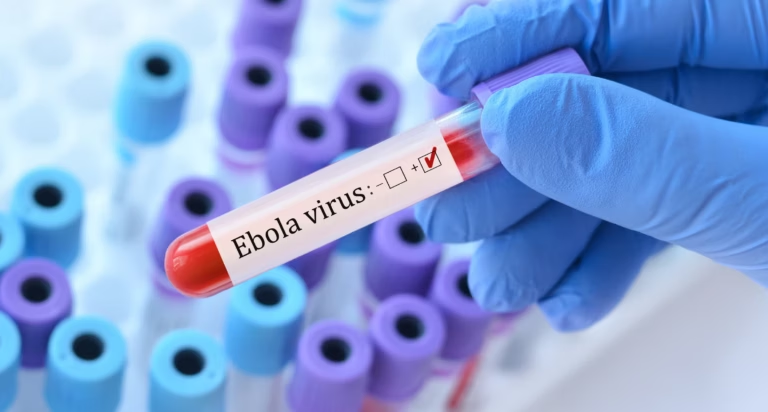
Ghebreyesus reiterated that the organization coordinated responses to outbreaks of Ebola, Marburg virus disease, cholera and meningitis, while continuing efforts to eradicate polio. He warned that attacks on healthcare are becoming normalized in modern conflict. It also verified 1,385 attacks on healthcare facilities and personnel in 19 countries and territories in 2025 alone, resulting in nearly 2,000 deaths.
Underlying all of WHO’s initiatives, he said, is a growing effort to modernize the organization’s scientific and digital infrastructure. “WHO recently convened the first Global Forum of WHO Collaborating Centres in Lyon, bringing together nearly 1,200 participants from hundreds of research institutions worldwide.”
The agency said it is also overhauling how it develops and disseminates global health guidelines and expanding international clinical trial networks.
In conclusion, he stated that WHO’s mandate; fighting infectious diseases, managing humanitarian crises, supporting mental health, expanding cancer care, defending vaccines, preparing for future pandemics and helping nations build stronger health systems, all at once is one of cautious determination.