Follow Us on Google
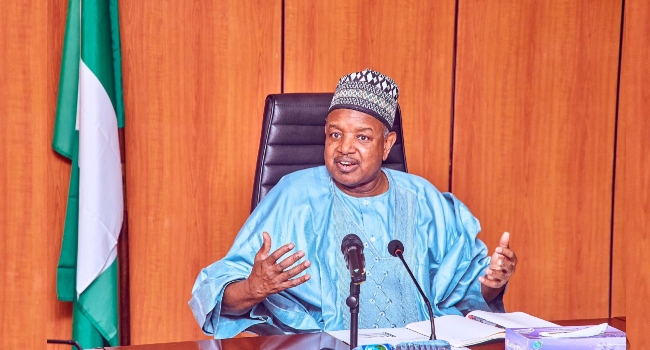
Minister of Budget and Economic Planning, Senator Abubakar Bagudu, has said that Nigeria remains firmly committed to a just and equitable energy transition that aligns with its development goals.
Delivering the keynote address at the Global South Peer Learning Workshop on Country Platforms for Climate Action and Just Energy Transition, in Abuja on Tuesday, Bagudu emphasised that the country is strategically implementing its Energy Transition Plan (ETP) through dedicated institutions.
“Our Energy Transition Plan (ETP) is a homegrown, data-backed strategy for achieving net-zero emissions fairly and equitably by 2060,” he said.
According to the minister, the ETP—launched in 2022—has evolved into Nigeria’s national policy, providing a comprehensive framework that integrates climate ambition with socio-economic development.
He noted that the plan focuses on five critical sectors—power, transport, cooking, oil and gas, and industry—which together account for about 65 per cent of Nigeria’s greenhouse gas emissions. The broader objectives, he explained, include universal energy access, poverty alleviation, economic growth, and job creation.
Bagudu outlined the multifaceted nature of Nigeria’s energy transition strategy, which he said is designed to reduce emissions and foster sustainability across all sectors.
“Decarbonising power is central to our strategy in the power sector. Nigeria plans to aggressively expand its generation capacity through renewable sources, such as solar and wind, while strengthening its national grid and distribution networks,” he said.
On transport, Bagudu highlighted a two-pronged approach: the adoption of cleaner fuels and vehicles alongside the expansion of mass transit systems. “Nigeria is promoting Compressed Natural Gas (CNG) and Electric Vehicles (EVs) to replace gasoline and diesel in road transport,” he noted.
He cited the Presidential CNG Initiative, which aims to convert public transit vehicles to CNG, leveraging Nigeria’s abundant gas reserves to reduce emissions and cut fuel costs. He also pointed to President Bola Ahmed Tinubu’s recent directive to launch a pilot fleet of 100 electric buses in major urban centres.
Other News
On household energy, Bagudu said the government is working to phase out traditional cooking fuels like firewood, kerosene, and charcoal. “We’ve significantly increased access to Liquefied Petroleum Gas (LPG), distributed cylinders and stoves, and implemented policies to make LPG affordable and widely available,” he added.
He stressed that Nigeria has undertaken sweeping reforms to support its climate agenda. “The Climate Change Act of 2021 is a landmark legislation that provides a legal framework for coordinated climate action across all sectors,” Bagudu said. The Act introduces five-year carbon budgets, annual emission targets, and institutionalizes the National Council on Climate Change (NCCC) to oversee implementation.
He further noted, “Nigeria has updated its Nationally Determined Contribution (NDC) under the Paris Agreement, enhancing its targets to align with our 2060 net-zero goal.”
Bagudu also cited complementary legislation such as the Electricity Act 2023, which liberalised the power sector, allowing state governments and private players to generate, transmit, and distribute electricity.
“In the oil and gas sector, the Petroleum Industry Act (PIA) 2021 restructured the regulatory landscape, aligning it with climate priorities. It increased penalties for gas flaring, mandated gas utilisation plans, and created a Host Communities Fund to support local development and drive a just transition in oil-producing areas,” he said.
According to the minister, Nigeria has also created robust institutional structures to drive climate and energy transition governance. “The NCCC is the apex body, working in tandem with the Energy Transition Inter-Ministerial Working Group, which coordinates the implementation of the ETP,” he explained.
Bagudu reiterated Nigeria’s commitment to global climate cooperation and solidarity, particularly in advancing the interests of the Global South. “Climate change is a global challenge that no country can solve alone. Nigeria’s diplomacy is anchored in the principle of ‘common but differentiated responsibilities,’ which recognises that while every nation must act, developed countries must support developing nations with finance and technology,” he said.
He affirmed Nigeria’s continued engagement at multilateral forums. “We are active in the African Group of Negotiators and the G77+China bloc at the UNFCCC, consistently advocating for outcomes that reflect Africa’s priorities,” he said.
Bagudu also reaffirmed Nigeria’s support for the Loss and Damage Fund, established at COP27 to help vulnerable countries manage the consequences of climate disasters. He emphasized that climate adaptation is just as urgent as mitigation, pointing to Nigeria’s backing of the Africa Adaptation Initiative and other regional platforms aimed at addressing drought, flooding, and desertification.