Follow Us on Google
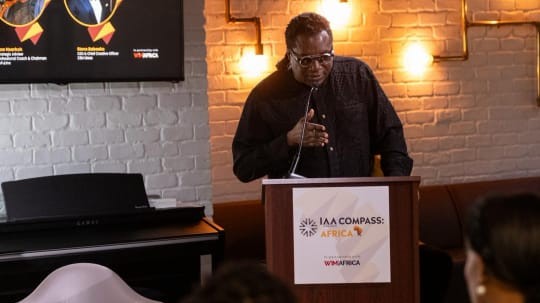
Advertising veteran Steve Babaeko has called for a strategic overhaul of the UK–Africa relationship, urging policymakers and businesses to move beyond legacy thinking and embrace partnership built on opportunity and relevance.
Speaking at the IAA Compass Africa Conference in Fordham as President of IAA Nigeria and Director of IAA Africa under the International Advertising Association, Babaeko drew on decades of industry experience rather than abstract theory.
Reflecting on the first time he saw a Nigerian advertising campaign reach audiences beyond Africa, he said it was a turning point: “We were not just creating ads; we were exporting identity.”
For Babaeko, that moment illustrates a broader transformation spanning culture, economics, and geopolitics, one that demands a reimagined approach to collaboration.
Criticizing the traditional framing of UK–Africa relations around “empire, aid, and dependency,” he said such perspectives anchor the relationship in outdated assumptions.
“The UK–Africa connection today is not just about history. It is about relevance, opportunity, and shared future,” he told the audience.
Acknowledging the complexities of colonial legacies and structural imbalances, Babaeko emphasized that genuine partnerships require clarity, intentional progress, and recognition of mutual value rather than sentiment or denial.
Culture, he argued, is one of the most potent connectors between Africa and the UK. Using Afrobeats as an example, he highlighted how collaboration, rather than hierarchy, drove its global influence, aided by UK diaspora communities, radio platforms, and live performance circuits.
“Culture goes where policy cannot,” Babaeko said. “It builds familiarity before agreements are signed. It humanizes markets.”
Economically, Babaeko framed Africa not as a “development challenge” but as a growth frontier, with a young, rapidly expanding population driving new markets and entrepreneurial opportunities.
For the UK, engaging Africa is about strategic relevance, not charity. “Words reveal mindset,” he noted. “And mindset shapes policy. “At the heart of his address was a call to rewrite the script of UK–Africa relations. “The old script says the UK gives and Africa receives.
The new script must say: we build together,” he said, advocating for fairer trade, deeper investment in African enterprise, support for creative industries, and greater mobility of talent and ideas.
Looking ahead, Babaeko framed the relationship within a rapidly shifting global context, warning that “no serious country can afford to misunderstand Africa. And no serious African nation should accept being treated as an afterthought.”
With Nigeria approaching the centenary of formal advertising practice in 2028, he emphasized the opportunity to redefine commercial and cultural ties as instruments of mutual growth rather than remnants of empire.
Babaeko concluded with a challenge: the future of UK–Africa relations hinges not on history alone, but on imagination, strategy, and the willingness to build something equal, a future that may already be within reach.