Follow Us on Google

By Moses Akaigwe
The recent fact-finding tour of selected automobile assembly and manufacturing plants by members of the Governing Board of the National Automotive Design and Development Council (NADDC) has provided a revealing insight into the state of Nigeria’s automotive industry.
From Lanre Shittu Motors (LSM), Mikano Motors and CIG Motors in Lagos, to Kojo Motors in Umunya and Innoson Vehicle Manufacturing Company (IVM) in Nnewi, Anambra State, one common feature stood out: low utilisation of installed production capacity, despite the impressive facilities and equipment available in many of the plants.
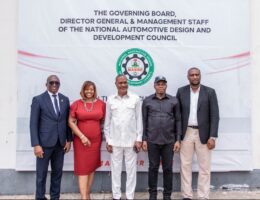
For Chief Emma Eneukwu, chairman of the NADDC Governing Board, the tour was an eye-opener.
Having heard a great deal about the activities and capabilities of some of the companies, Eneukwu said seeing their operations first-hand had given him a new appreciation of what Nigerian manufacturers and engineers could achieve when given the right support.

“I have come and I am surprised at the enormity of what Nigerians can do,” he said after inspecting a couple of the assembly plants accompanied by the NADDC director-general, Otunba Oluwemimo Joseph Osanipin, some directors and members of the Governing Board.
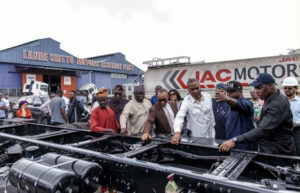
“I went round and I saw Nigerian engineers doing all manner of things. Things you used to believe Nigerians could not do.”
His assessment perhaps captures the central message from the multi-legged tour: Nigeria does not lack the human capacity or basic industrial infrastructure to develop a viable automotive manufacturing industry.
High capacity, low patronage
At Mikano Motors’ Karameh City in Warewa, along Lagos Ibadan expressway, the scale of the challenge became particularly evident. The company currently operates an SKD assembly plant with the capacity to produce between 15,000 and 20,000 vehicles annually. Yet, according to the National Operations Manager, Syam Abdulkadir, market demand remains below the plant’s production capability.
Regardless, the company, he disclosed, keeps the plant busy with daily assembly operations – producing Changan luxury SUVs and sedans, as well as the popular Maxus pick-ups..
Mikano nevertheless plans to migrate from SKD to CKD production, which would enable it to deepen local manufacturing and increase production capacity.
But such an investment, the company indicated, would make stronger commercial sense if demand for locally assembled vehicles increases.
The issue goes beyond Mikano. Across the facilities visited by the NADDC delegation, the difference between what the plants are capable of producing and what the market currently absorbs was evident.
The tariff differential between completely knocked-down (CKD) kits and fully built units (FBU), therefore, featured prominently during the discussions at virtually every stop, with both Chief Eneukwu and the NADDC Director General, Otunba Oluwemimo Osanipin, assuring of numerous initiatives to address the challenges faced by the auto industry.
He cited specifically the Federal Government’s Nigeria-First policy which directs all ministries, departments and agencies to buy only vehicles produced locally.
Osanipin also mentioned the hope-raising, well-articulated Draft National Automotive Industry Bill 2026 which the NADDC presented to stakeholders recently and was okayed with various fresh inputs. The bill, he said, would soon go to the Ministry of Justice preparatory to going for legislative approval, and subsequent presidential assent.
Nigerian engineers, technicians take over assembly plants
Perhaps the most encouraging discovery of the tour was the composition of the workforce at the plants.
At almost every facility visited, the majority of employees—particularly those working directly on assembly lines and in technical operations—were young Nigerians.
At Lanre Shittu Motors, Managing Director Taiwo Shittu disclosed that the company had only one expatriate among its 327-member workforce.
“Gone are those days when you had five expatriates. Over time, we have seen that Nigerians are even better. What you just need is to give them the opportunity and give them the working know-how because they have the knowledge,” he said.
The company, he added, had many young and talented Nigerians working in its operations.
At Innoson Vehicle, the Chairman and Chief Executive Officer, Chief Innocent Chukwuma, CON, recalled that at inception about 17 years ago, the company had no fewer than 60 Chinese expatriates helping to guide the engineering and technical team responsible for producing its early generation of vehicles.
Today, however, the situation is markedly different, with Nigerians making up a very high percentage of the workforce with no expatriates sighted during the visit.
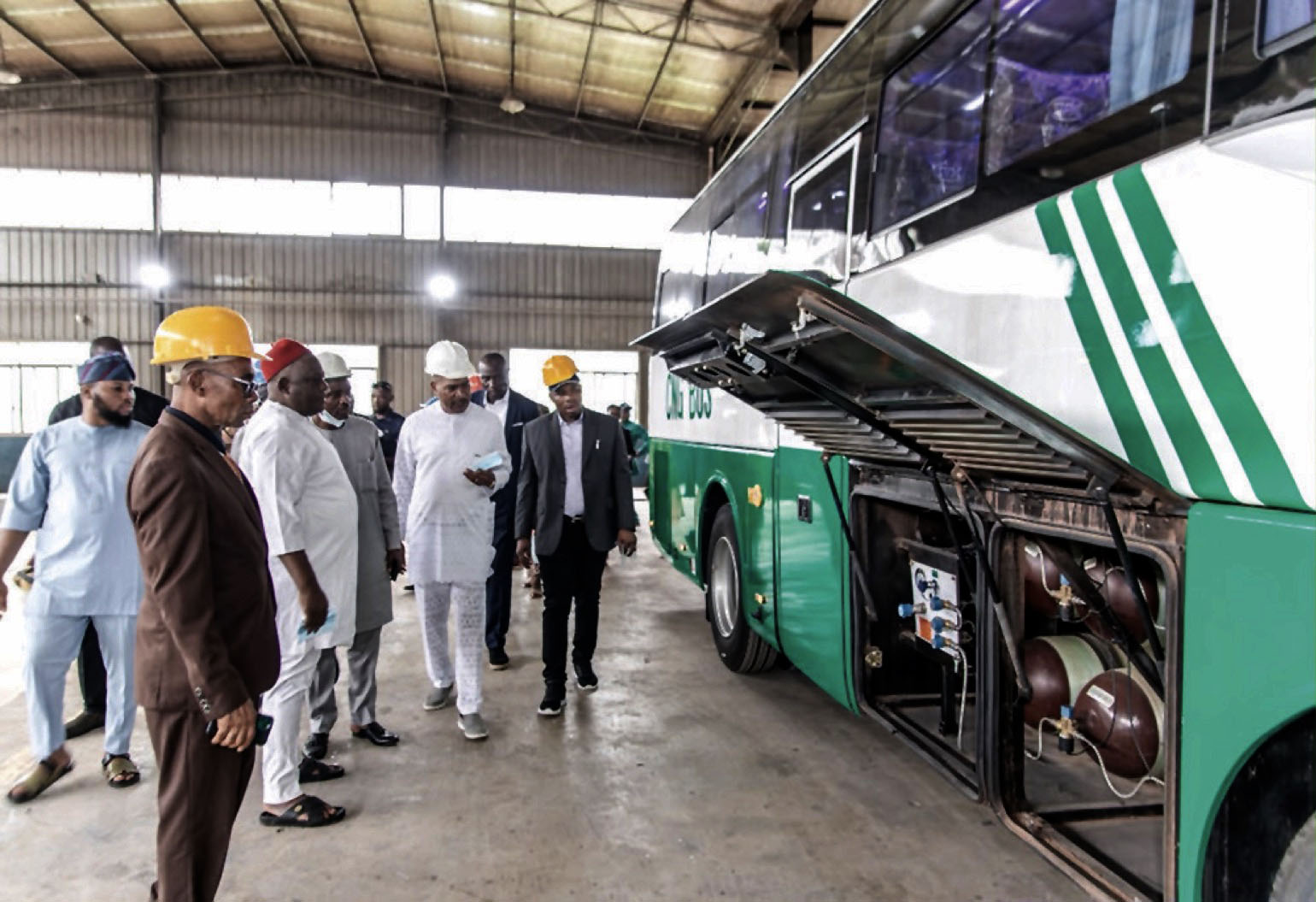
The development is even more evident at IVM’s new plant dedicated to the production of CNG-powered and electric vehicles.
The new facility in Nnewi, described as being about the size of two stadia, is already involved in the construction of articulated trucks and is designed to manufacture electric vehicles and heavy-duty commercial vehicles powered by CNG.
For Eneukwu, what he saw at IVM was jaw-dropping and far beyond what he had imagined.
The first-time visitor to the plant said he had heard a lot about Nigeria’s first indigenous automobile manufacturing company, but did not expect the investment and physical scale of the facility to be so massive.
From SKD to CKD
The need to deepen local manufacturing was another recurring theme of the tour.
At CIG Motors, the NADDC delegation was told of the company’s emphasis on human-capital development and technology transfer.
Special Adviser to the Chairman of CIG Group, Brigadier General Chukwuemeka Udaya (rtd.), said many of the company’s workers were young Nigerians, most of them below 27.
Other News
He said the company had partnerships with universities across southern Nigeria, including Yaba College of Technology, through which students undertake industrial attachments.
Some Nigerian graduates, he added, had also been sent to China for 18-month postgraduate training.
The objective is to equip Nigerian engineers with the skills required to manufacture vehicles locally and bring international experience into the country’s automotive industry.
Bawo Omagbitse, one of the NADDC Board Members present who is also the Chairman of the Nigerian Automotive Manufacturers Association (NAMA), called for deeper backward integration.
He stressed the need for increased local content utilisation and investment in facilities such as paint shops, while urging the company to move progressively from SKD assembly towards CKD production.
He also harped on the need for automakers in Nigeria to achieve the 40 per cent local-content threshold to play a stronger role in the African automotive market under the African Continental Free Trade Area (AfCFTA) arrangement.
This is an area where Innoson scores high marks, having invested in tyre manufacturing even as it operates Nigeria’s biggest plastics company – Innoson Technical and Industrial Company located in Emene, near Enugu.
Described as one the the two of its kind in Africa (the other one in South Africa) owing its plastic injection moulding machine with the capacity for 2,800 tonnes. Innoson Technical produces all plastic components for the IVM range of passenger cars and commercial vehicles manufactured in Nnewi.
Local content versus imported components
Mikano Motors provided another example of the difficulty of developing a domestic component industry in an import-driven market.
The company had previously manufactured brake pads over very high quality standards locally, but eventually stopped production because imported alternatives were being sold at prices significantly below the cost of producing the local components.
According to NADDC Director-General, the locally produced brake pads were of higher quality but sold for about N10,000, compared with imported alternatives costing about N2,400.
The price disparity eventually made local production unsustainable.
For Osanipin, the experience demonstrates why Nigeria’s automotive policy must go beyond vehicle assembly to create a sustainable environment for component manufacturers.
Mikano, he said, had produced “one of the best brake pads in the country,” but could not compete effectively under the prevailing market conditions where the cheaper (and in some cases substandard) imports) reign.
Government as major customer
One of the more significant developments highlighted during the tour was the Federal Government’s move to implement the Nigeria First Policy.
According to Osanipin, the Secretary to the Government of the Federation had signed a circular directing the MDAs without exception, to procure Nigerian-made vehicles.
The policy, he said, is expected to expand the market available to local assemblers and make government procurement a major driver of domestic automotive manufacturing.
For an industry struggling with low capacity utilisation, such patronage could provide a significant boost, argued Chief Chukwuma whose popular CNG buses have been a reference point since the President Bola Tinubu administration launched its green-energy mobility policy following the withdrawal of fuel subsidy.
Strong automotive law
Underlying virtually all the discussions was the need for a comprehensive legal framework for the automotive industry.
The issue has been on the table since the introduction of the Nigerian Automotive Industry Development Plan (NAIDP) in 2014 under the administration of former President Goodluck Jonathan.
The NADDC Director General believes that a permanent legal framework (Draft National Automotive Industry Bill 2026. when passed and signed) would provide greater policy certainty, encourage investment and create a more predictable environment for local manufacturing and component development.
Osanipin said the Council had learnt from previous attempts to legislate for the industry, particularly the need to ensure that critical stakeholders are adequately consulted.
Automakers, he explained, had reviewed a draft proposal and submitted their comments, with further consultations expected before the bill is finalised.
Protecting local manufacturers
Eneukwu also raised concerns about the continued preference for imported vehicles by Nigerians, adding, however, that the government is beginning to lead by example through its directives that vehicles to be used by the MDAs must be procured from within the country.
He urged the government to go further by discouraging the unrestricted importation of fully built vehicles and ensure that locally manufactured automobiles are not placed at a disadvantage.
“First of all, the government will take the first step by making sure that foreign vehicles do not take precedence over locally made vehicles,” he said.
His position is that government officials and agencies need to see the capabilities of local manufacturers first-hand and give them the patronage required to expand.
He also advocated appropriate measures to regulate used-vehicle imports, including consideration of age limits, arguing that unrestricted access to cheaper imported vehicles could undermine local assembly.
A sector at a crossroads
At the end of the tour, the picture that emerged was neither one of an industry without capacity, nor one of a sector that has fully arrived.
With the unprecedented private sector investment at Innoson in Nnewi, especially the new greenfield megaproject due for completion and commissioning soon, as well as the unutlised production capacities in parts of the country, the NADDC team concluded the tour convinced that what the industry needs is a better operating environment to thrive.
The NADDC tour therefore offered more than a routine inspection of factories. It provided a rare opportunity for policymakers to see, first-hand, what exists within Nigeria’s automotive manufacturing space—and what is keeping those investments from operating at full strength.
As Eneukwu put it, Nigerians may only need “a little push” for much more to happen.
The challenge now is for policy, legislation, financing, market demand and government patronage to provide that push.