Follow Us on Google
• Queries IReV, voter register, funding, security • INEC seeks technical assistance in 4 areas
From Romanus Ugwu, Abuja
The African Union (AU) has put the Independent National Electoral Commission’s (INEC) preparedness for the 2027 general election under scrutiny, demanding assurances on the readiness of IReV, credibility of the voter register, funding, security, logistics and integrity of election results.

The AU Pre-election and Needs Assessment Mission specifically asked whether the INEC Result Viewing Portal (IReV) had been fully tested and whether lessons from previous elections had been incorporated into preparations for the 2027 polls.
It also sought assurances that INEC had received adequate and timely funding to conduct the elections and demanded to know the major risks and logistical challenges that could affect the credibility of the exercise.
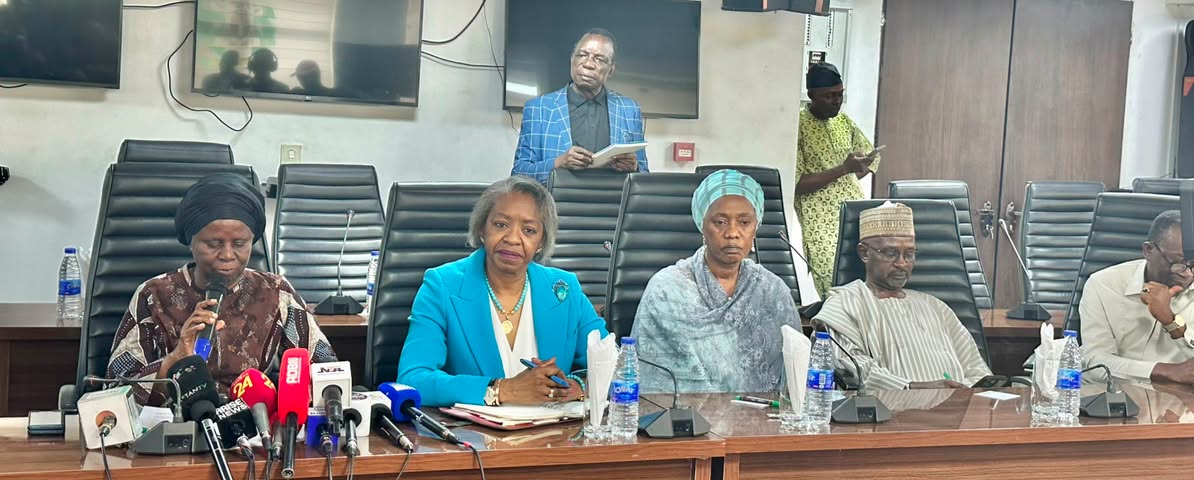
Head of the mission and former Deputy Prime Minister and Minister of Foreign Affairs of Ethiopia, Demeke Mekonen Hassen, raised the issues when he led an AU delegation to INEC headquarters in Abuja, yesterday.
“Is the IReV fully tested and ready?” Hassen asked, stressing the importance of technology to the credibility of the electoral process.
“The preparations on technology applications are very important. Is the IReV fully tested and ready? Lessons taken from the previous election, the preparations on the application of technologies may be really important,” he said.
The AU mission, deployed from September 13 to 19, is assessing Nigeria’s preparedness for the election, identifying potential challenges and recommending possible interventions before the polls.
Hassen said the exercise was intended to support rather than interfere with Nigeria’s electoral process, explaining that the mission would examine preparations across the pre-election, election and post-election phases.
“Our task is just a supporting mission. The mission is to facilitate and to play a preventive role, to appreciate the activities on track, and again, to identify gaps and, based on that, find possible remedies and corrections for a successful election process,” he said.
According to him, the different stages of the electoral process are interconnected and must meet the requirements of credibility, transparency, fairness and inclusiveness.
“In this regard, from the election process, the pre-election phase, the election phase and the post-election phase are very important and sequential processes,” Hassen said.
Other News
The mission sought clarification on the state of the voter register, including whether it had been finalised and was sufficiently credible to withstand scrutiny by political parties, civil society organisations and the public.
Beyond IReV and the voter register, the delegation raised questions about election logistics, funding, inclusion, transparency, electoral dispute resolution, security and result management. Hassen noted that Nigeria’s size and geographical spread presented significant operational challenges and asked INEC to explain how it intended to overcome them.
“So, what are the most significant logistical challenges, and how is INEC addressing them?” he asked.
The mission also wanted to establish whether funding for the election was adequate and being released early enough to allow INEC to execute its preparations without disruption.
It asked the commission to outline measures being taken to strengthen transparency, accountability and public confidence as well as mechanisms for addressing electoral disputes that could undermine trust in the process.
The AU delegation also turned its attention to election security and the management of results, demanding assurances that votes would be protected and results transparently and promptly published.
“What assurance can you provide regarding the integrity, transparency and timely publication of election results?” Hassen asked.
Responding, INEC identified four areas in which it requires technical assistance from the AU — digital training, countering election disinformation, strengthening its Election Monitoring and Support Centre, and improving inclusion and gender mainstreaming.
INEC Chairman, Joash Ojo Amupitan, represented by National Commissioner Rhoda Gumus, said the commission particularly required assistance in training more than 1.4 million ad hoc personnel expected to participate in the elections.
“We seek assistance in scaling interactive e-learning tools, digital simulation models and standardised ICT training protocols for over 1.4 million ad hoc staff to ensure uniform operational compliance across all the polling units,” she said.
The commission also sought AU support to combat election-related disinformation, including assistance with artificial intelligence-driven deepfake detection and rapid-response strategic communications to counter coordinated misinformation.
It requested specialised workshops to strengthen its Election Monitoring and Support Centre as part of efforts to improve the coordination and monitoring of election operations.
On inclusion and gender mainstreaming, INEC sought technical assistance to improve electoral participation and accessibility for persons with disabilities, internally displaced persons and other underrepresented groups. Gumus assured the AU delegation that the commission would cooperate fully with the assessment and make relevant operational information available.
“Our directors and technical teams stand ready to provide all necessary operational data to assist your mission in formulating an impactful assessment report,” she said.
She also assured the mission that INEC would maintain its independence and neutrality throughout the electoral process.
“Under our watch, every administrative decision will strictly follow the law. Every technical deployment will serve transparency, and the final outcome of the 2027 General Election will reflect nothing less than the sovereign will of the Nigerian electorate,” she said.