Follow Us on Google
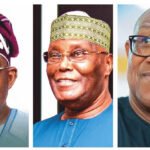
This columnist is interested in the recent homily by Alhaji Atiku Abubakar, former Vice President and presidential candidate of the ADC on judicial independence. He was reported as condemning the provision of houses to judges by politicians. He allegedly described it as a subtle form of inducement that compromises judicial independence and stains the reputation of the courts. He warned that such actions undermine the rule of law and destabilizes democracy. He was making the remark, I think, following the commissioning of judges’ residential quarters in Abuja by the FCT Minister, Mr Nyesom Wike recently. I would have thought that providing accommodation for judges is something to be praised, not pilloried, because we do provide accommodation for officers in the Executive and Legislative arms of the government. Why then should members of the judiciary be excluded from such favours which come not from the personal pockets of politicians but from the tax that Nigerians pay to the government? Infact, not providing accommodation for judges is what can actually induce them to barter their judicial independence for a mess of pottage if they do not want to live in a face-me-i-face-you dungeon.

What exactly is judicial independence in a setting where there are three arms of government? Judicial independence means that the judiciary should be independent from the other two branches, Executive and Legislature. It means that neither the Executive nor the Legislature should attempt to exert undue influence on the judiciary. Also, private or partisan interests are expected not to exert any influence on the judiciary because in a democracy there is something called the “Separation of powers.” What this means is that the three arms of government have separate duties to perform for the smooth functioning of the country. But it must be said that none of them is completely independent because their functions overlap and intertwine. That is why none of the three arms of government is completely and totally independent. The Executive sends its budget to the National Assembly for approval. The National Assembly gets its funds from the Executive; The Executive provides the funds for the running of the Judiciary. There are many more threads that bind the three arms together for the smooth running of the country. It is these threads that ensure that none of them is completely and fully independent. None. Each of them depends to some extent on one or two of the other arms. So while judicial independence may be attractive and romantic as an idea there is nothing like total judicial independence. That is why there is no country in the world with total judicial independence. However, some countries have a very high degree of judicial independence which makes them largely free from executive or legislative interference. Such countries include Denmark, Finland, Norway and New Zealand. Obviously, a large dose of judicial independence can contribute to the improvement in justice delivery and even to economic transformation of the country. For example, investors prefer to invest in countries where there is a stable judiciary and rule of law, not in countries that lack stable laws and judiciary that is seen to be fair in upholding the rule of law. That, I suggest, is what has led to stability in the four countries I earlier mentioned as having largely independent judiciaries. But we must note that the judiciary can also lose its independence from what happens within its own system. For example, heads of judiciaries and senior judges can contribute to the judiciary’s independence or lack of it by their decisions. Such decisions may include case assignments, transfers, disciplinary cases, panel composition and promotions. In Nigeria, election cases are occasions where allegations of favouritism have featured. It is believed that some judges always lobby to be assigned to handle election cases because they are “juicy” assignments. And some judiciary heads are also alleged to select their favourites for such juicy assignments. This is perhaps what contributes to the delivery of conflicting judgments in several political cases by courts of equal jurisdiction. That is evidence of the loss of internal judicial independence if those judges were not selected for those assignments on merit.
Our judiciary has been receiving lots of criticisms in recent times particularly from politicians especially if the decisions of the courts do not favour them. But there is no denying the fact that some of the court decisions especially at lower levels smack of incompetence or injustice or both. Some of those decisions have been overturned at the superior courts. Some of the erring judges have received severe tongue-lashing from the superior courts. In one case, the superior court described the decision of the lower court as “judicial rascality.”
Other News
There are some obvious defects in our judicial administration which have hampered our judiciary and prevented it from rising to the level of excellence that Nigerians expect. We certainly need to bring some reforms on board to improve the independence of our judiciary. One, today judges are nominated or appointed by partisan politicians. Many other countries employ an independent Judicial Service Commission to screen, interview and recommend candidates based largely on merit and some objective criteria. In Nigeria, such decisions are made either by partisan politicians or influential senior judges in the system. The proper thing, I believe, ought to be to allow the National Judicial Council to make the appointments strictly on merit. Two, today the judiciary is funded directly by the Executive at federal and sub national levels. In some other countries, judicial expenditure is charged directly to the Consolidated Revenue Fund as a first line charge. But for better results the Judiciary should directly manage its budget instead of depending on the executive at federal and state levels. Three, many democracies protect judges from arbitrary removal by granting them either life tenure or long, non-renewable terms. Judges can only be sacked if there are cases of misconduct established through a just process. Security of tenure guarantees that the judge will show undivided dedication to the job. Four, the salaries and allowances of judges must be fair and comparable to what other personnel in the public service earn. Their remuneration and other rewards must be regularly reviewed so as to ensure that they are happy. That is where the provision of housing and cars for transportation for judges comes in. These should be non-negotiable items of comfort for our judges, the same way that the officers in the Executive and Legislative branches are taken care of. We should actually applaud the various governments either at the federal or sub national levels that take the provision of accommodation and cars for judges as a priority. It is not an action to be condemned just because they do not openly agitate for the provision of such items. The officials in the Executive and Legislative branches get better items of comfort than members of the judiciary. Why that is so is because the judiciary prefers to be seen, not heard, except in delivering its court judgments. It doesn’t fight for its comfort.
Finally, there ought to be a strict accountability process mounted by the NJC to curb the corruption that some critics claim is rampant in the judiciary. Judges that are caught with unethical and unprofessional behavior must be subjected to swift, thorough and fair disciplinary process. The NJC deserves to be commended for the disciplinary decisions it took recently on some errant judges. It must continue that way to restore public trust in the judiciary especially as we approach the elections of 2027. I am, of course, aware that some politicians are in the habit of attacking judges especially when court decisions are not in their favour. However, the rest of the members in the public space who are not politicians are also available to commend judges when their decisions are fair and seen to be fair. But the truth is that many Nigerian politicians are bad losers. And when they lose an election they never accept defeat (except Dr Goodluck Jonathan). Then they go to court hoping that the court will perform magic by making them victors. When that doesn’t happen in the court they resort to blackmailing and scapegoating. The judiciary becomes the victim of their blackmail. It has happened repeatedly since 1999. I can tell you that 2027 will not be different.