Follow Us on Google
From Paul Osuyi, Asaba
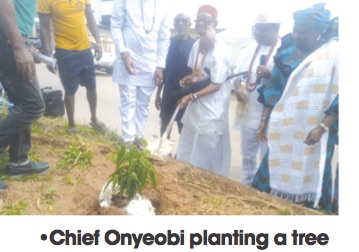
In remembrance of Nigeria’s former First Lady, Mrs. Maryam Ndidiamaka Babangida, indigenes of Asaba planted 76 masquerade trees in the Delta State capital, the land of her birth.

Although she hailed from Umu-Elibujor in Umuonaje quarters of the town, the symbolic trees were planted along the median of Maryam Babangida Road, named after the iconic First Lady by the administration of former Governor Emmanuel Uduaghan.
The ceremonial planting of the trees was also to mark her 76th posthumous birth, according to the Asagba of Asaba, Obi (Prof.) Chike Edozien, who led other natives and residents during the symbolic exercise.
The Asagba-in-Council had, last year, set aside November 1 (birthday of Maryam) every year for the celebration of one of the most illustrious daughters of Asaba, as well as to remember her contributions to the development of women.
Represented by the Iyase of Asaba Kingdom, Chief Patrick Onyeobi, Prof. Edozien said the symbolic tree-planting was part of a week-long programme of activities to mark this year’s Maryam Babangida Day.
He said the illustrious daughter of Asaba Kingdom had been acknowledged nationally and globally for her achievements, hinting at the crucial role she played in the emergence of Asaba as the capital of the oil-rich state in 1991 when it was created by the Gen. Ibrahim Babangida military administration.
According to him, naming Asaba as capital of Delta State was a befitting historical honour for the town that once served as the country’s colonial administrative headquarters, with the then Royal Niger Company based in the town.
“Maryam Babangida Day, which was started last year, is marked on November 1 every year to celebrate one of Asaba’s most iconic and illustrious daughters, and to remember her outstanding contributions toward the development and empowerment of Nigerian women as well as bringing women and their plight to the centre state of national discourse and policymaking.
“As the First Lady of Nigeria from August 27, 1985, when her husband became President, to August 26, 1993, Dr. (Mrs.) Maryam Babandiga had a dream and vision to bring greater recognition to women in our society, improve the lives of women and empower them to seek and achieve leadership roles in all spheres of human endeavour.
“She worked throughout her lifetime for the realisation of this dream, and was still pursuing the cause at the time she died about 13 years ago,” he said.
Chairman of the second annual Maryam Babangida Day, Mrs. Bridget Anyafulu, said the contributions of the late First Lady to gender equality and promotion of the rights of children and women, especially in rural communities, were legendary and unprecedented.
Anyafulu, who is also a member representing Oshimili South in the Delta State House of Assembly, described the contributions of Maryam Babangida as legendary and unprecedented.
She said the introduction and establishment of the Ministry of Women Affairs and Social Development was part of the fallout of the passionate fight for better life for the womenfolk by Mrs. Babangida.
“Dr. Maryam Babangida was not particular about Asaba women, but her focus was rather on Africa. She was a symbol of womanhood and she stood for advocacy of a better world such that, today, the world set aside a day for the girl-child, the boy-child, for rural women.
“She was a complete African woman and she epitomised the need to be proud of ourselves as African women, because ours is the most beautiful and powerful culture in the world. She lived and represented every woman and every woman represents the world because every woman, every human, came from the uterus of a woman.
“So, it was an advocacy for a better world, that was what she stood for. The Maryam Babangida Road is here; there are other places where she has also been honoured. The Women Development Centre, Abuja, has been named after her. But the best that we can give to her is to advocate all that she stood for and impact other people,” the lawmaker said.
Explaining the concept of the 76 masquerade trees, the Osowa Owelle of Asaba, Chief Chris Chukwurah, said the species of tree was deliberately chosen in order not to have a negative impact on the road when they are fully grown.
Commissioner for Environment in the state, Mr. Ejiro Jamani, who was one of those that planted trees, described the idea as laudable, noting that trees help mitigate climate change by reducing temperature and curbing global warming.
Represented by the director of forestry in the ministry, Godwin Enone, Jamani explained that trees in the environment “purify the air, provide food and shelter. That is why we at the ministry encourage citizens to plant trees.”