Follow Us on Google
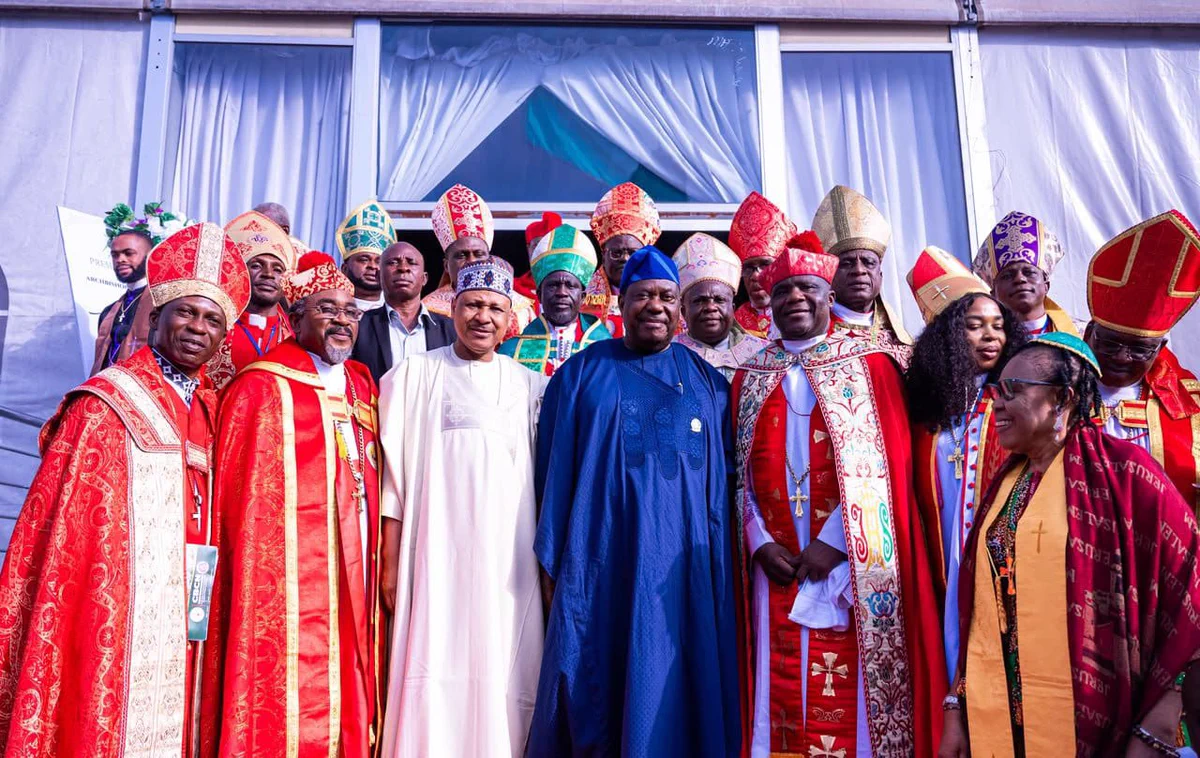
President-General of the Charismatic Bishops Conference of Nigeria (CBCN), Archbishop Leonard Bature Kawas, has defended the involvement of bishops in politics, saying he was never described as a “fake bishop” when he openly supported political leaders in the past.
Kawas spoke on ARISE News amid controversy over charismatic bishops’ decision to support President Bola Tinubu ahead of the 2027 general elections.
He said the CBCN had consistently prayed for political leaders and participated in political activities since 2010, insisting that personal interests did not drive the group’s actions.
“There is a biblical injunction that no power can exist without the approval of God Almighty. The Bible tells us to pray for the powers that be, because they’re of God,” he said.
“The Charismatic Bishops Conference have been consistent in doing that since 2010, not for any selfish interest but for the betterment of Nigeria.”
Kawas questioned why his involvement in political activities was now attracting criticism when he had engaged in similar activities during previous administrations.
He recalled how he travelled across the country to support former President Olusegun Obasanjo after some people approached him to lead prayers for the actualisation of Obasanjo’s political ambition.
“That people have come together and say that they want Obasanjo and that I should lead my group to pray for the actualization,” he said.
The cleric said he travelled through different parts of the country, sometimes at unusual hours, to campaign and mobilise support.
“I travel around this country 2 a.m. in the night, myself and others. We were around this country campaigning from church to church and nobody called me a fake bishop,” he said.
Kawas also recalled his support for another political leader who later became governor of Taraba State, saying his involvement eventually earned him an appointment as chairman of the Christian Pilgrims Welfare Board.
“I campaigned for my leader, Jolly Nyame and he became governor of my state and he appointed me chairman,” he said.
“Yes, Taraba State. He appointed me chairman, Christian Pilgrims Welfare Board and nobody called me fake then.”
He also spoke about his early support for Peter Obi’s presidential ambition, saying he accompanied the former Anambra State governor to campaign events without receiving financial assistance from him.
“I supported Peter Obi at the initial stage of his presidential ambition and went with him everywhere in Nigeria and he never gave me one dollar, one naira,” Kawas said.
Other News
He said Obi never questioned how he travelled to campaign venues or where he stayed during the trips.
“He never asked me how did I come, which hotel did I sleep, yet I did it and nobody called me fake,” he said.
Kawas added that he personally covered the transportation costs of six clergymen who accompanied him to some of Obi’s campaign events.
“He would just see me at the campaign, we would pray for him, I would pay the transportation of six clergymen, we would come there and support him,” he said.
The archbishop also cited his involvement in the political rise of former President Goodluck Jonathan.
He said he began supporting Jonathan when he was deputy governor of Bayelsa State and publicly expressed his belief that Jonathan would eventually reach the presidency.
“So during Goodluck Jonathan, I started supporting Goodluck Jonathan as deputy governor of Bayelsa State and I was one of the people that prophesied that we would see him in Abuja,” Kawas said.
According to him, Jonathan later became vice-president and subsequently president following the death of President Umaru Musa Yar’Adua and the invocation of the doctrine of necessity.
“And he came to Abuja and he became vice president and then president from the doctrine of necessity and then he won the election,” he said.
Kawas said he later served on Jonathan’s presidential campaign council, describing himself as the only bishop on the council.
“I was in his presidential campaign council. I was the only bishop in Goodluck Jonathan’s presidential campaign council and I took campaign everywhere,” he said.
“Nobody called me fake.”
Against this background, Kawas questioned why his political activities had suddenly become grounds for questioning his status as a bishop.
“Is it now because I have prayed and God has led me that it is tenable that I suddenly now become fake?” he asked.
The CBCN president-general maintained that his participation in political affairs should not be interpreted as evidence of personal gain, arguing that religious leaders have a responsibility to pray for those in authority and contribute to the country’s development.