Follow Us on Google

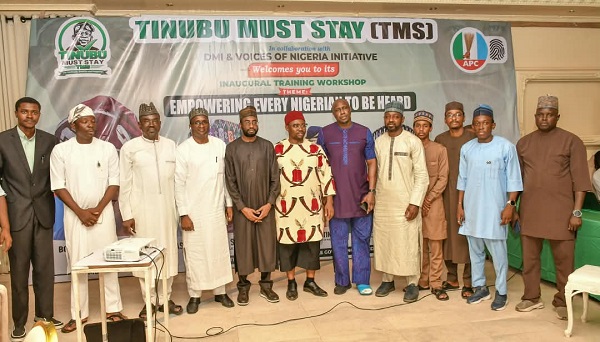
Launch platform to facilitate his re-election in 2027
_____________________________________________________________________
From Romanus Ugwu, Abuja
All Progressives Congress (APC) stakeholders have defended President Bola Tinubu’s developmental strides, insisting that he has not only laid a strong foundation but also shifted from subsidising consumption to subsidising production, innovation and investment.
The stakeholders, under the auspices of the Tinubu Movement for Sustainable Governance Foundation, known as TMS, expressed satisfaction that President Tinubu has excelled in eight priority areas through his Renewed Hope Agenda.
Enumerating the areas, the Director-General of the National Information Technology Development Agency (NITDA) and Chairman, Board of Trustees and National Coordinator of TMS, Kashifu Inuwa Abdullahi, said that he deserves re-election in next year’s presidential election.
According to him, the eight priority areas include reforming the economy for sustained growth; strengthening national security; boosting agriculture for food security; unlocking energy and natural resources; enhancing infrastructure and transportation; focusing on health, education and social investment; accelerating diversification through industrialisation, digitalisation and the creative industry; and improving governance through efficient service delivery.
Inuwa, who spoke at the inaugural training workshop for Nigerians to protect and sustain the reform agenda of the Tinubu-led administration, said that he is on track to take Nigeria to the next level in his second tenure.
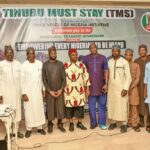
In his remarks at the event held in Abuja on Thursday, he explained that it is targeted at providing a platform for Nigerians to contribute ideas on how to move the country forward.
“We spend most of our resources trying to subsidise consumption. When President Tinubu came on board, he looked at it: Is it consumption we should subsidise, or production, innovation, and investment? That is what the reforms are all about,” Kashifu said.
He further cited ongoing initiatives such as the integration of digital skills into formal education, the introduction of Technical and Vocational Education and Training (TVET) by the Ministry of Education and the Student Loan scheme to ensure that no Nigerian is left behind due to economic circumstances.
The DG said that NITDA is fostering digital literacy through initiatives such as Digital Literacy for All, training over 19,000 National Youth Service Corps (NYSC) champions in markets and motor parks, and the three million tech talent programme that empowers young Nigerians to work remotely for global companies.
Other News
According to him, reforms are already building investor confidence, citing the Dangote Refinery, a $1 billion data centre investment by a South African firm announced this week, and JP Morgan’s decision to open operations in Nigeria.
“No country in the world developed in less than 30 years. The fastest developed country is South Korea. It took 30 years. To develop, you need the right policies first. That is the foundation Mr President is laying. Then you build on it to get investors.
“Reform is a journey; it is not a one-off event. The essence of this movement is to enlighten Nigerians on these reforms, so that Nigerians can understand what is in it for them. You are the ultimate beneficiary,” the DG argued.
He urged participants at the roundtable to propose ideas on how to sustain the reforms and articulate what government needs to do more, including inputs for the approved National Youth Conference.
Also speaking, a member of the Board of Trustees of TMS, Olujonwo Obasanjo, said the Movement was established to bridge the information gap between government and citizens and to project progress being recorded through projects spread across the country.
He noted that the creation of regional development commissions by President Tinubu, and his commitment to local government autonomy affirmed by the Supreme Court, were deliberate steps to fast-track inclusive development and bring governance closer to the people.
“Nigeria’s development challenge has never been lack of ideas, but policy discontinuity. There is the need for sustained, uninterrupted reforms to consolidate gains, drive economic growth and ensure that ongoing investments translate into lasting prosperity,” he stated.
In his remarks, the Director-General of TMS, Marcel Ngogbehei, said the inaugural workshop was conceived to empower and educate ordinary Nigerians and give them a credible platform to be heard on national issues.
He explained that the training combined civic education with practical engagement, including role-play sessions where participants juxtaposed public expectations of governance with what the Tinubu administration is already implementing.
Ngogbehei acknowledged that reforms come with initial pains but maintained that continuity is critical to attracting long-term investment and ensuring that the benefits eventually reach every household.
While urging Nigerians to move beyond rhetoric and demand substance from political actors, he said: “Instead of following rhetoric, we should encourage Nigerians to ask the opposition a simple question: What alternative are you offering that President Bola Ahmed Tinubu is not already doing?”