Follow Us on Google

By Goli Innocent
The United States Congress has proposed sweeping sanctions, including visa bans and asset freezes, against former Kano State governor Rabiu Musa Kwankwaso and members of Miyetti Allah groups over what American lawmakers described as their alleged roles in the persecution and massacre of Christians in northern Nigeria.
The proposed legislation, titled Nigeria Religious Freedom and Accountability Act of 2026, was introduced on Tuesday by Chris Smith, chairman of the House Foreign Affairs Subcommittee on Africa, alongside Congressman Riley Moore.
The bill seeks to compel President Bola Tinubu’s administration to take stronger action against what U.S. lawmakers characterised as targeted killings of Christians in parts of the country.
In the draft legislation submitted to the U.S. House of Representatives, Messrs Smith and Moore urged the Department of State and the Department of Treasury to impose targeted sanctions under the Global Magnitsky Human Rights Accountability Act.
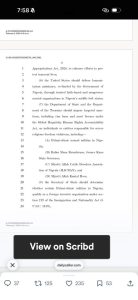
“The Department of State and the Department of Treasury should impose targeted sanctions, including visa bans and asset freezes, on individuals and entities responsible for severe religious violations,” the bill stated.
Among those named for possible sanctions are “Fulani ethnic nomad militia, Rabiu Musa Kwankwaso, former Kano governor, Miyetti Allah Cattle Breeders Association of Nigeria, and Miyetti Allah Kautal Hore.”
See the screenshot below:
The proposed sanctions come amid heightened diplomatic tension between Washington and Abuja over allegations of religious persecution.
Former U.S. President Donald Trump had in 2025 redesignated Nigeria as a “Country of Particular Concern” over what he described as a “genocide” of Christians a claim that has generated sharp debate within Nigeria’s political and religious circles.
Other News
The bill referenced several high-profile incidents, including the October 2025 killings in Plateau State and the controversial case of Sunday Jackson, a farmer who spent nearly a decade in prison and was sentenced to death for killing a Fulani herder in what supporters described as self-defence. Jackson was later pardoned in 2025 following international pressure and U.S. diplomatic intervention.
Beyond visa restrictions and asset freezes, the lawmakers are also pushing for a formal review of Fulani militias to determine whether they should be designated as foreign terrorist organisations.
The proposed law further calls for investigations into individuals and networks allegedly sponsoring armed groups linked to violence in northern Nigeria.
If passed, the legislation could significantly strain relations between Nigeria and the United States, particularly at a time when security cooperation between both countries has deepened.
In December, U.S. forces reportedly carried out airstrikes in Sokoto targeting terrorist hideouts, an operation Nigeria’s First Lady, Remi Tinubu, publicly described as “a blessing.” Washington has also announced plans to deploy 200 American soldiers to support Nigeria’s counter-terrorism operations.
There has been no immediate response from Kwankwaso or officials of Miyetti Allah regarding the proposed sanctions. The Presidency has likewise not issued an official statement as of press time.
The development signals a new phase in U.S. scrutiny of Nigeria’s handling of religious violence one that could carry personal consequences for prominent political figures if the bill gains congressional approval.
For Nigeria, the stakes are high. Beyond diplomatic optics, the proposed sanctions underscore growing international impatience with the country’s persistent security crisis and the perception that perpetrators of sectarian violence continue to act with impunity.
Whether the bill will pass both chambers of Congress remains uncertain. But its introduction alone sends a strong message: Washington is prepared to escalate pressure on individuals it believes are complicit in religious bloodshed.
As the debate unfolds, all eyes will be on Abuja, and on how the Federal Government of Nigeria responds to what could become one of the most consequential foreign policy confrontations in recent years.